
Summary of SELF-CHARGING ‘THOUSAND-YEAR’ BATTERY COMPLETES LAB TESTS
NDB, a green energy startup, successfully completed Proof of Concept tests for its nano diamond battery (NDB) at Lawrence Livermore National Laboratory and Cambridge University. The self-charging device converts recycled radioactive waste into electricity, achieving 40% charge collection efficiency compared to the 15% of commercial diamonds. Claimed to last up to 28,000 years depending on the radioisotope, the emission-free battery aims to power diverse devices from aircraft to smartphones without carbon emissions.
Parts used in the Nano Diamond Battery:
- Nano diamond battery
- Recycled radioactive waste
- Natural air
- Diamond-based alpha, beta, and neutron voltaic components
Green energy startup NDB, which is developing a high-power self-charging diamond-based alpha, beta, and neutron voltaic battery that it claims provides up to thousands of years of charge, has announced the completion of two successful Proofs of Concept tests of its nano diamond battery (NDB). by Rich Pell @ smart2zero.com
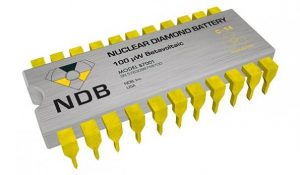
In the tests, which were conducted at Lawrence Livermore National Laboratory and the Cavendish Laboratory at Cambridge University, the battery, says the company, achieved a breakthrough 40% charge – a significant improvement over commercial diamonds, which have only 15% charge collection efficiency. The company also announced its first two beta customers, including a leader in nuclear fuel cycle products and services and a leading global aerospace, defense, and security manufacturing company.
The company’s proprietary, universal, self-charging battery creates energy from recycled radioactive waste and is claimed to be able to provide a charge for the entire lifetime of a device or machine, with up to 28,000 years of battery life depending on the radioisotope being used. Its technology, says the company, is poised to completely transform the concept of energy, and can power devices and machines of any size, from aircraft and rockets to electric vehicles, hearing aids, smartphones, sensors and more, all with no carbon emissions.
Our team is bringing together leaders in the nanotechnology, nuclear science, and diamond fields with military, academic and research backgrounds, and combining our unique mix of expertise has made it possible for us to crack the code in developing this groundbreaking, life-changing solution,” says Nima Golsharifi, CEO and co-founder of NDB. “Moreover, as members of society, we are extremely concerned about the welfare of the planet and are focused on lowering climate change to protect our planet for future generations. With the NDB battery, we have achieved a massive, groundbreaking, proprietary technological breakthrough of a battery that is emission-free, lasts thousands of years, and only requires access to natural air in order to power devices.
Read more: SELF-CHARGING ‘THOUSAND-YEAR’ BATTERY COMPLETES LAB TESTS
- Where were the NDB Proof of Concept tests conducted?
The tests were conducted at Lawrence Livermore National Laboratory and the Cavendish Laboratory at Cambridge University. - What charge collection efficiency did the new battery achieve?
The battery achieved a breakthrough 40% charge collection efficiency. - How does this technology compare to commercial diamonds?
Commercial diamonds have only 15% charge collection efficiency, whereas the NDB achieved 40%. - Can the battery power large machines like aircraft?
Yes, the technology can power devices of any size, including aircraft, rockets, and electric vehicles. - Does the battery produce carbon emissions?
No, the battery is emission-free and creates energy from recycled radioactive waste. - What is the maximum claimed lifespan of the battery?
The battery can provide a charge for up to 28,000 years depending on the radioisotope used. - What resources are required to power the devices using this battery?
The battery only requires access to natural air in order to power devices. - Who are the first beta customers for this technology?
The first two beta customers include a leader in nuclear fuel cycle products and a global aerospace, defense, and security manufacturing company.