


Summary of Remote controlled LED lighting effects
This project builds a remote-controlled LED system with multiple lighting effects using an IR receiver and microcontroller. The TSOP1738 receives 38KHz signals to activate the PIC12F1822, which drives LEDs via transistors for dynamic visual patterns. Effects are generated using built-in PWM or pulse logic to create attractive illumination modes controllable from a distance.Parts used in the Remote Controlled LED Lighting Effects:
- TSOP1738 IR Receiver
- PIC12F1822 Microcontroller
- Transistors (Q1 and Q2)
- LEDs
- Household Remote Control
- Timer Module
- CCP1 Module
LED’s have become most important component in lighting industry due to its miniature size and less power consumption. Also LED lights are lot more attractive than the primitive lights used once. This project focused on building an remote controlled LED with multiple lighting effects. Imagine setting the mood of your room using remote, will be cool isn’t it.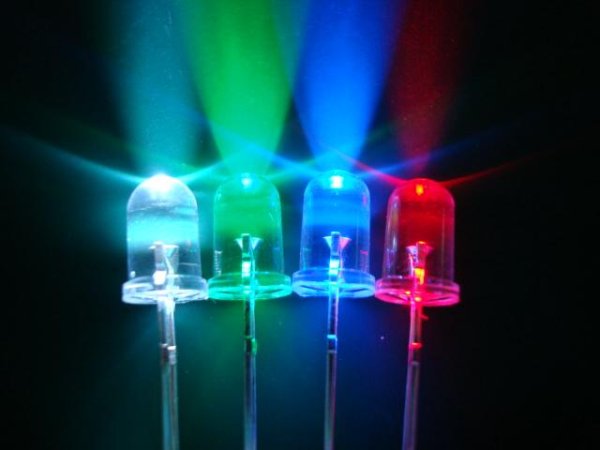
DESIGN OF RECEIVER AND CONTROLLER:
The receiver and Controller part comes with TSOP1738, a receiver capable of receiving IR beam of 38Khz which is the operating frequency of a normal household remote. This receiver acts as an activator for the controller connected to it. PIC12F1822, a 8 pin low end microcontroller is deployed as a controller in this project. Other low end microcontrollers can also be used for this purpose.
The Microcontroller cannot produce enough current to drive a large set of transistors. So we are using a Transistors as a driver element in this circuit, RA2 pin from the controller feeds the signal to the base of these transistors. The reason for using two individual transistors is to create attractive effect when driven by a pulse from the Microcontroller. When the Pulse from MCU is Logic 1 Q1 will activate the LED’s connected to it, when it was logic 0 Q2 will activate all the LED’s connected to it.
TSOP 1738:
TSOP1738 is a simple IR receiver capable of receiving IR pulses of frequency 38Khz. The output of this component is active low which means that this component gives low output when IR beam is incident on it and high output in the absence of IR beam. Refer the “Datasheet” for more information about this component.
METHODS TO IMPLEMENT MULTIPLE EFFECTS IN LED LIGHTS:
We are going to add effects using two methods in this project. You can choose the method you find it comfortable to use.
1) USING INBUILT PWM:
This is a pretty old trick in sleeves of every designer when comes to controlling. The PIC12F1822 has an inbuilt PWM module using which we are going to control the illumination of led.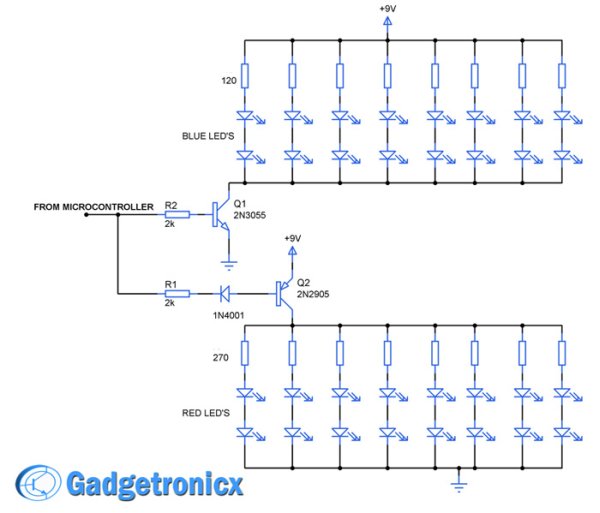
CODE:
- #include <main.h>
- #bit TRIS_PIN1=0x8C.0
- #bit PIN1=0x0C.0
- void main()
- {
- int16 i=0;
- TRIS_PIN1=1;
- setup_timer_2(T2_DIV_BY_16,255,1); //819 us overflow, 819 us interrupt
- setup_ccp1(CCP_PWM|CCP_SHUTDOWN_AC_L|CCP_SHUTDOWN_BD_L);
- while(TRUE)
- {
- set_pwm1_duty(i);
- if((PIN1==0)&&(i<=600))
- {
- i=i+100;
- }
- else if((PIN1==0)&&(i>600))
- i=100;
- }
- }
For more detail: Remote controlled LED lighting effects
- What frequency does the TSOP1738 receiver operate at?
The TSOP1738 is capable of receiving IR pulses of frequency 38Khz. - Which microcontroller is deployed as the controller in this project?
A PIC12F1822, which is an 8 pin low end microcontroller, is used as the controller. - How do the two individual transistors create attractive effects?
When the MCU pulse is Logic 1, Q1 activates its connected LEDs, while Logic 0 activates all LEDs connected to Q2. - What output state does the TSOP1738 produce when an IR beam is incident on it?
The component gives a low output when the IR beam is incident on it. - Can other microcontrollers be used instead of the PIC12F1822?
Yes, other low end microcontrollers can also be used for this purpose. - What method is used to control the illumination of the LED in this project?
The project uses the inbuilt PWM module of the PIC12F1822 to control illumination. - Why are transistors used as driver elements in the circuit?
The microcontroller cannot produce enough current to drive a large set of transistors directly. - How many methods are available to implement multiple effects in the LED lights?
Two methods are provided, allowing users to choose the one they find comfortable.
Related projects
RFID Reader – Access Control System
This device is a simple access control system which uses RFID cards. It is designed with PIC12F1822 microcontroller running on internal oscillator...
Wireless & IoT · PIC12F1822Wireless Communication Using Cheap 433MHz RF Modules and Pic Microcontrollers. Part 2
On the first part of this instructable, I demonstrated how to program a PIC12F1822 using MPLAB IDE and XC8 compiler, to send...
Sensors & Temperature · PIC12F1822DHT11 Interfacing with PIC12F1822 microcontroller
In this blog there are some topics talking about the DHT11 relative humidity and temperature sensor and how to interface it with...
LED ProjectsAn Application-Driven Microcontroller Curriculum
Understanding how to apply microcontrollers lies at the core of modern embedded systems education. This student project takes an experiential approach to...
LED ProjectsBuild this microcontroller controlled rainbow flying disc – and then throw it!
Hello all and welcome to this super simple and inexpensive instructable. If you like throwing frisbees AND you like flashing lights AND...
LED ProjectsLED Scrolling Display Project Working With Circuit Diagram
We normally use a simple static LED display screen to convey a message. Earlier, when we want to display large data, we...

Ibrar Ayyub
I am an experienced technical writer holding a Master's degree in computer science from BZU Multan, Pakistan University. With a background spanning various industries, particularly in home automation and engineering, I have honed my skills in crafting clear and concise content. Proficient in leveraging infographics and diagrams, I strive to simplify complex concepts for readers. My strength lies in thorough...