Summary of RE FAMILY, THE WORLD’S MOST ENERGY EFFICIENT MCUS WITH ARM® CORTEX® M CORE
This article introduces Renesas' new RE family of microcontrollers, certified as the world's most energy-efficient MCUs by EEMBC with a score of 705. Utilizing Silicon on Thin Buried Oxide (SOTB) technology, these devices offer high performance with ultra-low power consumption in both active and standby modes. Key features include an ARM Cortex-M0+ core, built-in energy harvesting control circuits, extensive memory options, robust security protocols, and versatile peripherals like ADCs, USB, and motor drivers. They are ideal for IoT applications such as smart homes, medical devices, and hybrid watches.
Parts used in the RE Family Microcontroller Project:
- ARM Cortex-M0+ core at 64MHz
- Silicon on Thin Buried Oxide (SOTB) process
- Built-in energy harvesting control circuit
- 256/1536kB Flash memory
- 128/256kB RAM memories
- Ultra low power 14-bit ADC
- MIP-LCD parallel interface (optional)
- 2D graphics engine (optional)
- RTC (optional)
- Motor driver control for clock (optional)
- 32-bit wakeup timer (optional)
- USB interfaces
- DMA with 3 channels
When designing a low power system, you want to make the most out of your batteries, while keeping them small and cheap and desirably incorporate energy harvesting for full autonomy, but your desired microcontroller should also perform decently at the lowest energy cost. The new family of microcontrollers from Renesas is here to help you!
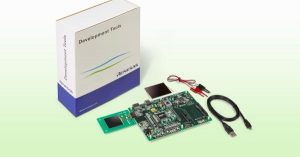
The new RE family are the world’s most energy efficient MCUs, certified by EEMBC with an incredible score of 705! Based on the Silicon on Thin Buried Oxide (SOTB) process, guarantees both high performance at an extremely current consumption in both active and standby modes. In addition to that, it has a built-in energy harvesting control circuit, enabling you to harness energy from the ambient more easily.
Regarding their base specs:
- ARM Cortex-M0+ core at 64MHz (25 to 35uA/MHz operating current, 400 to 500nA on standby, 1.62 to 3.6V operating voltage)
- 256/1536kB Flash (0.6mA rewriting) and 128/256kB RAM memories
- Built-in energy harvesting control circuit
- Ultra low power 14-bit ADC (4uA)
- Security: trusted secure IP, random number generation, secure updating of flash memory, secure boot
According to the version of microcontroller in the family, you can still get a MIP-LCD parallel interface (does not require power to display received images), 2D graphics engine, an RTC, a motor driver control for clock, or even a 32-bit wakeup timer. Besides these extra features, you also get almost everything you expect from a microcontroller, such as timers of all sorts, PWM, 2xSPI, 2xI2C, and USB interfaces, DMA with 3 channels, among other interesting peripherals.
Due to its set of features, the RE family is the ideal candidate in multiple IoT applications, including hybrid watches, smart homes, medical, smart agriculture, structure monitoring, tracking, among others.
Read more: RE FAMILY, THE WORLD’S MOST ENERGY EFFICIENT MCUS WITH ARM® CORTEX® M CORE
- What certification does the RE family hold?
The RE family is certified by EEMBC with a score of 705. - How much current does the MCU consume in standby mode?
It consumes between 400 to 500nA in standby mode. - Does the RE family support energy harvesting?
Yes, it has a built-in energy harvesting control circuit. - What is the operating voltage range of the device?
The operating voltage ranges from 1.62 to 3.6V. - Which core processor is used in the RE family?
It uses an ARM Cortex-M0+ core running at 64MHz. - Can the MCU drive a MIP-LCD display?
Yes, certain versions include a MIP-LCD parallel interface. - What security features are included?
It includes trusted secure IP, random number generation, and secure boot. - Are there specific IoT applications recommended for this MCU?
Yes, it is ideal for hybrid watches, smart homes, medical devices, and smart agriculture.