


Summary of Power MOSFET RGB LED PWM Driver for PIC12F683
This article details a high-power RGB LED driver board using logic-level N-channel MOSFETs, capable of controlling up to 5 amps per channel without heatsinks. Compatible with the same firmware as smaller drivers, it operates on 9-24V DC and was demonstrated illuminating a Piranha LED light bar.Parts used in the Power MOSFET RGB LED Driver:
- N channel MOSFETs
- PIC12F683 microcontroller
- 78L05 voltage regulator
- Capacitors C3 and C4
- Switch S2 (optional)
- PCB screw terminal connectors
- Aluminium U section
- Piranha RGB LEDs
Description
Since I published the original RGB LED driver (photo right) I've had many enquiries from people asking how they could make the original board work with more LEDs. I'd already made a couple of custom boards up for myself, so I finally decided it was time to put together one for the website.
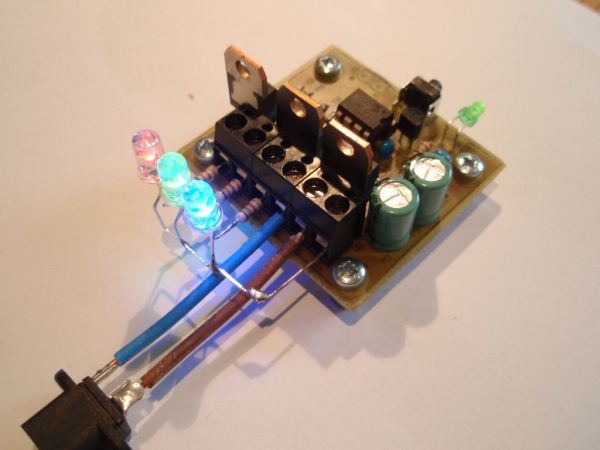
The RGB LED driver described on this page uses logic level 'N' channel MOSFETs which allow it to control LED arrays or lamps at up to 5 amps per channel without heatsinks.
The driver uses exactly the same firmware as the small RGB LED driver so you can use the same code and sequences with this board to control big arrays of LEDs.
Piranha LED colour bar
Here's a one off light bar I built using 20 Piranha RGB LEDs and the (prototype) MOSFET driver board. Assembled into a 25mm x 50mm x 1000mm aluminium 'U' section. This was fitted under a wall shelf to illuminate the floor. It's very bright and gives a nice even illumination without any additional diffuser.
Circuit Description
This circuit is essentially the same as the smaller RGB driver using the 5mm LEDs elsewhere on this website except that this version uses high power MOSFETs capable of sinking 5 amps on each channel without heatsinks (at 5amps the MOSFETs will run hot)
The input power to the board must be regulated DC and be capable of suppling the power requirements of the output load.
The circuit will operate from a supply voltage in the range 9 to 24 volts. This voltage range is dictated by the input requirements of the 78L05 voltage regulator and capacitors C3/4.
Switch S2 is not used with the firmware on this website and you do not need to fit it. I've incorporated it the PCB design because I've written some customized versions of the code that did require two switches.
How much power can it handle?
During testing I connected the controller to some 50W / 12Volt halogen downlight bulbs, one on each channel then ran them at 100% PWM duty cycle.
| Ambient temperature during test | 22oC |
| MOSFET temperature after 5mins (measured on metal tab) | 52oC |
| Current (sink per channel) | 4.4A |
| Voltage drop across MOSFET Source-Drain terminal (measured) | 20mV |
Based on these measurements and the specification of the MOSFETs and PCB connectors, the controller should comfortably handle 5 amps per channel. While the individual MOSFETs could handle more current, the PCB screw terminal connectors are rated at 16 amps and since there is only a single Ground connection to the board, total load for the three RGB channels should not exceed this.
PCB
PCB only option is available to buy
from the on-line shop page
Component List

Buy the complete kit for this project from the Picprojects on-line shop page
You can buy all the parts needed to build this project from most component suppliers world wide. In the UK you can get everything from Rapid Online and I've included a parts list with their part numbers below.
For more detail: Power MOSFET RGB LED PWM Driver for PIC12F683
Quick Solutions to Questions related to Power MOSFET RGB LED Driver:
- How many LEDs can this driver control?
The driver can control LED arrays or lamps at up to 5 amps per channel. - Does the circuit require a heatsink for the MOSFETs?
No, the MOSFETs allow operation without heatsinks, though they will run hot at 5 amps. - What is the operating voltage range for the supply?
The circuit operates from a supply voltage in the range of 9 to 24 volts. - Can I use the same firmware as the small RGB driver?
Yes, the driver uses exactly the same firmware as the small RGB LED driver. - Is Switch S2 required for the standard firmware?
No, Switch S2 is not used with the firmware on this website and does not need to be fitted. - What is the maximum total load for the three RGB channels?
The total load should not exceed 16 amps due to the single Ground connection and connector ratings. - How much current can each channel handle comfortably?
Based on testing, the controller should comfortably handle 5 amps per channel. - What type of input power is required?
The input power must be regulated DC capable of supplying the output load requirements.
Related projects
Automotive Voltage Monitor using PIC12F683
Description Recently I got a new motorbike and on my second trip out, with only 50 miles on the clock the rectifier/regulator...
Communication & Interfacing · PIC12F683EnvStick USB Temperature Sensor using PIC12F683
The EnvStick is cheap, homemade temperature sensor that plugs into a USB port. It provides a simple way to collect a room’s...
Sensors & Temperature · PIC12F683Metal detector robot using pic microcontroller
This project describes hardware and software I have developed which allows a small 8 bit PIC microprocessor to function as a single...
Motors & RoboticsReal-Time CAN-Based Vehicle Monitoring System with PIC MCU
INTRODUCTION The Controller Area Network (CAN) is a robust vehicle communication bus standard that was primarily developed for automobile applications but has...
Motors & RoboticsEasy Way to Learn Robotics Using Microcontrollers: A Beginner’s Guide
The title, "Easy Way to Learn Robotics Using Microcontrollers," promises an accessible entry point for those curious about the exciting world of...
Motors & Robotics · PIC16F877AEfficient Sun-Following Robot: A Solar Tracker with Microcontroller Control
Abstract The impending global challenge of dwindling non-renewable fuel resources underscores the urgency of transitioning towards renewable energy alternatives like solar power....

Ibrar Ayyub
I am an experienced technical writer holding a Master's degree in computer science from BZU Multan, Pakistan University. With a background spanning various industries, particularly in home automation and engineering, I have honed my skills in crafting clear and concise content. Proficient in leveraging infographics and diagrams, I strive to simplify complex concepts for readers. My strength lies in thorough...