
Summary of PIC16F84A Temperature Controller
This project details a temperature measurement and display system using a PIC16F84a microcontroller, a TMP37 analog temperature sensor, and a TLC549 ADC to convert signals for the 8-bit processor. The setup includes input buttons and a 16×2 LCD with an HD44780 controller to show current readings, set points, and alarms. Designed as a breadboarded module for a final year undergraduate project, it allows users to increment or decrement set temperatures and triggers alerts based on conditions.
Parts used in the Temperature Control Module:
- TMP37 Temperature Sensor
- TLC549 Analog-to-Digital Converter
- PIC16F84 / PIC16F84a Microcontroller
- Input Buttons
- 16×2 Liquid Crystal Display (LCD)
- HD44780 LCD Controller
Ever needed to measure temperature and display it? This project details measuring temperature using a temperature sensor ,an ADC and a Microcontroller PIC16f84a with schematics,codes and illustrations. You can also get the following kit, although not based on the pic, which would make your life easier for your future projects.
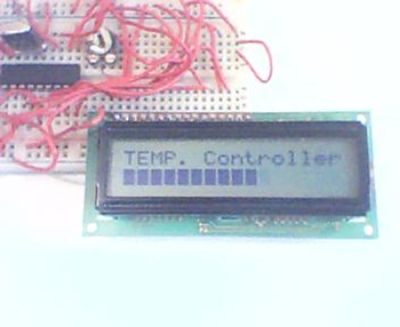
This project was done fairly long ago, so please excuse the quality of the pictures.
Overview
The Temperature control module was a part of my Final year undergraduate project,which consisted of transmitting data wirelessly.
The module uses an inexpensive 8 bit Temperature Sensor the TMP37 from Analog Devices.
Since the data was analog and the PIC16f84 does not have an analog input,an external ADC had to be used.
Texas Instruments’ TLC549 was chosen for this.The advantage of this ADC was that it could communicate with the microcontroller serially.You may also use similar ADCs from Maxim-IC.
The LCD is a normal 16×2 display which uses the Hitachi Controller HD44780.
The module is breadboarded and not done on a PCB.Schematics are included in appropriate places below.
This site was a great help in building the project.
Mark S. Csele’s PIC Temperature Controller Page
Capabilities of the system:
-Show Current Temperature,Set temperature and Alarm Display.
-Go into Set Mode.
-Increment/Decrement Set Point.
-Enter Set point.
The project is divided into the following subparts:
-The Analog to Digital converter TLC 549 [8 bit]
-The Temperature Sensor TMP37
-The PIC16F84 / PIC16F84a Microcontroller
-Input Buttons
-The Liquid Crystal Display [LCD]
-Temperature Control
-Codes
Note:To follow this project you may need to know to program a PIC,there are some helpful links at the bottom of the page if you are not familiar with it.
The Analog to Digital converter TLC 549 [8 bit]
Description : The TLC549 is an analog-to-digital converter (ADC) integrated circuit built around an 8-bit switched-capacitor successive-approximation ADC. This device is designed for serial interface with a microprocessor or peripheral.
Signals:
The TLC549 has two control lines and one data output line.
They are as follows:
–CS[bar] :: Input signal.The Chip Select signal.When low it selects/activates the chip.When high it disables the chip
–I/O clock :: Input signal.The input/output clock line is used to clock the ADC.
–Data Out :: Output signal.The data out signal clocks out bits into the PIC microcontroller.
For more detail: PIC16F84A Temperature Controller
- What components are used to measure temperature?
The system uses an inexpensive 8 bit Temperature Sensor named TMP37 from Analog Devices. - Why was an external ADC required?
An external ADC was needed because the PIC16f84 does not have an analog input. - Which specific ADC model was chosen for this project?
Texas Instruments’ TLC549 was chosen because it communicates serially with the microcontroller. - What type of display is utilized in the module?
A normal 16×2 display using the Hitachi Controller HD44780 is used. - Can you adjust the set point using this system?
Yes, the system allows users to enter Set Mode and increment or decrement the Set Point. - Is the project built on a printed circuit board?
No, the module is breadboarded and not done on a PCB. - Does the system support alarm functionality?
Yes, the capabilities include showing an Alarm Display along with current and set temperatures.