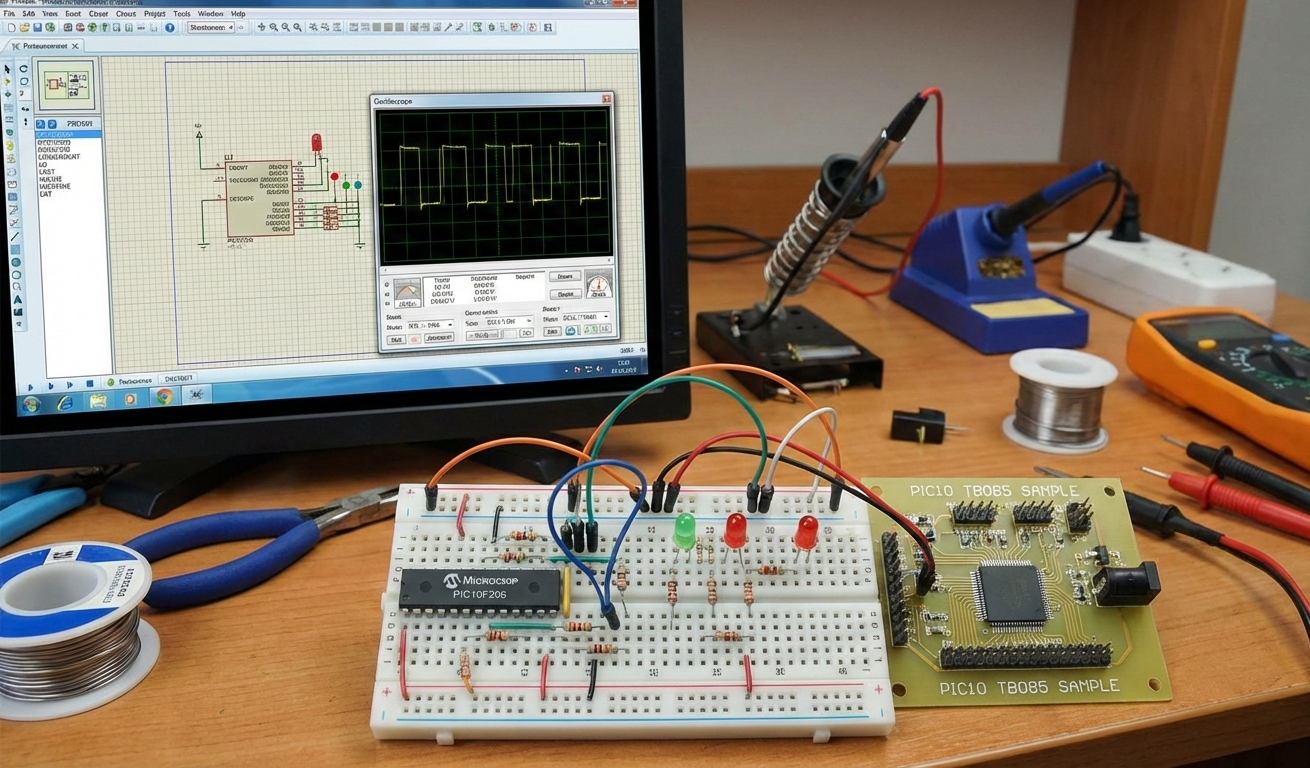
PIC10 TB085 Sample using PIC10F206 with Proteus Simulation

Summary of PIC10 TB085 Sample using PIC10F206 with Proteus Simulation


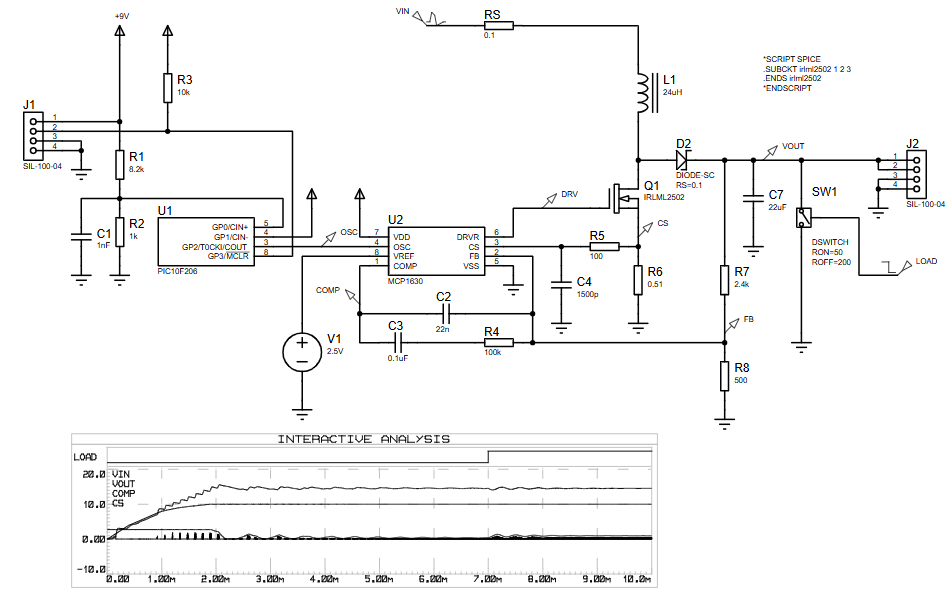
This project implements a compact DC/DC pulse generator using a PIC10F206 simulated in Proteus. It produces a 250 kHz pulse to drive an MCP1630 controller and provides firmware-based soft start, undervoltage lockout, over-temperature shutdown, external shutdown, and automatic fault recovery. The design demonstrates minimal-pin embedded power control and is fully testable within Proteus for educational and practical applications.

Parts used in the PIC10 TB085 Sample using PIC10F206 with Proteus Simulation:

  • PIC10F206 microcontroller
  • MCP1630 DC/DC controller (external driver)
  • External digital temperature sensor (digital output)
  • Resistors (passive components)
  • Capacitors (passive components)
  • Inductor (power stage)
  • Diode (power stage)
  • MOSFET (power stage)
  • Linear regulated supply (2.5V – 5.5V)
  • Proteus VSM simulation environment

Introduction

This microcontroller project demonstrates a compact DC/DC power supply pulse generator built around the PIC10F206, simulated entirely in Proteus.
The design focuses on generating a controlled high-frequency pulse signal for a switching regulator while adding intelligent protection features.
Using a simple PIC10 device, the project implements soft start, undervoltage lockout, over-temperature shutdown, and external shutdown control.
It is a strong example of how embedded systems and practical electronics can be combined in a minimal-pin microcontroller project.
This Proteus simulation helps learners understand real-world firmware-driven power control without additional hardware.

How the Project Works (Overview)

The PIC10F206 generates a 250 kHz pulse signal used to drive an external DC/DC controller (MCP1630).
At power-up, the firmware performs a soft-start routine, gradually increasing the pulse output from 0% to full operation over approximately 5 ms.
The system continuously monitors supply voltage and temperature conditions.
If an undervoltage or over-temperature condition is detected, pulse generation is immediately stopped and safely restarted once conditions return to normal.
All logic is handled directly through firmware using GPIO pins and the internal comparator.

Block Diagram / Workflow Explanation

  1. Power-Up Initialization
    GPIO direction, comparator configuration, and watchdog timer are initialized.

  2. Voltage Check (Comparator Input – GP0)
    The internal comparator verifies the scaled supply voltage before allowing startup.

  3. Soft Start Pulse Generation
    A pulse table gradually increases the number of output pulses, ensuring controlled startup.

  4. Normal Operation Loop
    Continuous 250 kHz pulses are generated for the MCP1630 controller.

  5. Fault Monitoring

    • Undervoltage detected via comparator output

    • Over-temperature detected through a digital temperature sensor input (GP1)

  6. Fault Recovery
    When faults clear, the firmware restarts the soft-start sequence automatically.

Key Features

  • Firmware-based soft start control

  • 250 kHz pulse generator using GPIO

  • Undervoltage lockout using internal comparator

  • Over-temperature shutdown via external temperature sensor

  • Automatic restart after fault conditions

  • Minimal-pin PIC10F206 implementation

  • Fully testable Proteus simulation

Components Used

  • PIC10F206 Microcontroller

  • MCP1630 DC/DC controller (external driver)

  • External temperature sensor (digital output)

  • Passive components (resistors, capacitors, inductor)

  • Diode and MOSFET for power stage

  • Linear regulated supply (2.5V – 5.5V)

  • Proteus VSM simulation environment

Applications

  • DC/DC converter control circuits

  • Embedded power management systems

  • Educational microcontroller project for power electronics

  • Proteus-based embedded systems training

  • Low-cost firmware-controlled switching regulators

Explanation of the Code (High-Level)

The firmware is written in MPASM for the PIC10F206.
At startup, GPIO pins and the comparator are configured, and the watchdog timer is enabled.

A pulse table controls the soft-start process by gradually increasing the number of output pulses sent to the MCP1630.
During normal operation, the firmware continuously generates pulses while checking for undervoltage and over-temperature conditions.
If a fault is detected, pulse output stops, and the system enters a delay-and-monitor loop.
Once safe conditions return, the firmware automatically restarts the soft-start sequence.

Source Code

DOWNLOAD
* #	Name	Function                                                    *
;* 1	GP0	externally scaled supply voltage                            *
;* 2 	Vss	Ground                                                      *
;* 3 	GP1	digital output of temperature sensor                        *
;* 4	GP2 	250 kHz output for MCP1630                                  *
;* 5	Vdd	+2.5 to 5.5 Volts Power Supply (linear regulator)           *
;* 6	GP3 	MCLR input for !Shutdown control        

Proteus Simulation

In Proteus, the PIC10F206 generates a clean 250 kHz pulse output visible at the PWM pin.
During startup, the pulse density increases smoothly due to the firmware-based soft-start table.
When undervoltage or over-temperature conditions are introduced, the pulse output halts immediately and resumes only after safe recovery.
This behavior closely mirrors real-world switching power supply control.

(FAQs)

1. Why use a PIC10F206 for this project?

It provides minimal pin count with sufficient comparator and GPIO functionality.

2. Can this project run entirely in Proteus?

2. Can this project run entirely in Proteus?

3. How is soft start implemented without PWM hardware?

Through a firmware pulse table that gradually increases pulse bursts.

4. What happens during undervoltage?

Pulse generation stops until the comparator detects a safe voltage.

5. How is over-temperature detected?

Using a digital temperature sensor connected to GP1.

6. Can the pulse frequency be changed?

Yes, by adjusting delay loops and pulse timing in firmware.

7. Is external shutdown supported?

Yes, via the MCLR pin configured for active-low shutdown.

8. Can this design be adapted to other PIC10 devices?

Yes, with minor pin and configuration adjustments.

Conclusion

This PIC10 TB085 sample project demonstrates how a tiny PIC10F206 can reliably control a DC/DC power stage using pure firmware logic.
It highlights essential embedded systems concepts, including soft start, fault protection, and pulse generation.
The Proteus simulation makes it an excellent learning platform for DIY electronics, firmware design, and power control applications.

Quick Solutions to Questions related to PIC10 TB085 Sample using PIC10F206 with Proteus Simulation:

  • Why use a PIC10F206 for this project?
    Because it provides a minimal pin count while offering an internal comparator and GPIOs needed for pulse generation and protection features.
  • Can this project run entirely in Proteus?
    Yes, the project is fully simulated in Proteus VSM and demonstrates pulse output, soft-start behavior, and fault responses.
  • How is soft start implemented without PWM hardware?
    Soft start is implemented in firmware via a pulse table that gradually increases the number of output pulses over about 5 ms.
  • What happens during undervoltage?
    The internal comparator detects undervoltage and pulse generation is stopped until the comparator indicates a safe voltage.
  • How is over-temperature detected?
    Over-temperature is detected using an external digital temperature sensor connected to GP1.
  • Can the pulse frequency be changed?
    Yes, the frequency can be adjusted by changing delay loops and pulse timing in the firmware.
  • Is external shutdown supported?
    Yes, external shutdown is supported via the MCLR input configured for active-low shutdown.
  • Can this design be adapted to other PIC10 devices?
    Yes, it can be adapted with minor pin and configuration adjustments to other PIC10 devices.

About The Author

Ibrar Ayyub

I am an experienced technical writer holding a Master's degree in computer science from BZU Multan, Pakistan University. With a background spanning various industries, particularly in home automation and engineering, I have honed my skills in crafting clear and concise content. Proficient in leveraging infographics and diagrams, I strive to simplify complex concepts for readers. My strength lies in thorough research and presenting information in a structured and logical format.

Follow Us:
LinkedinTwitter