Summary of MCP23X08 Evaluation Board using PIC10F202 with Proteus Simulation
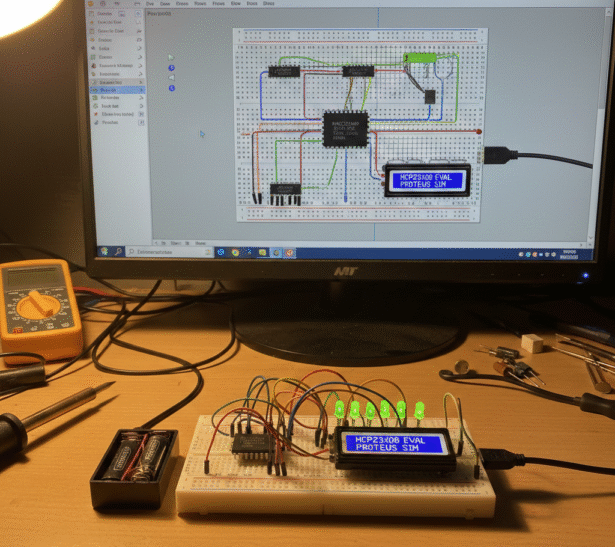
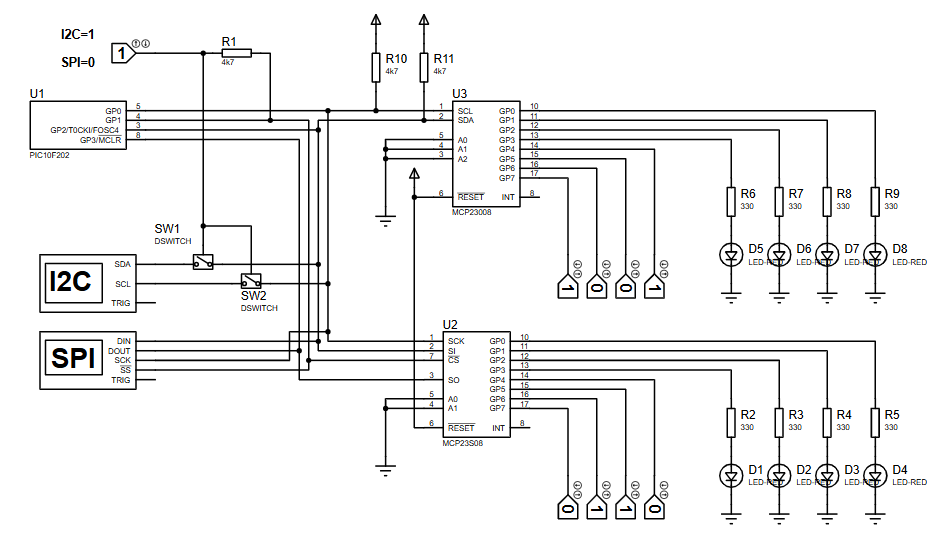
MCP23X08 evaluation board PIC10F202 demonstrates GPIO expansion using MCP23008 (I2C) and MCP23S08 (SPI) with bit-banged protocols on a PIC10F202. A toggle switch selects I2C or SPI; the PIC reads upper-nibble inputs from the expander, swaps bits as needed, and mirrors them to lower-nibble LEDs. Fully simulated in Proteus, the project is educational for protocol comparison, dynamic mode switching, and firmware-driven serial communication.
Parts used in the MCP23X08 evaluation board PIC10F202:
- PIC10F202 microcontroller
- MCP23008 I2C I/O expander
- MCP23S08 SPI I/O expander
- LEDs
- Current-limiting resistors for LEDs
- Toggle switch for protocol selection
- Pull-up resistors for I2C lines
- Proteus simulation software (for testing)
- How does the project switch between I2C and SPI?
A hardware toggle switch selects I2C or SPI and the PIC10F202 dynamically switches modes in firmware. - Can this project run on real hardware?
Yes, the article states the code is hardware-ready and based on Microchip’s application note. - Why is bit-banging used instead of hardware I2C or SPI?
Because the PIC10F202 does not include built-in serial peripherals. - What expanders are used for I2C and SPI?
MCP23008 is used for I2C and MCP23S08 is used for SPI. - How are inputs and outputs mapped on the expander?
The upper nibble of the expander GPIO is read as inputs and the lower nibble drives LEDs after bit swapping. - What oscillator clock is used for the PIC10F202?
The internal RC oscillator with factory calibration is used. - Why is RAMTRIS used instead of TRIS?
PIC10 baseline devices require manual tracking of pin direction, so RAMTRIS is used. - Can more I/O be added to this design?
Yes; multiple expanders can be chained using address pins according to the article. - Is Proteus used in this project?
Yes, the project is fully simulated and testable in Proteus for live mode switching and debugging. - Is this project suitable for beginners?
The article says yes, but a basic understanding of embedded systems and serial communication helps.