


Summary of PIC Projects: Digital Temperature Controller
This article presents a low-cost, microcontroller-based digital temperature controller capable of measuring and regulating temperatures from 0 to 1000ºC. Utilizing a PIC16F877A microcontroller and an AD8495 amplifier with a K-type thermocouple, the device displays real-time readings on an LCD screen and controls heating elements via a relay within user-defined limits. It addresses the high cost and limited range of commercial controllers by offering a robust, direct-measurement solution suitable for both home and industrial applications.Parts used in the Digital Temperature Controller:
- PIC16F877A microcontroller (IC1)
- AD8495 precision thermocouple amplifier (IC2)
- K-type thermocouple
- 16×2 LCD (LCD1)
- Single-changeover relay (RL1)
- Connector CON3
Digital temperature controller is an essential instrument in the field of electronics, instrumentation and control automation for measuring and controlling temperatures. It can be used as much at homes as in industrial applications. Different types of analogue and digital temperature controllers are readily available in the market, but they are generally not only expensive, their temperature range is also usually not very high. Presented here is a low-cost microcontroller-based temperature controller that can read and control temperatures in the range of zero to 1000ºC. Real-time temperature is displayed on its LCD screen, and you can use it to control the temperature within the preset minimum and maximum range.
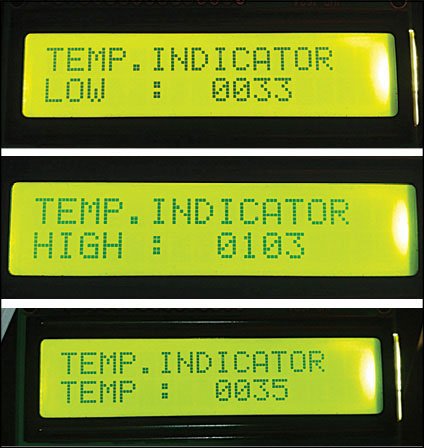
Circuit and working
Fig. 2 shows circuit diagram of the digital temperature controller. The circuit is built around microcontroller PIC16F877A (IC1), precision thermocouple amplifier AD8495 (IC2), K-type thermocouple (connected at CON3), 16×2 LCD (LCD1), single-changeover relay (RL1) and a few common components.
Sensor selection. There are basically two types of temperature-measurement systems—direct temperature-measurement systems for up to 1000ºC and indirect temperature-measurement systems for higher temperature range, where temperature sensors may get physically damaged due to the high temperatures. The selection of temperature sensor is dependent on the range of temperature you wish to check. There are different types of direct-measurement sensors, for different ranges of temperature (refer Table I).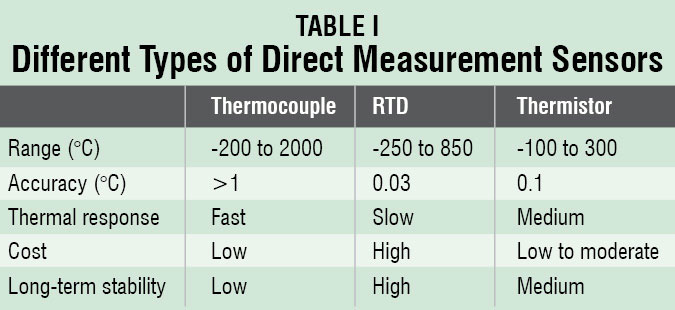
Thermocouple. Here we have used a K-type thermocouple for direct measurements of up to 1000ºC temperature. In K-type thermocouple, the two materials used to form the junction are Chromel (Ni-Cr) and Alumel (Ni-Al). K-type is a low-cost and one of the most popular general-purpose thermocouples. Its operating range is around -250 to +1350ºC, with sensitivity of 42µV/ºC approximately.
For more detail: PIC Projects: Digital Temperature Controller
- What is the primary function of this project?
The project measures and controls temperatures in the range of zero to 1000 degrees Celsius. - How does the system display the current temperature?
Real-time temperature is displayed on its 16x2 LCD screen. - Can this controller be used in industrial settings?
Yes, it can be used at homes as well as in industrial applications. - What type of sensor is used for direct measurements up to 1000C?
A K-type thermocouple made of Chromel and Alumel is used. - Does this design use expensive components compared to market options?
No, it is presented as a low-cost alternative to generally expensive market controllers. - How does the controller maintain the desired temperature?
It uses a single-changeover relay to control the temperature within the preset minimum and maximum range. - What is the operating sensitivity of the K-type thermocouple mentioned?
The sensitivity is approximately 42 microvolts per degree Celsius. - Which microcontroller is the circuit built around?
The circuit is built around the PIC16F877A microcontroller.
Related projects
PIC16F877 Driving LCD in 4-Bit Mode using PIC16F877 with Proteus Simulation
Introduction This microcontroller project shows how a PIC16F877 can drive an LCD display using 4-bit mode inside a Proteus simulation.The project demonstrates...
Programmers & ICSP · PIC16F877AEPE PIC/LCD Demo using PIC16F877 with Proteus Simulation
IntroductionThe EPE PIC/LCD Demo is a classic microcontroller project that demonstrates how a PIC16F877 can fully control a PG12864F graphical LCD.Designed as...
Motors & Robotics · PIC16F877AEfficient Sun-Following Robot: A Solar Tracker with Microcontroller Control
Abstract The impending global challenge of dwindling non-renewable fuel resources underscores the urgency of transitioning towards renewable energy alternatives like solar power....
Sensors & TemperatureSpectrum Analyzer using TMS320F28023DA with Proteus Simulation
Introduction This project demonstrates a real-time audio spectrum analyzer using the TMS320F28023DA Piccolo microcontroller, simulated in Proteus VSM. The system captures an...
Sensors & TemperatureDHT22 Low Cost Humidity Sensor using PIC18F25K20 with Proteus Simulation
IntroductionThis microcontroller project demonstrates how to interface a DHT22 (RHT03) digital temperature and humidity sensor with a PIC18F25K20 using Proteus simulation.The project...
Sensors & TemperatureCrafting a Microcontroller-Based Temperature Monitoring System
Abstract As technological advancements progress, processes become increasingly intricate, demanding a corresponding expansion in the parameters necessary for efficient analysis. Data acquisition,...

Ibrar Ayyub
I am an experienced technical writer holding a Master's degree in computer science from BZU Multan, Pakistan University. With a background spanning various industries, particularly in home automation and engineering, I have honed my skills in crafting clear and concise content. Proficient in leveraging infographics and diagrams, I strive to simplify complex concepts for readers. My strength lies in thorough...