
Summary of Peltier-Powered Drink Cooler!
This article details a DIY desktop-sized drink cooler utilizing a Peltier module. The author explains sourcing a new 50mm x 50mm Peltier device from eBay and emphasizes the critical need for a large heatsink to dissipate heat generated by both power consumption and heat pumping. The project involves constructing an aluminum mounting block with thermal grease, embedding LM335 temperature sensors on both the cold and hot sides using epoxy and wire leads, and ensuring a waterproof seal with RTV.
Parts used in the Desktop-Sized Can Cooler:
- Peltier module (50mm*50mm*3.9mm)
- Large heatsink
- Aluminum bar stock (2 inches wide)
- 10-24 bolts
- White thermal grease
- Epoxy
- LM335 temperature sensor
- Wire leads
- Heat shrink tubing
- RTV sealant
desktop-sized can cooler
From the “Something that Should be Made Department” comes this drink cooler. Ever since seeing peltier devices for sale I have wanted to put one to a cool use, and this is it. 🙂 The heart of the device is of course the peltier module.
photo is from ebay auction for my peltier)
I got the peltier I used (pictured above) off of ebay for about $20 after shipping and such. It was in new condition when received. If you are going to make this project or use a peltier in anything make sure it is new. A used peltier may have water damage, and may not function at all or inadequately. Also, the device should have a perimeter seal to prevent moisture getting inside. This unit has an RTV seal. Specs on my unit are: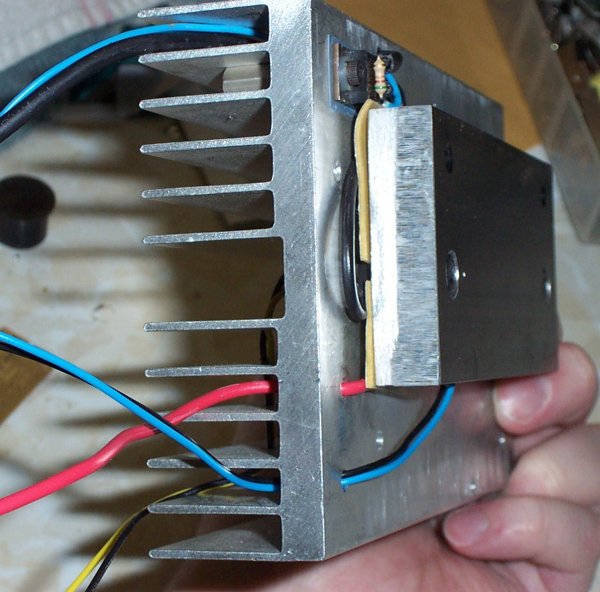
Size: 50mm*50mm*3.9mm
Imax = 12 Amps (maxium allowable device current)
Qmax = 102 Watts (maximum heat pumping capability (at 0 degree temp. differential)
Vmax = 15.2 Volts (theoretical maximum pumping efficiency occurs at this voltage)
DTmax = 69 degrees C (theoertical maximum differential temp (occurs at no heat load)
To use a peltier, it must be mounted on a (large!) heatsink. Running a peltier without a heatsink on the hot side will cause it to overheat and fail nearly instantly. The device generates TWO forms of heat which are transferred to the heatsink: the actual wattage of the power used, (the peltier appears as a purely resistive load) and the heat pumped from the cold side. OK, enough peltier theory. Onto the project.
This is the peltier block I constructed for the device. I had some aluminum scraps laying around, and happened to have some 2″ wide bar stock with 4 holes drilled in it in favorable positions. I used a larger drill bit to “over-drill” the two holes I used so that the heads fo the bolts would be flush with the top surface. I then drilled 2 holes in the heatsink and tapped them for the 10-24 bolts. Then, I greased the peltier with some white thermal grease and installed the aluminum bar over the top, being very careful not to crush the peltier! (this is very easy to do if pressure isn’t even on both bolts). There were 2 threaded mounting holes in the side of the bar, so I filled one full of epoxy and stuck an LM335 on wire leads (soldered wires to the leads and heatshrunk them indivually, then put shrink over that) into the hole. The end result is a very rugged and water-proof temperature sensor that will track the “cold” side very well. The black and blue wires coming off the bar are visible at the bottom left of the pic.
This side view shows the cold side temp sensor pretty well and the RTV seal on the peltier.
Bottom of the heatsink- The “hot” side temp sensor can be seen in the middle. It is another LM335 clamped to the underside of where the peltier mounts. This should track it pretty well. I drilled a hole through all the heatsink fins to pass the black and yellow wires through so that they exit with the blue and black (cold side) wires. The red wire near the top is for the positive connection to the peltier. The heatsink was used and there were a shitload of pre-existing holes. Ideally the sink should be clean and new, but I don’t think the holes will reduce efficiency enough to matter.
For more detail: Peltier-Powered Drink Cooler!
- Why must the Peltier module be new?
A used Peltier may have water damage and might not function or could fail inadequately. - What happens if you run a Peltier without a heatsink?
The device will overheat and fail nearly instantly because it generates two forms of heat. - How should the Peltier be mounted to the aluminum bar?
You must apply white thermal grease and install the bar carefully to avoid crushing the Peltier due to uneven pressure. - How is the cold side temperature monitored?
An LM335 sensor is filled into a threaded hole in the aluminum bar with epoxy to create a rugged, waterproof sensor. - Where is the hot side temperature sensor located?
It is another LM335 clamped to the underside of the heatsink where the Peltier mounts. - What type of seal does the author's unit have to prevent moisture entry?
The unit features an RTV seal around the perimeter to prevent moisture from getting inside. - Can a used heatsink be used for this project?
Yes, while a clean new sink is ideal, pre-existing holes on a used sink likely will not reduce efficiency enough to matter.
