
Summary of Open Radiation Detector
This project details an Open Radiation Detector designed to identify radioactive hazards using a low-cost, mass-producible ionization chamber. Built with PCB technology and standard SMD components, it avoids fragile glass tubes and high voltages, making it ideal for detecting alpha radiation in non-critical applications. The open-source design aims to democratize radiation safety through simple, pick-and-place assembly.
Parts used in the Open Radiation Detector:
- Open-air ionization chamber
- Simple amplifier circuit
- PCB technology board
- Standard low-cost SMD components
DESCRIPTION
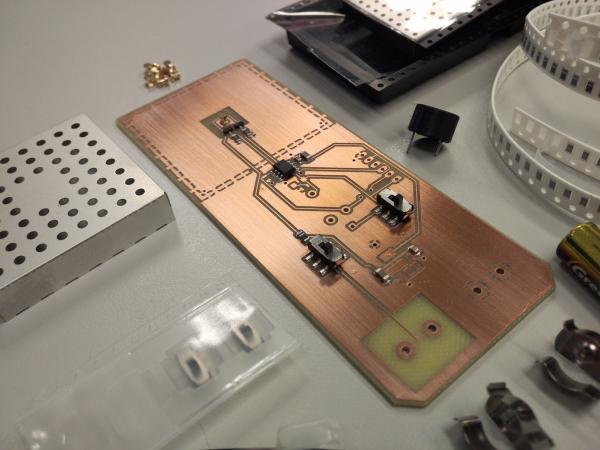
This device uses an open-air ionization chamber with a simple amplifier circuit. It is based on the brilliant work by Charles Wenzel & Alan Yates (http://www.techlib.com/science/ion.html & http://www.vk2zay.net/category/30) among others.
The main innovation when compared to existing meters is the novel ion chamber design, made with PCB technology and standard low-cost components.
DETAILS
Disclaimer
This is an experimental design, at the moment IT MUST NOT BE USED IN CRITICAL APPLICATIONS. The author(s) of this project are not liable for any damage or responsibility derived from the use or misuse of the Open Radiation Detector.
Challenges addressed
The project started as a personal challenge to build a true low cost radiation detector. For this we needed to tackle the following problems:
- Decide the detection method among all the options (see log entry 1).
- Design prototypes and test them to assess performance (see log entry 4).
- There were problems with electrostatic affecting the measurements. See how we solved it in entry 6.
- Thorough the whole project, optimize the design for pick-and-place manufacture with the least components possible.
List of specifications and how they will be met
- It must tell if an object is substantially radioactive. There is a lack of low cost options to measure alpha radiation (see log entry 1: introduction to radiation detectors). We decided to go for a ionization chamber design for the following reasons: as opposed to other detectors, ion chambers are simple and don’t require high voltages, any vacuum tubes nor delicate mica windows. Still, they are really good at detecting alpha radiation (see log entry 2: DIY ion chambers).
- The Open Radiation Detector must be small and low cost. We have already gone through many prototypes and iterations: a spark detector, and many different shapes of ionization chambers (see the log entries).
- It must use standard, modern components. Existing DIY designs that can be found online are great, but they rely upon old transistor models that are difficult to find. For this project we have studied more up-to-date options (see log entry 5).
- Preference goes to facilitating pick-and-place assembly. Existing DIY projects use recycled tin cans and hand-made parts. We have designed an ion chamber that is built with low cost SMD components and can be assembled with pick-and-place machines. These components originally had completely different purposes, but we arranged them to work as an effective ion chamber (see log entry 4).
- It must be open source. We don’t believe in patents, specially in the field of safety. The on-line maker community is the best place to share this design and ensure that it reaches the places and applications that may benefit from the Open Radiation Detector.
Will it be world changing?
The goal of this project is to facilitate the identification of radioactive hazards by creating a low cost & mass-producible detector.
Like it or not, the world has become more and more radioactive since the discovery of nuclear energy. Containing radioactive waste is a real problem, and some nuclear disasters have shown us that we live closer to radiation than we think.
The Open Radiation Detector can tell if an object emits dangerous levels of radiation (these are often imperceptible – radiation doesn’t glow like in movies!). Our hope is to be sensitive enough to tell if food is contaminated, though we don’t know how to test this sensitivity yet. The detector could also be placed in low-cost swarms of disposable robots that roam around a disaster area and mark the hot spots that should be avoided by humans.
We have shared a novel design that uses standard components and can be assembled by pick-and-place machines. There are similar DIY radiation detectors out there, but none of them can be mass-manufactured consistently at such a low cost.
Read More: Open Radiation Detector
- What is the main goal of this project?
The goal is to provide a simple, low-cost device that can prevent cases of radiation poisoning by identifying radioactive objects. - How does this device detect radiation compared to professional meters?
It uses an open-air ionization chamber with a novel PCB design, avoiding expensive vacuum discharge tubes made of glass. - Can this device be used for critical applications?
No, this is an experimental design that must not be used in critical applications due to potential liability issues. - Why was an ionization chamber design chosen over other detectors?
Ion chambers are simple, do not require high voltages or delicate mica windows, and are effective at detecting alpha radiation. - What innovation distinguishes this detector from existing DIY designs?
The innovation is the novel ion chamber design made with PCB technology and standard low-cost components suitable for pick-and-place assembly. - Does this project rely on old transistor models?
No, the project studies and uses more up-to-date options rather than old transistor models that are difficult to find. - Is the design for this detector open source?
Yes, the design is open source to ensure it reaches places and applications that may benefit from the Open Radiation Detector. - Can this detector tell if food is contaminated?
The hope is that it will be sensitive enough to tell if food is contaminated, though the sensitivity has not been tested yet.