Summary of MINI USB-C PD SINK BOARD ENABLES POWER REGULATION FOR ANY DEVICE
The USB-C PD-Sink board by Pier 42 enables devices to draw power from USB supplies at selectable voltages (5V, 9V, 12V, 15V, 20V) with up to 5A current. It uses resistor settings for configuration without software, features an I2C interface for telemetry, and includes a 2-pin screw terminal or solder points for output connections. Designed with 2oz copper for high current capacity, it prevents adapter overload issues and avoids using a USB-A connector to prevent damage to downstream devices.
Parts used in the USB-C PD-Sink:
- USB-C PD Power Delivery Sink
- Selector switch for voltage selection
- Resistors for current setting
- Red LED indicator
- I2C telemetry interface
- Break-off tab for telemetry separation
- 2-pin screw terminal
- Solder points for direct PCB connection
- Wire jumper for fixed voltage
The USB-C PD-Sink is a board by Pier 42 that enables any device to be powered from a USB supply. It allows the option to set the voltage at 5V, 9V, 12V, 15V or 20V and allowing current as high as 5A.
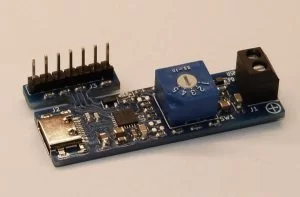
The current settings are very flexible in steps of 250mA from 0 to 5A, but this depends on whether the source can limit the current in those small steps. It uses 2oz copper thickness to ensure good current capacity.
The board was built to develop a standard way to use a USB-C power delivery (USB PD) instead of random power adapters. It will prevent the typical USB-C case where your power adapter cannot supply enough current for your load.
No programming or software configuration is needed for the regular operation of the board because all options are set through resistor values. Any type of power connector can be connected to the board through a 2-pin screw terminal or directly soldered into the PCB for projects on a low budget especially during rapid prototyping.
An I2C interface to a microcontroller is available, to access status and control registers. This part of the board is separated through a break-off tab (mouse bits) and can be snapped off. However, it is recommended to score a line along the holes on both sides before snapping off so that you put less stress on the components nearby.
A USB-A connector option at the output end was not included by design since the device could put more than 5 volts through the VBUS pin of the USB cable, which could destroy the device that is plugged in.
Some features of the device are :
- USB-C PD Power Delivery Sink
- Selector switch for 5V, 9V, 12V, 15V or 20V
- Max current 5A, settable in 250mA steps through resistor options
- Red LED to indicate failed power request
- I2C telemetry interface to the controller chip
- Snap off option for a telemetry interface
- For fixed voltage, the switch can be replaced by wire jumper
- small form factor to be heat-shrunk as part of the power cable
- Size 48mm x 15mm (without telemetry interface)
- Height 12mm with screw terminal and switch, 6mm without.
- 2oz copper to safely handle 5A
- Lead-free to be RoHS compliant
Read more: MINI USB-C PD SINK BOARD ENABLES POWER REGULATION FOR ANY DEVICE
- What voltages can the USB-C PD-Sink provide?
The board allows voltage selection at 5V, 9V, 12V, 15V, or 20V. - How is the current limit set on this board?
Current is settable in 250mA steps from 0 to 5A using specific resistor values. - Does the board require programming or software configuration?
No, all options are set through resistor values without any programming. - Can I connect different types of power connectors to the board?
Yes, you can use a 2-pin screw terminal or solder directly into the PCB. - Why was a USB-A connector not included in the design?
A USB-A connector was excluded because the device could exceed 5 volts on the VBUS pin, potentially destroying connected devices. - How do I safely remove the telemetry interface section?
It is recommended to score a line along the holes before snapping off the break-off tab to reduce stress on nearby components. - What is the maximum current capacity of the board?
The board supports a maximum current of 5A thanks to its 2oz copper thickness. - Is the board RoHS compliant?
Yes, the board is lead-free and RoHS compliant.