Summary of MATCHX’S EDGEX AI DEVELOPMENT KIT PROMISES AI ON EDGE WITH LORAWAN SUPPORT
The EdgeX AI Dev Kit by MatchX is a unique platform for building edge AI applications with long-range LPWAN connectivity. It leverages the MX1941 SoM, which combines a Kendryte K210 RISC-V processor and a Semtech SX1261 LoRa transceiver to process visual and audio data efficiently. This kit supports complex tasks like video, image, and speech analysis on sensor nodes while maintaining low-power wide-area network capabilities.
Parts used in the EdgeX AI Dev Kit:
- MatchX MX1941 AI System on Module
- Kendryte K210 dual-core RISC-V system on chip
- Semtech SX1261 LoRa transceiver
- LiPo battery connector
- Three buttons acting as switches
- USB – C female connector port
- Integrated microphone
- Camera connector
- LCD connector
I recently discovered this new board called the EdgeX AI Dev Kit made by German IoT guys MatchX following an hackster post. The specifications of the board look promising, but it also raises some questions as well. According to MatchX, EdgeX AI enables you to build complex data LPWAN or NB-IoT applications, such as videos, images, and speech. EdgeX AI runs artificial intelligence models on edge devices such as sensor nodes.
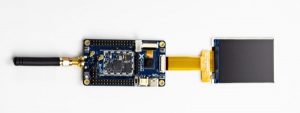
EdgeX AI Dev Kit is a unique development platform for applications requiring visual or audio data processing and feature extraction combined with long-range radio connectivity.
EdgeX AI is built around MatchX’s MX1941 AI System on Module. The MX1941 AI SoM is based on the Kendryte K210 dual-core RISC-V system on chip and a Semtech SX1261 LoRa transceiver in a tiny form factor. The Kendryte K210 is a dual-core 64-bit RISC-V processor running at 400 MHz with KPU CNN hardware accelerator, APU audio hardware accelerator, 6 MB general-purpose SRAM, 2MB AI SRAM memory, and AXI ROM to load user program from SPI flash. Combined with the Semtech SX1261, the MX1941 makes it possible to add long-range radio connectivity for edge AI applications.
The MatchX’s MX1941 isn’t the first AI SoM based on the Kendryte K210, and the SIPEED M1 is also a similar SoM based around the RISC-V processor which is deployed to the Grove AI HAT for the Raspberry Pi. The main difference between both SoM is that the MX1941 provides onboard LoRa connectivity.
The Edge AI development kit extends the functionality of the SoM. The development kit provides an outlet for a LiPo battery connector, a couple of three buttons acting as some sort of switches, a USB – C female connector port, comes with an integrated microphone, a camera connector, and also an LCD connector.
Read more: MATCHX’S EDGEX AI DEVELOPMENT KIT PROMISES AI ON EDGE WITH LORAWAN SUPPORT
- What applications can the EdgeX AI Dev Kit build?
It enables building complex data LPWAN or NB-IoT applications such as videos, images, and speech. - How does the EdgeX AI Dev Kit run artificial intelligence models?
It runs these models on edge devices such as sensor nodes. - What is the main difference between the MX1941 and the SIPEED M1 SoM?
The MX1941 provides onboard LoRa connectivity while the SIPEED M1 does not. - Does the development kit include an integrated microphone?
Yes, the development kit comes with an integrated microphone. - Can the EdgeX AI Dev Kit connect to a camera?
Yes, it includes a camera connector. - What type of processor powers the Kendryte K210 chip?
It is a dual-core 64-bit RISC-V processor running at 400 MHz. - What hardware accelerators are included in the Kendryte K210?
It features a KPU CNN hardware accelerator and an APU audio hardware accelerator. - How much general-purpose SRAM does the Kendryte K210 have?
The chip has 6 MB of general-purpose SRAM.