Summary of Making A SMD Reflow Oven
Summary: The article describes converting a toaster oven into a DIY SMD reflow oven using the Whizoo Controleo2 controller, covering options for SMD soldering (hand, frying pan, toaster oven), reasons for choosing Whizoo (GUI, self-calibration, PWM, accessories), safety warnings about high voltage/temperature, and selecting a suitable toaster oven (quartz heaters, size example Black & Decker TO1322SBD).
Parts used in the Reflow Oven Project:
- Toaster oven (example: Black & Decker TO1322SBD)
- Whizoo Controleo2 Reflow Controller
- Insulation materials (included with Whizoo kit)
- Booster heater (optional, included in kit options)
- Servo for door opening (Whizoo option or user-made servo mechanism)
- Quartz-style heating elements (present in chosen oven)
- PWM-capable heater control hardware (part of Controleo2)
- Thermocouple or temperature sensor (used for calibration)
- Wiring and connectors for integration
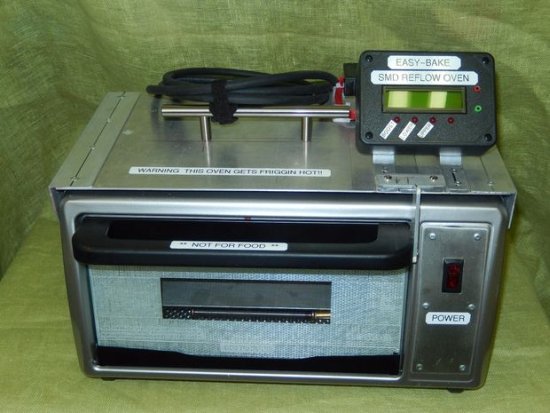
I have been an electronics hobbyist for many years and have always stuck with through-hole components when making a project. However as time goes by, not only are more and more components are becoming available only in SMD (surface mount device) but also more interesting projects are also SMD based.
There are several options for doing your own SMD soldering:
Hand Soldering – Using a fine-tipped soldering iron and small-diameter solder you can work with the larger of the SMD devices. However it can be pretty tedious and take a long time if you have lots of parts.
Electric Frying Pan – This can work for smaller boards but the temperature control is pretty difficult so it can be hit and miss.
Toaster Oven – This seems the most promising for the hobbyist and while you can just wing it with the manual controls there are also a range of control options for automation and temperature control. This essentially mimics a commercial reflow oven.
I decided to put together a toaster oven and wanted something that could handle large boards and possibly do small production runs. Doing a web search, you will find many options for toaster oven reflow controllers. They range from one-off designs to DIY boards to full kits. A large number of them are Arduino based. Some controllers just allow the oven to plug in (so you don’t need to take the oven apart) while others integrate completely inside the oven (more work but a much better product in the end).
Looking at various options I decided on the Whizoo Controleo2 Reflow Controller. It offers a decent GUI and a self-calibration function that I felt was important to get decent results. It also has full PWM (pulse width modulation) control of the heaters to give you a more accurate temperature profile which is very important in reflow soldering. While I had wanted a kit, the Whizoo is fully assembled but you still have a lot of work to integrate it with your toaster oven. They also offer some extras in the kit including various insulation types (allows the oven to heat up quickly and evenly) and a booster heater (ensures the unit heats up at the correct rate). There is even a servo to crack the door open after the cycle is complete to allow the board to cool correctly. I bought my kit before the servo was available so I rigged up my own servo door opening mechanism. You can see the various purchasing options Here.
Whizoo also has a great Build Guide which details each step. I recommend you read completely through their guide and this Instructable before you start your own oven as there are a few caveats you will run into along the way. You can also find various examples of user made ovens Here.
I also found that the person behind Whizoo (Peter Easton) answers email questions very quickly and at all hours of the night. It is nice to know you get very good support when you purchase a product.
DISCLAIMER!! – This project deals with high voltages and high temperatures. You can easily electrocute yourself and/or burn your house down if you are not careful. Do not attempt this project if you are not competent in the various tasks required and able to do them safely. You will need to make various design decisions during a project of this nature and you need to be able to evaluate the various potential safety issues involved.
Don’t say I didn’t warn you…
Update:
If you are interested in an Instructable on setting up a solder paste dispenser for SMD projects check out this one I just recently publish
Step 1: Find A Toaster Oven
You have many toaster oven options. While you can use something you find in the trash or “borrowed” from the kitchen, I decided to get something new. I didn’t want any chance of contamination from previous food stuff nor did I want to work on something old and nasty. Ideally you want an oven with quartz style heaters as they heat up faster than the old rod style heaters. I went with the same model that Whizoo used in their example: a Black & Decker TO1322SBD. It has quartz heaters (one above and one below) and is rated at 1150 Watts. It will handle a board up to approx. 6″ x 9″ (large enough for anything I expect to do). You can get larger ovens and ovens with convection fans (the Whizoo controller also has a output to control the fan).
For more detail: Making A SMD Reflow Oven
- What soldering options are available for SMD components?
Hand soldering, electric frying pan, and toaster oven reflow are described. - Why choose a toaster oven for SMD soldering?
It mimics a commercial reflow oven and can be automated for consistent temperature profiles. - Which reflow controller did the author choose?
The author chose the Whizoo Controleo2 Reflow Controller. - What features of the Whizoo Controleo2 influenced the decision?
It offers a GUI, self-calibration, full PWM heater control, and optional accessories like insulation, booster heater, and servo. - Do you need to disassemble the oven to install the controller?
Some controllers allow plug-in use, but the Whizoo integrates inside the oven for a better final product. - What oven characteristics are recommended?
A toaster oven with quartz-style heaters and sufficient internal size (example fits ~6 x 9 inch boards) is recommended. - Is support available for the Whizoo controller?
The author reports that Peter Easton, the person behind Whizoo, answers email questions quickly. - Are there safety concerns with this project?
Yes; the project involves high voltages and high temperatures and can be dangerous if not performed competently and safely.