


Summary of LM75 Temperature Sensor with 7 segment display output using PIC16F628
This article describes a hastily assembled test project using a solderless breadboard to read temperature via an LM75 sensor (I2C) and display it on three 7-segment displays. The system is controlled by a PIC16F628 microcontroller running at 4 MHz, with the program written in JAL. Due to the LM75's surface-mount package, wires were manually soldered for breadboard compatibility. A 5V regulator powers the circuit, though it is not included in the schematic.Parts used in the LM75 Temperature Sensor Project:
- Three 7SEG-CA 7-segment displays
- PIC16F628 microcontroller
- LM75 temperature sensor
- Three BC557C PNP transistors
- Two 12K resistors
- Three 1K resistors
- Six 220 ohm resistors
- 5V voltage regulator
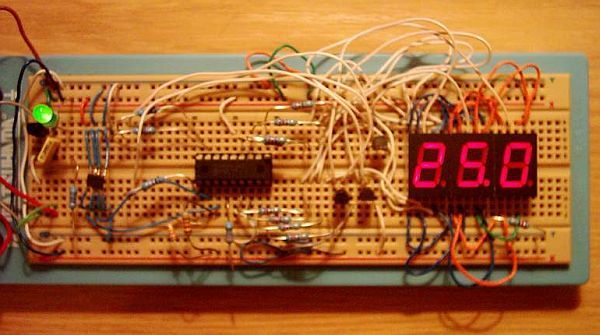
The program was created using JAL
Note the LM75 is a surface mount device, so I had to solder wires onto it to use it on the solderless breadboard.
Sorry for the bad quality photo. The stuff on the left is a 5V voltage regulator and not shown on the schematic below.
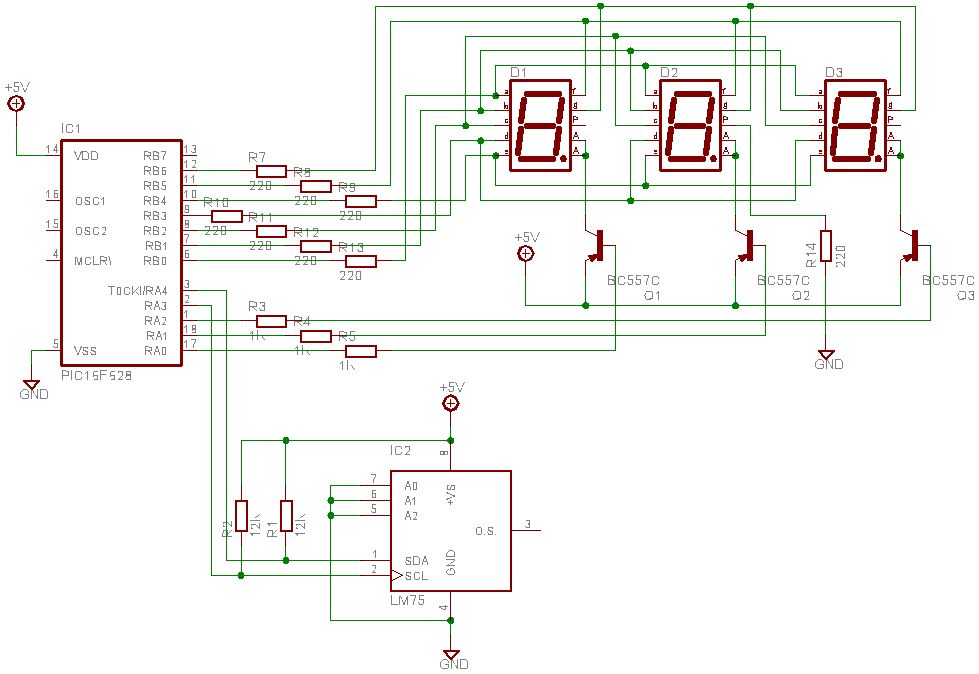
Component List
Part     Value          Device      Package  Library        Sheet

D1                      7SEG-CA     7SEG-13  special        1
D2                      7SEG-CA     7SEG-13  special        1
D3                      7SEG-CA     7SEG-13  special        1
IC1      PIC16F628      PIC16F628   DIL18    microchip      1
IC2      LM75           LM75        SOP-8    andre_lm75     1
Q1       BC557C         BC557C      TO92-EBC transistor-pnp 1
Q2       BC557C         BC557C      TO92-EBC transistor-pnp 1
Q3       BC557C         BC557C      TO92-EBC transistor-pnp 1
R1       12K            R-EU_0207/7 0207/7   rcl            1
R2       12K            R-EU_0207/7 0207/7   rcl            1
R3       1K             R-EU_0207/7 0207/7   rcl            1
R4       1K             R-EU_0207/7 0207/7   rcl            1
R5       1K             R-EU_0207/7 0207/7   rcl            1
R7       220            R-EU_0207/7 0207/7   rcl            1
R8       220            R-EU_0207/7 0207/7   rcl            1
R9       220            R-EU_0207/7 0207/7   rcl            1
R10      220            R-EU_0207/7 0207/7   rcl            1
R11      220            R-EU_0207/7 0207/7   rcl            1
R12      220            R-EU_0207/7 0207/7   rcl            1
R13      220            R-EU_0207/7 0207/7   rcl            1
R14      220            R-EU_0207/7 0207/7   rcl            1
For more detail: LM75 Temperature Sensor with 7 segment display output using PIC16F628
Quick Solutions to Questions related to LM75 Temperature Sensor Project:
- How does the project read the current temperature?
The LM75 reads the current temperature via I2C. - What component displays the result?
The result is displayed on three 7 segment displays. - Which microcontroller is used in this project?
A PIC16F628 with an internal 4 Mhz clock is used. - What programming language was used for the program?
The program was created using JAL. - Why were wires soldered onto the LM75?
Wires were soldered because the LM75 is a surface mount device. - Where is the 5V voltage regulator located?
The 5V voltage regulator is on the left side of the photo. - Is the voltage regulator shown on the schematic?
No, the 5V voltage regulator is not shown on the schematic. - What type of breadboard was used for assembly?
A solder less breadboard was used for the test project.
Related projects
DHT11 Low Cost Humidity Sensor using PIC16F628A with Proteus Simulation
IntroductionThis microcontroller project demonstrates how to interface a low-cost DHT11 temperature and humidity sensor with a PIC16F628A using a Proteus simulation environment.The...
LCD & Display Projects · PIC16F628AFrequency Counter by PIC16F628
In this project we are building a basic and low cost frequency counter circuit . It can measure from 16Hz to 100Hz...
Games, Toys & Calculators · PIC16F628ATIC TAC TOE game using PIC16F628
This project is not to introduce Tic Tac Toe. Everyone knows this game. It's to introduce two features. Bi-coloured LEDs, microcontrollers and...
Sensors & TemperatureSpectrum Analyzer using TMS320F28023DA with Proteus Simulation
Introduction This project demonstrates a real-time audio spectrum analyzer using the TMS320F28023DA Piccolo microcontroller, simulated in Proteus VSM. The system captures an...
Sensors & TemperatureDHT22 Low Cost Humidity Sensor using PIC18F25K20 with Proteus Simulation
IntroductionThis microcontroller project demonstrates how to interface a DHT22 (RHT03) digital temperature and humidity sensor with a PIC18F25K20 using Proteus simulation.The project...
Sensors & TemperatureCrafting a Microcontroller-Based Temperature Monitoring System
Abstract As technological advancements progress, processes become increasingly intricate, demanding a corresponding expansion in the parameters necessary for efficient analysis. Data acquisition,...

Ibrar Ayyub
I am an experienced technical writer holding a Master's degree in computer science from BZU Multan, Pakistan University. With a background spanning various industries, particularly in home automation and engineering, I have honed my skills in crafting clear and concise content. Proficient in leveraging infographics and diagrams, I strive to simplify complex concepts for readers. My strength lies in thorough...