
Summary of Inside the Intel RealSense Gesture Camera
The article describes Intel RealSense gesture camera technology, its integration into the Lenovo ThinkPad Yoga 15, and the structured-light projector that enables 3D gesture sensing. The system combines a color CMOS sensor, an infrared image sensor, an infrared structured-light projector (IR laser diode, line lens, MEMS resonant micromirror on an aluminum optical bench), and an image processor; microphones may be included. STMicroelectronics supplies the torsional MEMS mirror. The piece also references STMicroelectronics VL6180 Time-of-Flight sensor and its proximity sensing applications.
Parts used in the Intel RealSense gesture camera project:
- Color CMOS image sensor camera
- Infrared image sensor
- Infrared structured-light projector assembly
- IR laser diode (inside projector)
- Line lens (inside projector)
- MEMS resonant micro mirror device (torsional mirror)
- Die cast aluminum optical bench (projector mount)
- Image processor
- PCB assembly (long thin PCB along top edge of laptop screen)
- Pair of microphones (optional)
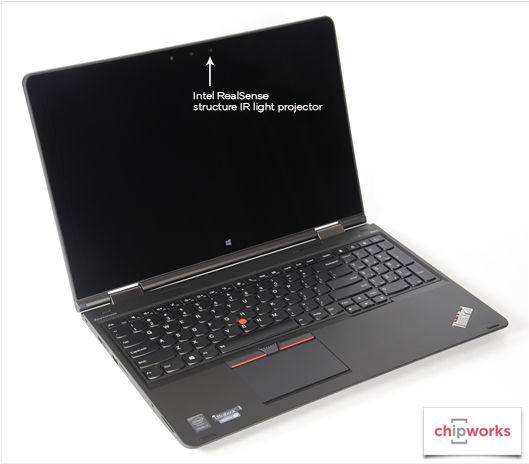
The Intel® RealSense™ gesture camera represents another foray by Intel into the consumer products space. The camera has been incorporated into the Lenovo ThinkPad Yoga 15. Intel disclosed at IDF14 that the device is formed using three components: a conventional color CMOS image sensor camera, an infrared images sensor, an infrared light projector (the main focus of this article), plus an image processor. It can also incorporate a pair of microphones.Lenovo ThinkPad Yoga 15 Laptop. The Lenovo ThinkPad Yoga 15 contains a PCB assembly which looks essentially identical to that disclosed by Intel. It features the aforementioned components all mounted on a long thin PCB that fits along the top edge of the laptop screen.Intel RealSense PCB AssemblyThe Intel RealSense is based on the same principles as the PrimeSense technology used in the Microsoft Kinect 1. PrimeSense was recently purchased by Apple. The infrared structured light projector emits a structured pattern of infrared light which is reflected back from the scene and is detected by the infrared image sensor. The position of the reflected light pattern depends on the distance to the reflecting surface, as a result of simple geometry. Hence with bit of trigonometry it is possible to reconstruct a 3-dimensional (3D) scene.Intel RealSense Structure Light Projector.
Typical Structured Light Pattern
Source: http://image-sensors-world.blogspot.ca/2015/01/intel-releases-more-details-on-its-f200.html
Infrared Image Sensor Die Photograph
The structured light projector contains an IR laser diode, a line lens and a MEMS resonant micro mirror device all mounted onto a small die cast aluminum optical bench. The line lens takes the relatively circular laser beam and stretches it along a horizontal line. The comb driven micro mirror is driven into resonant oscillation by an electrical signal which is applied to two bond wires. The reflected IR light is projected onto the scene.
Inside the Intel RealSense Structured Light Projector
Line Lens Inside the Structured Light Projector
The resonant MEMS micro mirror device used in the Intel RealSense is manufactured by STMicroelectronics, as disclosed in a recent press release. According to the press release, the devices feature a “tiny MEMS mirror that moves thousands of times per second to scan an infrared light beam, painting an invisible grid on objects in front of it. The light reflected back from the object is captured and analyzed for 3D imaging and gesture applications.” The devices were provided by ST for the “Perceptual Computing initiatives at Intel.”
STMicroelectronics Resonant MEMS Micro Mirror Device Inside the Structured Light Projector
The micro mirror device used in the Intel RealSense features a torsional mirror, similar to that described in a recent STMicro publication [1]. The paper concerned the effects of fluid damping by ambient air on the out-of-plane resonant oscillation of the mirror.
The Intel RealSense represents a significant departure for Intel from the core business of advance CMOS technology and also demonstrates an unusual partnership between these two major international semiconductor manufacturers.
More from STMicroelectronics
STMicroelectronics has been doing exciting work in proximity sensing with its VL6180 Time of Flight Sensor. The integration of the SPAD, IR emitter and Ambient Light Sensor into a single chip is an impressive engineering feat, all fabbed in STMicroelectronics BCD9 Process.
The primary application of the VL6180 is the replacement of existing proximity detection technology. Proximity sensors are used in nearly all smartphones to detect the user’s head during a phone call. Unfortunately, the amplitude of the reflected light varies according to the distance but also with the reflectance level of the target, which can be as low as 3 percent for dark black hair. This can lead to ambiguous results – quite frustrating to some users. The VL6180 allows absolute distance to be measured independent of target reflectance. Instead of estimating the distance by measuring the amount of light reflected back from the object, the VL6180C precisely measures the time the light takes to travel to the nearest object and reflect back to the sensor. Interestingly, it was used in the LG G3 as the laser autofocus for the rear facing camera. Chipworks has completed multiple reports on this device.
For more detail: Inside the Intel RealSense Gesture Camera
- What components form the Intel RealSense gesture camera?
The device is formed using a color CMOS image sensor camera, an infrared image sensor, an infrared light projector, plus an image processor and optionally a pair of microphones. - Where has the Intel RealSense camera been incorporated?
It has been incorporated into the Lenovo ThinkPad Yoga 15. - How does the structured light system reconstruct 3D scenes?
The infrared structured light projector emits a patterned infrared light that reflects back to the infrared image sensor; the pattern displacement varies with distance, allowing 3D reconstruction via geometry and trigonometry. - What are the main parts inside the structured light projector?
The projector contains an IR laser diode, a line lens, and a MEMS resonant micro mirror device mounted on a die cast aluminum optical bench. - Who manufactures the MEMS micro mirror device used in Intel RealSense?
The resonant MEMS micro mirror device is manufactured by STMicroelectronics. - How is the MEMS micro mirror driven to project the pattern?
The comb-driven micro mirror is driven into resonant oscillation by an electrical signal applied to two bond wires, scanning the infrared beam to paint a grid on objects. - What similarity does Intel RealSense share with Microsoft Kinect 1?
Both use structured light: projecting an infrared pattern and sensing its reflection to reconstruct 3D scenes; Intel RealSense is based on the same principles as PrimeSense technology used in Kinect 1. - What additional STMicroelectronics sensor is mentioned and for what use?
The VL6180 Time of Flight sensor is mentioned; its primary application is proximity detection and absolute distance measurement independent of target reflectance.

