Summary of How to Route Differential Pairs
This article explains the benefits and routing rules for differential pairs in high-speed PCB designs using Autodesk EAGLE. Differential pairs use two traces to transmit signals, offering advantages like reduced electromagnetic interference (EMI), better noise resistance, and precise timing. Key design rules include keeping trace lengths equal to maintain polarity balance. The text outlines why these pairs are essential for technologies like HDMI and USB3.0 but does not list specific hardware components used in a physical build.
Parts used in the Routing of Differential Pairs:
- Differential signaling
- Two traces
- Positive trace
- Negative trace
- Power systems
- Ground
How to Route Differential Pairs in Autodesk EAGLE
If you’re designing a high speed PCB, then chances are you’re working with the latest and most powerful technologies, like HDMI, USB3.0, Ethernet, or DDR. But with great power comes great responsibility! As a result, you’ll likely be dealing with issues like electromagnetic interference (EMI) and noise.
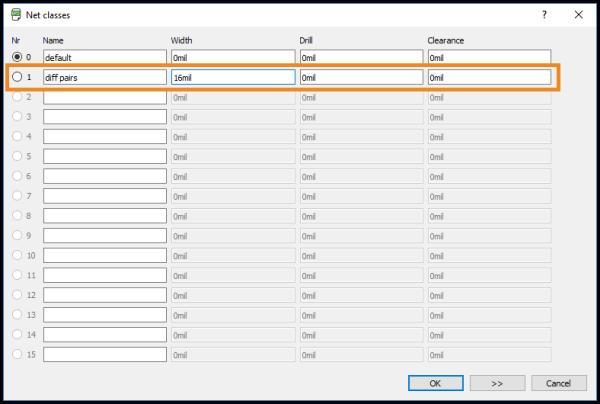
So what do you do about these problems? When you’ve got a bunch of noisy signals on your board and you need a way to protect the transmission of your data then you need to be using differential pairs. In this blog we’ll be looking at all of the great benefits for using differential pairs in your high speed design project, and how to route them in Autodesk EAGLE.
It’s a Dual Benefit
Differential pairs are the physical manifestation of putting differential signaling into action on your high speed PCB layout. Put simply, this is the process of using not just one, but two traces to transmit a signal on your board. These two traces both carry the same signal. The first trace, considered positive, carries your original signal. And the second trace, considered negative, carries the inverse of the original signal.
Why would you ever want to carry the same signal along two traces? There are a ton of reasons, such as:
- Separating power systems. Differential signals don’t typically send a return signal to ground, and because of this, you don’t need to worry about crossing over power boundaries. This can make it a lot easier to keep your power systems separate.
- Reducing electromagnetic interference. Your tightly coupled differential signals are great at resisting any EMI emissions from other noisy traces on your board layout. They also cancel out their own EMI emissions with their shared polarity and distance.
- Precisely timing. It’s also a lot easier to determine what kind of logic state a differential pair is at in any given moment. If the negative trace has a higher voltage than the positive one, then it has a higher logic state, and if it’s the other way around, then the pair has a low logic state.
- While differential pairs do have a ton of advantages when it comes to resisting electromagnetic interference and noise, they also have some particular design rules that you need to pay attention to. These include:Rule 1 – Keep differential signal traces at equal lengths. Your differential pairs are only beneficial when their lengths are kept the same, which keeps their polarity in balance.
Read more: How to Route Differential Pairs
- What is differential signaling?
It is the process of using two traces to transmit a signal where one carries the original signal and the other carries the inverse. - Why do you need differential pairs for high speed PCBs?
They protect data transmission by reducing electromagnetic interference and noise from other signals. - Does differential signaling send a return signal to ground?
No, differential signals typically do not send a return signal to ground, making it easier to keep power systems separate. - How do differential pairs reduce electromagnetic interference?
They resist EMI from other noisy traces and cancel out their own emissions through shared polarity and distance. - How is the logic state determined in a differential pair?
If the negative trace has a higher voltage than the positive one, it is a high logic state; otherwise, it is low. - What is the primary rule for keeping differential signal traces beneficial?
You must keep the differential signal traces at equal lengths to keep their polarity in balance. - Can differential pairs cross over power boundaries?
Yes, because they do not send a return signal to ground, crossing power boundaries is easier without worry. - What technologies benefit from using differential pairs?
High speed technologies like HDMI, USB3.0, Ethernet, and DDR benefit from this method.