
Summary of FTDI CHIP HIGH-SPEED USB BRIDGE ICS WITH TYPE-C CONTROLLERS
FTDI Chip high-speed USB bridge ICs with Type-C/PD 3.0 controllers support USB Type-C and Power Delivery Rev 3.0, offering up to two PD ports (one shared with USB data, one power-only), configurable PDO profiles via external EEPROM, multi-channel USB bridging up to 40 MBytes/s, and multi-protocol channel modes (UART, MPSSE, FIFO), plus integrated PD policy engine, VCORE LDO, and broad package/temperature support.
Parts used in theFTDI Chip High-Speed USB Bridge ICs with Type-C/PD 3.0 Controllers:
- FTDI high-speed USB bridge IC with Type-C/PD 3.0 controller
- USB Type-C connector (shared with PD1 and USB data)
- Type-C power-only connector for PD2 (power port)
- External EEPROM for PD mode and PDO configuration
- External MCU for optional PD policy control via I2C (optional)
- External power supply supporting 5V, 9V, 12V, 15V, 20V PDOs
- 1.2V LDO regulator (integrated in IC)
- PCB and passive components for USB and power routing
- Appropriate package options: QFN-56, QFN-46, QFN-76, QFN-68, LQFP-80
FTDI Chip High-Speed USB Bridge ICs with Type-C/PD 3.0 Controllers fully support the latest USB Type-C and Power Delivery (PD) standards. This enables the support for power negotiation with the ability to sink or source current to USB host devices. These high-speed USB bridge devices feature up to two PD ports viz, PD1 port and PD2 port. The PD1 port shares the same Type-C connector with USB data and the PD2 port is the power port only without USB data. The high-speed USB bridge ICs support 5V, 9V, 12V, 15V, and 20V PDO profiles and these profiles are configurable through an external EEPROM at power-up/reset.
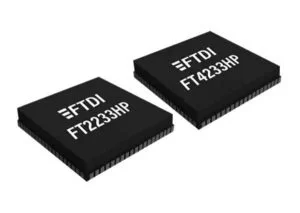
The high-speed USB bridges offer up to 40Mbytes/s data rates and multi-channel interfacing. The benefit of a multi-channel bridge is that the system BOM is reduced by removing the need for a USB hub chip. Additionally, each channel of the device appears to the host PC as a separate device. This enables each channel to be independently configured for different modes such as UART, MPSSE, or FIFO. Also, with different parameters such as 4 UARTS all operating with different baud rates.
Features
- Supports PD specification Rev 3.0
- 2 USB PD 3.0 port support:
- Port 1 mode configuration for Sink or Dual-role
- Port 2 works as Sink, supporting charge through to Port 1
- Support 5V 3A, 9V 3A, 12V 3A, 15V 3A, and 20V 3A PDOs as sink or source
- Type-C/PD physical layer protocol
- PD policy engine using 32-bit RISC controller with 8kB data RAM and 48kB code ROM
- PD mode configuration through external EEPROM
- Options to use external MCU controlling PD policy through I2C interface
- USB 2.0 high speed (480Mbits/second) and full-speed (12Mbits/second) compatible
- Adjustable receive buffer timeout
- Multi-Protocol Synchronous Serial Engine (MPSSE) to simplify the synchronous serial protocol (USB to JTAG, I2C (MASTER), SPI (MASTER), or bit-bang) design
- FTDI royalty-free Virtual Com Port (VCP) and Direct (D2XX) drivers eliminate the requirement for USB driver development in most cases
- Highly integrated design includes 1.2V LDO regulator for VCORE and integrated POR function
- Low operating and USB suspend current
- USB Bulk data transfer mode (512-byte packets in high-speed mode)
- Fully assisted hardware or X-On / X-Off software handshaking
- Extended -40°C to 85°C industrial operating temperature range
- Available in Pb-free QFN-56/QFN-46/QFN-76/QFN-68/LQDP-80 packages (RoHS compliant)
Read more: FTDI CHIP HIGH-SPEED USB BRIDGE ICS WITH TYPE-C CONTROLLERS
- Does the IC support USB Power Delivery Rev 3.0?
Yes, the devices support PD specification Rev 3.0. - How many PD ports do these bridge ICs support?
They support up to two PD ports: PD1 shares the Type-C connector with USB data and PD2 is power-only. - Can the device act as a power source and sink?
Yes, it can sink or source current and supports PDOs as sink or source. - What PDO voltages are supported?
Supported PDO profiles are 5V, 9V, 12V, 15V, and 20V at 3A. - How are PDO profiles configured?
PDO profiles are configurable through an external EEPROM at power-up or reset. - What USB data rates do the bridges support?
The bridges support USB 2.0 high speed (480 Mbits/second) and full speed (12 Mbits/second), with up to 40 MBytes/s data rates for the device. - Can multiple channels appear as separate devices to the host?
Yes, each channel appears to the host PC as a separate device and can be independently configured. - What channel modes are supported?
Channels can be configured for modes such as UART, MPSSE, or FIFO, including multiple UARTs with different baud rates. - Are there driver options to avoid custom USB driver development?
Yes, FTDI provides royalty-free Virtual Com Port (VCP) and Direct (D2XX) drivers that eliminate the need for custom USB driver development in most cases. - What temperature range and packages are available?
Devices support an extended -40°C to 85°C industrial range and come in Pb-free QFN-56, QFN-46, QFN-76, QFN-68, and LQFP-80 packages.