
Summary of Elektor 500ppm LCR meter case tips
This article details the author's experience with a 500ppm LCR meter from Elektor, highlighting its superior accuracy for measuring inductance, capacitance, and ESR compared to standard multimeters. The narrative covers delivery delays, initial testing on faulty regulators, and assembly challenges with the premium case. Specific issues included missing fasteners, LED length discrepancies requiring re-soldering, and excess ribbon cable. The author shares practical solutions like using spacers and custom mounting techniques to successfully integrate the unit.
Parts used in the Elektor 500ppm LCR Meter Project:
- Elektor 500ppm LCR meter
- Elektor pre-drilled and labelled case
- Generic case (mentioned as alternative)
- Screws holding the case together
- M3 x 16mm countersink screws
- Nuts
- Washers
- 7mm M3 spacers
- 6 BA x 1/8" spacers
- LCD PCB
- LED
- Ribbon cable
I recently bought a 500ppm LCR meter from Elektor because I didn’t have anything for measuring inductors or the ESR (equivalent series resistance) of capacitors, both of which are important for modern electronics, particularly switch mode regulators that have become ubiquitous.
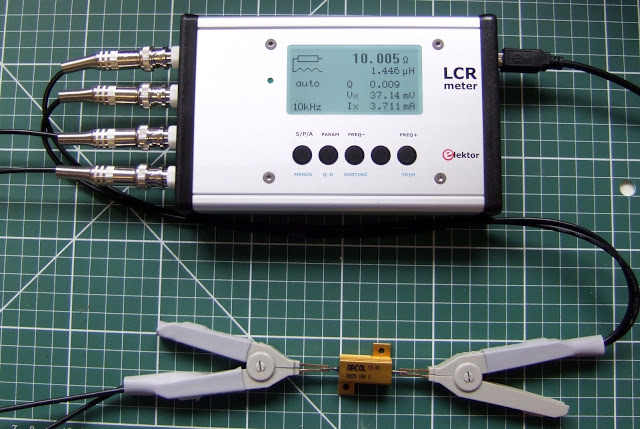
It is also more accurate than any of my multimeters and has wider measurement ranges. For example it can measure resistance from 0.1mΩ to 1GΩ and capacitance between 0.1pF and 0.1F. This means I can now measure parasitics like contact resistance, stray capacitance and lead inductance. The principal reasons it can do this while my multimeters can’t is because it uses a four wire Kelvin connection to the device under test, and as well as measuring voltage and current, it also measures the phase between them.
It took over a month to be delivered and the case arrived two weeks later. The meter’s arrival coincided with the arrival some ridiculously cheap switch mode buck and boost regulators from China. None of them worked properly (no surprise there) so it was pressed into service straight away, without its case. It worked well but when I got the case there were a few snags assembling it and then it then didn’t work properly.
The case comes pre-drilled and labelled from Elektor and is about three times the price of the generic version available from RS and Farnell. I expected it to include all the fasteners for that price but it only came with the screws that hold the case together.
To mount the LCD PCB I needed four M3 x 16mm countersink screws, nuts and washers and four 7mm M3 spacers. Luckily I already had suitable screws and I used eight 6 BA x 1/8″ spacers as the LCD is actually 6.4mm only thick. If I hadn’t had those I would have printed some custom plastic ones.
I found the LED was too short to reach the hole for it in the front panel, so I re-soldered it as high as I could to improve its appearance. I also chamfered the back of the hole for it with a countersink to guide it in.
The next issue I had was the ribbon cable was way too long with nowhere to store the excess.
For more detail: Elektor 500ppm LCR meter case tips
- Why is the Elektor LCR meter more accurate than standard multimeters?
It uses a four wire Kelvin connection and measures the phase between voltage and current. - What measurement ranges does this LCR meter cover?
It measures resistance from 0.1mΩ to 1GΩ and capacitance between 0.1pF and 0.1F. - Did the Elektor case include all necessary fasteners?
No, it only came with the screws that hold the case together. - How did the author fix the LED being too short for the front panel hole?
The author re-soldered the LED higher and chamfered the back of the hole with a countersink. - What problem was encountered with the ribbon cable during assembly?
The ribbon cable was way too long with nowhere to store the excess. - What type of spacers were used to mount the LCD PCB?
The author used eight 6 BA x 1/8" spacers because the LCD is only 6.4mm thick. - Why was the LCR meter pressed into service immediately upon arrival?
It arrived at the same time as cheap switch mode buck and boost regulators from China that did not work properly. - What parasitics can be measured with this device that multimeters cannot?
It can measure contact resistance, stray capacitance, and lead inductance.