
Summary of E-PEAS NEW BUCK-BOOST ICS ENABLES HIGHLY EFFICIENT ENERGY HARVESTING FROM SOLAR & VIBRATIONAL SOURCES
e-peas introduced AEM30330 (RF/vibration) and AEM10330 (solar) buck-boost PMICs covering 100mV–4.5V inputs to support low and high power energy harvesting. They provide 60mA output, rapid supercapacitor charging, adaptive boost/buck/buck-boost switching, and a record-low cold-start of 275mV/3µW. Features include programmable MPPT down to 20ms, patented constant-impedance MPPT, wide temperature range, small 40-pin QFN package with only four passive components, and compatibility with various batteries and supercapacitors.
Parts used in the AEM30330/AEM10330 PMICs Project:
- AEM30330 PMIC (RF/vibration oriented)
- AEM10330 PMIC (solar oriented)
- Supercapacitors (storage elements)
- Photovoltaic cells (up to 7 for solar deployment)
- Passive components (4 required alongside PMIC)
- 40-pin QFN package (PMIC packaging)
- Batteries of various types (compatible low-voltage batteries)
Expanding its portfolio of advanced power management ICs (PMICs) for energy harvesting applications, e-peas has announced two new devices capable of further pushing the performance envelope. The RF AEM30330, Vibration AEM30330 and solar AEM10330 PMICs both utilize a buck-boost architecture. This enables them to cover a greater range of input voltage levels (from 100mV right through to 4.5V), meaning that low and high power sources can be addressed. The AEM30330 is targeted at RF/vibration-oriented deployments (including industrial equipment, home automation systems, healthcare monitoring, and household appliances), while the AEM10330 is specifically intended for solar deployments (with the scope to manage up to 7 connected photovoltaic cells).
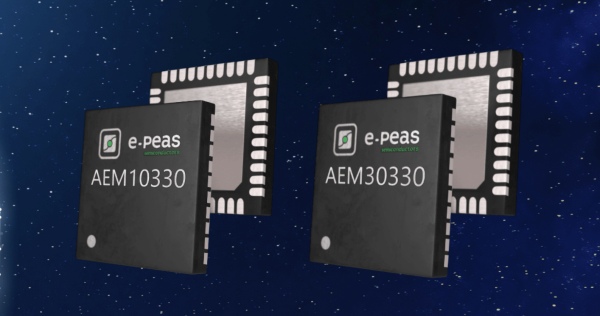
The new e-peas PMICs deliver a maximum current of 60mA, so storage elements (such as supercapacitors) can be charged rapidly. Their adaptive energy management capabilities permit them to automatically switch between boost, buck-boost, and buck operational configurations as deemed appropriate. This ensures that optimal energy transfer is always maintained between the respective inputs and outputs of these devices.
Another key aspect is the cold-start threshold at which an AEM30330/AEM10330-based system can begin to draw energy from the surrounding environment. This has been lowered to just 275mV/3µW, which is a substantial improvement on the previous generation of e-peas PMICs – and is unmatched by any other solution currently on the market.
Benefits
- Built around a buck-boost architecture which enables them to cover a greater range of input voltage levels [from 100mV right through to 4.5V], meaning that low and high power sources can be addressed
- Optimal energy transfer from the source to the storage element for all source/storage element voltages combinations
- Works with all battery types, even the ones with low voltages and uses all the energy stored in supercapacitors thanks to the lowest underdischarge storage element threshold on the market, 0.2V.
- Charges supercapacitors 3 times faster than any other PMIC available on the market thanks to a maximum current of 60mA
- Lowest cold-start voltage and power on the market: from 275 mV input voltage and 3 μW input power
- Input power from 3µW and 100mW
- Output current of 60mA @1.2/1.8/2.5 or 3.3V
- Programmable Maximum Power Point Tracking [MPPT] sensing period as fast as once every 20ms (fastest on the market)
- Offers a unique and patented constant impedance MPPT feature
- Easy to integrate in comparison to competitors, smallest BOM and footprint
- A working temperature range that spans from -40°C to 125°C
- Supplied in compact 40-pin QFN packages and require only 4 passive components to accompany them.
- What input voltage range do the AEM30330 and AEM10330 cover?
They cover from 100 mV up to 4.5 V input voltage. - Which device is intended for solar deployments?
The AEM10330 is specifically intended for solar deployments and can manage up to 7 connected photovoltaic cells. - What is the maximum output current of these PMICs?
They deliver a maximum output current of 60 mA. - How low is the cold-start threshold for these PMICs?
The cold-start threshold is from 275 mV input voltage and 3 µW input power. - Do these PMICs support MPPT?
Yes, they offer programmable MPPT with sensing periods as fast as once every 20 ms and a patented constant impedance MPPT feature. - Can these PMICs work with supercapacitors and batteries?
Yes, they work with supercapacitors and all battery types, including low-voltage batteries, and can fully use energy down to 0.2 V storage element threshold. - What operational modes do the PMICs use?
They automatically switch between boost, buck-boost, and buck modes for optimal energy transfer. - What temperature range do these PMICs support?
They operate from -40°C to 125°C. - How many passive components are required with the PMIC packages?
They require only 4 passive components alongside the PMIC.