
Summary of DFROBOT’S NEW 24GHZ MMWAVE RADAR SENSOR MODULE
DFRobot's new 24GHz mmWave radar sensor detects human presence—including static or sleeping people—using millimeter-wave radar technology. Operating in the 30–300GHz band, mmWave provides sub-millimeter accuracy, small antennas, and material penetration (e.g., plastic, drywall, clothing), while remaining resilient to weather (rain, fog, dust, snow). Radar systems emit microwave signals that reflect off objects to reveal location and motion, and can even sense breathing and heartbeat signatures for human-presence detection.
Parts used in theDFROBOT 24GHz mmWave Radar Sensor Project:
- DFRobot 24GHz mmWave radar sensor module
- Transmitter/receiver microwave antenna (integrated with module)
- Power supply for the radar module
- Mounting hardware or enclosure
- Signal processing or microcontroller unit for data interpretation
- Interface cabling (power and data)
Human presence detection is essential for safety, security, or other reasons. There are various software and hardware technologies and methods for detecting the presence of a human body in an area of interest (AOI). Among those techniques, Radar technology is one of the widely used techniques if the aim is to detect only the presence of a human.
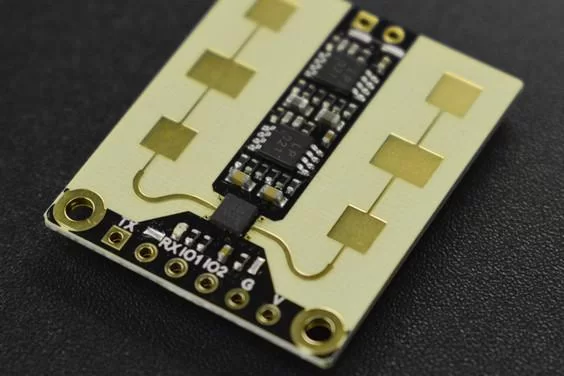
As we all know, radar is a system that uses radio waves for the detection of an object and to determine its distance, velocity, and angle. A radar system consists of a transmitter that transmits electromagnetic waves (generally microwave). The waves transmitted reflect off the object and return to the receiver, giving information about the object’s location and speed. The radar technology can also detect the unique signature of a human’s breathing pattern and heartbeat.
The mmWave (millimeter-wave) Radar sensors are very accurate. It is a contactless technology that operates in the spectrum between 30GHz and 300GHz. Due to the small wavelengths, it can provide sub-mm range accuracy and can penetrate certain materials such as plastic, drywall, clothing. Further, it is not affected by environmental conditions such as rain, fog, dust, and snow. Due to short wavelengths, this radar sensor provides high resolution, and the antenna required is relatively small.
DFRobot’s new 24GHz millimeter-wave radar sensor can sense human presence within the detection area. Moreover, it can even detect static or stationary humans, such as a sleeping person.
Read more: DFROBOT’S NEW 24GHZ MMWAVE RADAR SENSOR MODULE
- What does the DFRobot 24GHz mmWave radar sensor detect?
It detects human presence within the detection area, including static or stationary humans. - How accurate is mmWave radar technology?
mmWave provides sub-millimeter range accuracy due to its small wavelengths. - Can the radar detect breathing or heartbeat?
Yes, radar technology can detect the unique signature of a human’s breathing pattern and heartbeat. - What frequency range does mmWave operate in?
mmWave operates in the spectrum between 30GHz and 300GHz. - Can mmWave penetrate materials like clothing or drywall?
Yes, due to small wavelengths it can penetrate certain materials such as plastic, drywall, and clothing. - Is the radar affected by environmental conditions like rain or fog?
No, mmWave radar is not affected by environmental conditions such as rain, fog, dust, and snow. - Why are antennas relatively small for mmWave sensors?
Because of the short wavelengths, the required antenna size is relatively small. - What is the basic principle of a radar system?
A radar transmits electromagnetic waves that reflect off objects and return to the receiver, providing information about the object’s location and speed.