
Summary of Counterfeit Macbook charger teardown: convincing outside but dangerous inside
The article describes a teardown of a convincing counterfeit MacBook charger that externally mimics Apple’s charger but internally omits crucial safety features, notably the microcontroller that limits output until a laptop is detected, increasing short-circuit and damage risk.
Parts used in the Counterfeit Macbook charger teardown:
- Plastic charger housing with embossed Apple logo
- Serial number sticker
- Metal ground pin
- Magsafe output connector
- Internal power supply components (simplified power output circuitry)
- Output wiring to Magsafe connector
- AC input pins and connections
What’s inside a counterfeit Macbook charger? After my Macbook charger teardown, a reader sent me a charger he suspected was counterfeit. From the outside, this charger is almost a perfect match for an Apple charger, but disassembling the charger shows that it is very different on the inside. It has a much simpler design that lacks quality features of the genuine charger, and has major safety defects.
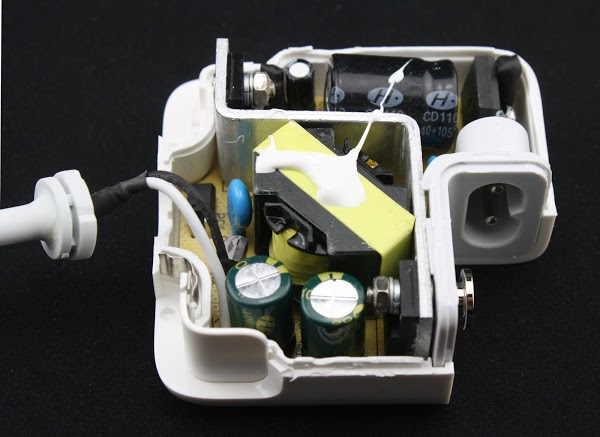
The counterfeit Apple chargers I’ve seen in the past have usually had external flaws that give them away, but this charger could have fooled me. The exterior text on this charger was correct, no “Designed by Abble” or “Designed by California”. It had a metal ground pin, which fakes often exclude. It had the embossed Apple logo on the case. The charger isn’t suspiciously lightweight. Since I’ve written about these errors in fake chargers before, I half wonder if the builders learned from my previous articles. One minor flaw is the serial number sticker (to the right of the ground pin) was a bit crooked and not stuck on well. A problem showed up when I plugged in the charger and measured the output at the Magsafe connector. I measured 14.75 volts output and got a spark when I shorted the pins. Since the charger is rated at 14.85 volts, this may seem normal, but the behavior of a real charger is different. A Magsafe charger initially produces a low-current output of 3 to 6 volts, so shorting the output should not produce a spark. Only when a microcontroller inside the charger detects that the charger is connected to a laptop does the charger switch to the full output power. (Details are in my Magsafe connector teardown article.) This is a safety feature of the real charger that reduces the risk from a short circuit across the pins. The counterfeit charger, on the other hand, omits the microcontroller circuit and simply outputs the full voltage at all times. This raises the risk of burning out your laptop if you plug the connector in crooked or metallic debris sticks to the magnet.
For more detail: Counterfeit Macbook charger teardown: convincing outside but dangerous inside
- How did the counterfeit charger compare externally to a genuine Apple charger?
It closely matched the genuine charger externally, including correct exterior text, embossed Apple logo, and a metal ground pin, with only a slightly crooked serial sticker as a minor flaw. - Does the counterfeit charger produce full voltage immediately?
Yes, the counterfeit outputs full voltage (measured 14.75 V) immediately and does not limit output until a laptop is detected. - How does a real Magsafe charger behave when not connected to a laptop?
A real Magsafe charger initially produces a low-current output of 3 to 6 volts and only switches to full power after a microcontroller detects a laptop connection. - Can shorting the counterfeit charger output cause a spark?
Yes, shorting the counterfeit charger output produced a spark, unlike a genuine charger which limits current before switching to full output. - What safety feature is missing in the counterfeit charger?
The counterfeit charger omits the microcontroller circuit that detects the laptop and limits output until a valid connection is detected. - Does the lack of the microcontroller increase risk to the laptop?
Yes, omitting the microcontroller increases the risk of burning out the laptop if the connector is plugged in crooked or if metallic debris contacts the pins. - Was the counterfeit charger suspiciously lightweight?
No, the charger was not suspiciously lightweight and could have fooled the author based on weight and appearance. - Did the author find the exterior text to be incorrect on this counterfeit?
No, the exterior text was correct and did not show common fake errors like Designed by Abble or Designed by California.
