Summary of COMPACT SYNTHUSB3 6.4GHZ MICROWAVE SIGNAL GENERATOR
The SynthUSB3 is a pocketable, low-cost RF signal generator and frequency sweeper tunable from 12.5 MHz to 6.4 GHz in 0.1 Hz steps, USB-powered and controllable from Windows, Linux, or Android. It features nonvolatile flash for standalone operation, a LabVIEW GUI, 0.1 dBm power step setting (−50 dBm to +8 dBm), onboard per-unit calibration, and a 2.5 ppm 10 MHz crystal for frequency accuracy. Compact and mobile, it suits communications design, ATE, EMC pre-compliance testing, and as a high-quality LO.
Parts used in the SynthUSB3 project:
- USB interface for power and control
- RF synthesizer tunable 12.5 MHz to 6.4 GHz
- Onboard nonvolatile flash memory
- LabVIEW GUI application (software)
- 2.5 ppm 10 MHz crystal oscillator
- Per-unit calibration look-up table stored in flash
- Power control circuitry with 0.1 dBm steps
- Compact enclosure (approx. 2 x 1 x 0.5 inches)
- USB-controllable sweep and modulation firmware
The SynthUSB3 is an innovative, low-cost, pocketable RF signal generator – software-tunable from 12.5MHz to 6.4GHz in 0.1 Hz steps
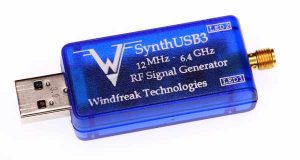
Saelig Company Inc. announces the Windfreak Technologies SynthUSB3 – a pocketable 12.5MHz to 6.4GHz software-tunable RF signal generator and frequency sweeper that can be controlled and powered by any device running Windows, Linux or Android via a USB port. The SynthUSB3 also has built-in nonvolatile flash memory so it can be programmed to operate by itself without requiring a PC connection for any frequency, power, sweep, or modulation setting. This provides a highly mobile, low power, light weight solution for a wide range of RF signal generation needs.
The provided user-friendly GUI application controlling the SynthUSB3, written in LabVIEW™, provides a desktop instrument experience and performance at a fraction the cost of a standalone instrument. Data entry on the PC can be performed either with a displayed touch pad or knob, or directly with the PC’s keyboard and arrow keys. Power levels can be set in 0.1dBm increments, with a maximum output of 8dBm and minimum of -50dBm. RF power setting resolution is non-linear with finer resolution at higher output powers. On-board calibration is attained through a look-up table unique to each SynthUSB3 device. Calibration over the whole range from 12.5MHz to 6.4GHz is performed at the factory and stored in the built-in flash memory. RF frequency accuracy relies on an onboard 2.5ppm 10MHz crystal oscillator.
Compact in size (2” X 1” X 0.5”) the SynthUSB3 will find application in wireless communications systems design, automated test equipment (ATE), radiated immunity pre-compliance EMC testing, etc. This device is a versatile generic RF signal generator for test setups, or as a high quality local oscillator in your RF / microwave communication system.
Read more: COMPACT SYNTHUSB3 6.4GHZ MICROWAVE SIGNAL GENERATOR
- What frequency range does the SynthUSB3 cover?
The SynthUSB3 is tunable from 12.5 MHz to 6.4 GHz. - Can the SynthUSB3 be powered by a USB port?
Yes, it can be controlled and powered by any device running Windows, Linux, or Android via a USB port. - Does the SynthUSB3 support standalone operation without a PC?
Yes, it has built-in nonvolatile flash memory so it can be programmed to operate by itself without a PC connection. - What is the output power range and resolution?
Power can be set from a maximum of 8 dBm to a minimum of -50 dBm with 0.1 dBm increments. - How accurate is the SynthUSB3 frequency reference?
Frequency accuracy relies on an onboard 2.5 ppm 10 MHz crystal oscillator. - How is calibration handled for each device?
Calibration over the whole range is performed at the factory and stored in a per-unit look-up table in the built-in flash memory. - What software controls the SynthUSB3?
The provided user-friendly GUI application is written in LabVIEW and provides desktop instrument controls. - What frequency step resolution is available?
The SynthUSB3 is software-tunable in 0.1 Hz steps. - What are typical applications for the SynthUSB3?
It is suitable for wireless communications systems design, automated test equipment, radiated immunity pre-compliance EMC testing, and as a local oscillator.