


Summary of CCS LM35 TEMPERATURE SENSOR EXAMPLE WITH PIC16F877 LCD
This article describes a CCS C project using the PIC16F877 microcontroller and LM35 temperature sensor. The system utilizes the PIC's 10-bit ADC to read voltage signals, converting them into temperature values where each degree Celsius equals 10mV. These calculated values are then displayed on a 2x16 LCD screen. The text also mentions Proteus ISIS simulation availability for this circuit.Parts used in the PIC16F877 and LM35 Temperature Sensor Application:
- PIC16F877 Microcontroller
- LM35 Temperature Sensor
- 2X16 LCD Display
- CCS C Compiler Software
- Proteus ISIS Simulation Environment
PIC16F877 and LM35 Temperature Sensor Application simple CCSC Example PIC16F877 10-bit ADC isbe used. Read the ADC result and the information is transferred to the 2X16 LCD temperature value is printed LM35 Digital... Electronics Projects, CCS LM35 Temperature Sensor Example with PIC16F877 LCD "ccs c examples, microchip projects, microcontroller projects, pic16f877 projects, "
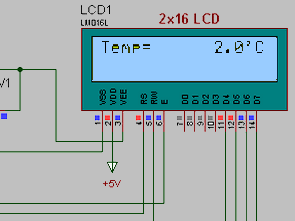
PIC16F877 and LM35 Temperature Sensor Application simple CCSC Example PIC16F877 10-bit ADC is be used. Read the ADC result and the information is transferred to the 2X16 LCD temperature value is printed LM35 Digital conversion of the signal undergoes the process of calculating the voltage in mV each 1 degree increase 10mv
PIC16F877 LM35 LCD TEMPERATURE CIRCUIT SCHEMATIC

PIC16F877 LCD CCS LM35 EXAMPLE TEST
Source: CCS LM35 TEMPERATURE SENSOR EXAMPLE WITH PIC16F877 LCD PIC16F877 LM35 example proteus isis simulation and CCS C source C code: ccs-lm35-temperature-sensor-example-with-pic16f877-lcd
Alternative File Download LINK list (in TXT format): LINKS-25270.zip
Quick Solutions to Questions related to PIC16F877 and LM35 Temperature Sensor Application:
- What microcontroller is used in this project?
The PIC16F877 microcontroller is used. - How does the ADC conversion work in this application?
The PIC16F877 uses its 10-bit ADC to read the signal, calculating that every 1 degree increase equals 10mV. - What type of display is used to show the temperature?
A 2X16 LCD is used to print the temperature value. - Can this project be simulated?
Yes, the project includes a Proteus ISIS simulation. - Which programming language or compiler is mentioned?
The example uses CCS C source code. - How is the voltage converted to temperature?
The digital conversion calculates the voltage in mV where each 1 degree increase corresponds to 10mV. - Where can the source code be found?
The source code is available via a download link named LINKS-25270.zip. - Does the article mention any specific hardware interface?
The article details the connection between the PIC16F877, LM35, and the LCD.
Related projects
PIC16F877 Driving LCD in 4-Bit Mode using PIC16F877 with Proteus Simulation
Introduction This microcontroller project shows how a PIC16F877 can drive an LCD display using 4-bit mode inside a Proteus simulation.The project demonstrates...
Programmers & ICSP · PIC16F877AEPE PIC/LCD Demo using PIC16F877 with Proteus Simulation
IntroductionThe EPE PIC/LCD Demo is a classic microcontroller project that demonstrates how a PIC16F877 can fully control a PG12864F graphical LCD.Designed as...
Motors & Robotics · PIC16F877AEfficient Sun-Following Robot: A Solar Tracker with Microcontroller Control
Abstract The impending global challenge of dwindling non-renewable fuel resources underscores the urgency of transitioning towards renewable energy alternatives like solar power....
Sensors & TemperatureSpectrum Analyzer using TMS320F28023DA with Proteus Simulation
Introduction This project demonstrates a real-time audio spectrum analyzer using the TMS320F28023DA Piccolo microcontroller, simulated in Proteus VSM. The system captures an...
Sensors & TemperatureDHT22 Low Cost Humidity Sensor using PIC18F25K20 with Proteus Simulation
IntroductionThis microcontroller project demonstrates how to interface a DHT22 (RHT03) digital temperature and humidity sensor with a PIC18F25K20 using Proteus simulation.The project...
Sensors & TemperatureCrafting a Microcontroller-Based Temperature Monitoring System
Abstract As technological advancements progress, processes become increasingly intricate, demanding a corresponding expansion in the parameters necessary for efficient analysis. Data acquisition,...

Ibrar Ayyub
I am an experienced technical writer holding a Master's degree in computer science from BZU Multan, Pakistan University. With a background spanning various industries, particularly in home automation and engineering, I have honed my skills in crafting clear and concise content. Proficient in leveraging infographics and diagrams, I strive to simplify complex concepts for readers. My strength lies in thorough...