
Summary of ANALOG DEVICES’ TINY MODULE BOOST REGULATOR FOR LOW VOLTAGE OPTICAL SYSTEMS
### Article Summary Analog Devices introduced the LTM4661, a compact step-up µModule regulator in a 6.25mm BGA package. This low-power device integrates controllers, MOSFETs, and inductors, requiring minimal external components like capacitors and a resistor. It supports input voltages from 1.8V to 5.5V (down to 0.7V post-startup) and outputs between 2.5V and 15V. Capable of delivering up to 4A at 5V output with 92% efficiency, it features three operation modes for optimized battery life or noise reduction, making it ideal for optical modules, battery systems, and small motors.
Parts used in the LTM4661 Project:
- LTM4661 µModule regulator
- Capacitors
- Resistor
- Switching DC/DC controller
- MOSFETs
- Inductors
- External clock source
Analog Devices, Inc. has announced the Power by Linear LTM4661, a low power step-up µModule regulator in a 6.25mm x 6.25mm x 2.42mm BGA package. Only a few capacitors and one resistor are required to complete the design, and the solution occupies less than 1cm²single-sided or 0.5cm²on double-sided PCBs. The LTM4661 incorporates a switching DC/DC controller, MOSFETs, inductors and supporting components. The LTM4661 operates from a 1.8V to 5.5V input supply, and continues to operate down to 0.7V after start-up. The output voltage can be set by a single resistor ranging from 2.5V to 15V. The combination of the small, thin package and wide input and output voltage range is ideal for a wide range of applications including optical modules, battery-powered equipment, battery-based backup systems, bias voltage for power amps or laser diodes and small DC motors.
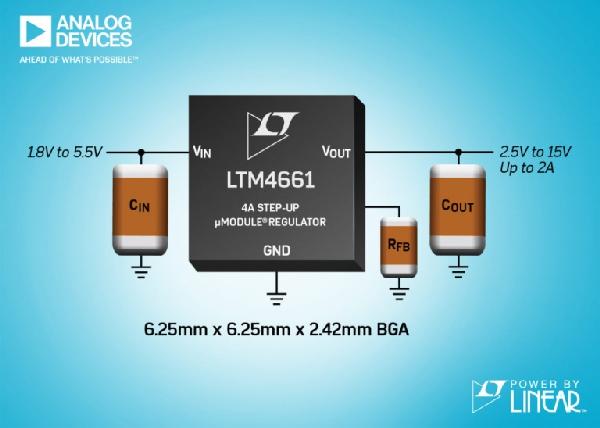
The LTM4661 can deliver 4A continuously under 3.3VINto 5VOUT, and 0.7A continuously under 3.3VINto 12VOUT. The LTM4661 employs synchronous rectification, which delivers as high as 92 per cent conversion efficiency (3.3VIN to 5VOUT). The switching frequency is 1MHz, and can also be synchronised to an external clock ranging from 500kHz to 1.5MHz. The LTM4661 1MHz switching frequency and dual phase single output architecture enable fast transient response to line and load changes and a significant reduction of output ripple voltage. The LTM4661 has three operation modes: Burst Mode operation, forced continuous mode and external sync mode. The quiescent current in Burst Mode operation is only 25µA, which provides extended battery run time. For applications demanding the lowest possible noise operation, the forced continuous mode or external sync mode minimise possible interference of switching noise.
Read More: ANALOG DEVICES’ TINY ΜMODULE BOOST REGULATOR FOR LOW VOLTAGE OPTICAL SYSTEMS
- What is the package size of the LTM4661?
The LTM4661 comes in a 6.25mm x 6.25mm x 2.42mm BGA package. - How many external components are required to complete the design?
Only a few capacitors and one resistor are required to complete the design. - Can the switching frequency be synchronized to an external clock?
Yes, the switching frequency can be synchronized to an external clock ranging from 500kHz to 1.5MHz. - What is the quiescent current in Burst Mode operation?
The quiescent current in Burst Mode operation is only 25µA. - Which operation mode minimizes switching noise interference?
The forced continuous mode or external sync mode minimize possible interference of switching noise. - What is the maximum conversion efficiency achieved by the LTM4661?
The LTM4661 delivers as high as 92 per cent conversion efficiency when operating from 3.3VIN to 5VOUT. - Does the LTM4661 support dual phase single output architecture?
Yes, the LTM4661 utilizes a dual phase single output architecture to enable fast transient response. - What applications is this regulator ideal for?
It is ideal for optical modules, battery-powered equipment, battery-based backup systems, bias voltage for power amps or laser diodes, and small DC motors.

