
Summary of AN245 – MCP23016 Interfacing using PIC16F877A with Proteus Simulation
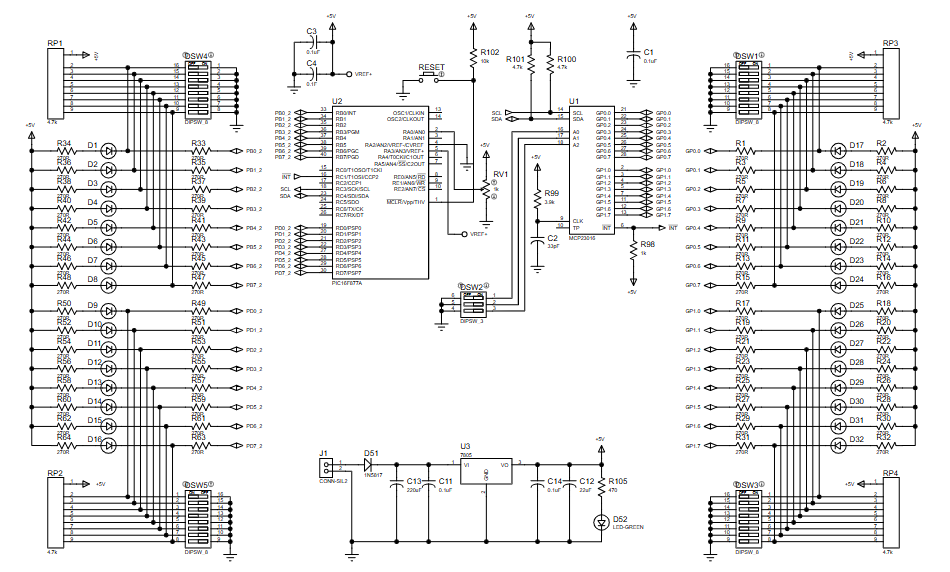
This project demonstrates interfacing the Microchip MCP23016 16-bit I/O expander with a PIC16F877A over hardware I²C, using Proteus VSM for simulation. It implements LED chaser output, interrupt-driven input monitoring via CCP2, bidirectional GPIO mirroring, and modular XC8/HI-TEC firmware (I²C driver, read/write routines, ISR), illustrating practical I/O expansion, interrupt handling, and firmware–hardware integration.
Parts used in the MCP23016 PIC16F877A Interfacing Project:
- PIC16F877A microcontroller
- MCP23016 16-bit I/O expander
- LEDs (16 channels)
- Push switches (16 channels)
- Pull-up resistors
- Crystal oscillator
- Power supply circuitry
- Proteus VSM simulation environment
- Why use MCP23016 instead of direct GPIO?
It expands I/O capability without changing the microcontroller. - Can this work with other PIC16 devices?
Yes, any PIC with hardware I²C support can be adapted. - Why are outputs inverted in the code?
The test board uses active-low LED configuration. - Does this work in Proteus without hardware changes?
Yes, the project is fully compatible with Proteus simulation. - Can inputs and outputs be mixed on MCP23016?
Yes, via the I/O direction registers. - What triggers the interrupt?
Input state changes on MCP23016 monitored through CCP2. - Can XC8 replace HI-TEC compiler?
Yes, with minor syntax adjustments. - Is polling possible instead of interrupts?
Yes, but interrupts are more efficient.