


Summary of An LED Dice using a PIC 16F84 (or 16F88)
This project describes a compact LED dice implemented with a single PIC 16F84 (or 16F88) microcontroller that can drive two dice displays, reduce hardware complexity, and add features like recalling the last roll. It replaces multi-IC and transistor designs with firmware-driven outputs, lowering component count and power use while enabling flexible behavior through software.Parts used in the LED Dice:
- PIC16F84 microcontroller (or PIC16F88)
- LEDs for dice displays (6 per die or arranged as desired)
- Current-limiting resistors for LEDs
- Pushbutton(s) for roll and recall functions
- Battery or power supply
- PCB or prototyping board
- Optional capacitors for power decoupling
- Optional transistors or driver components if required by LED count
An LED Dice using a PIC 16F84 (or 16F88)
This is a re-print of a project that I made a number of years ago - I was trawling the web, and discovered that others had been making it, so I decided to put the detail here on instructables.com - so that others can benefit.
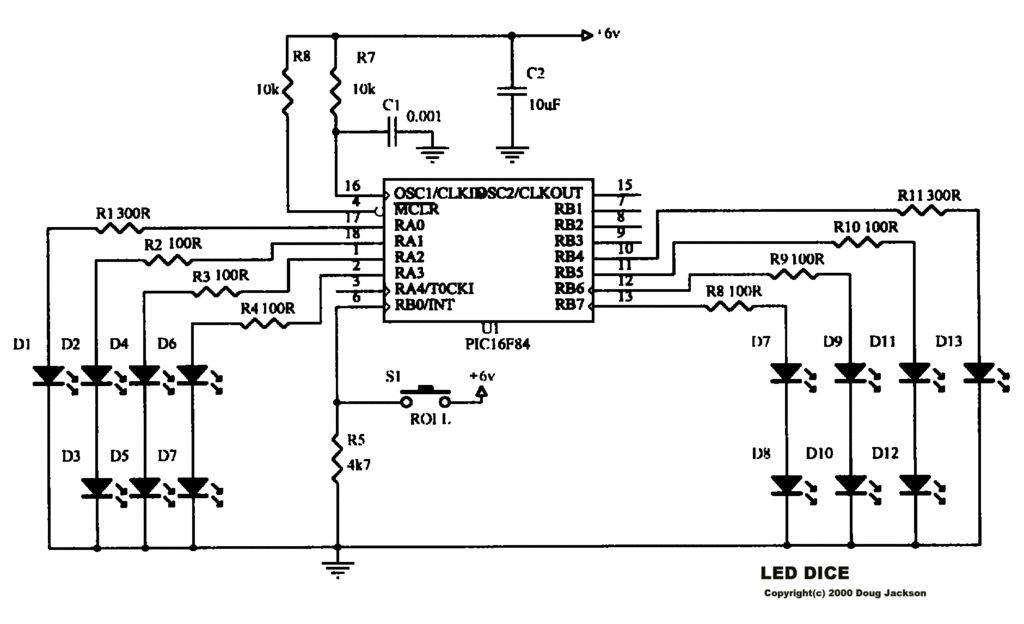
Many Led Dice have been published in various forms over the years, using output methods including a 7 segment display to display the numbers 1 through 6, or having 6 individual LEDs or even having a Die shaped display.
All of these designs have been fairly complex in hardware, typically having at least 2 IC’s, 4 or so transistors, and many resistors and capacitors. Most have also been fairly current hungry, discharging a set of batteries in a short period if the device has been left on.
Using a single chip microprocessor allows us to implement 2 individual dice, using a single IC. In addition to this, we turn a hardware problem into a software problem. We can also add features that have previously not existed before, such as the ability to recall the last roll.
For more detail: An LED Dice using a PIC 16F84 (or 16F88)
- What microcontroller is used in this LED dice project?
The project uses a PIC16F84 or alternatively a PIC16F88 microcontroller. - Can this design drive two dice with a single IC?
Yes, using a single chip microprocessor allows implementing two individual dice with one IC. - Does this design reduce hardware complexity compared to traditional designs?
Yes, it replaces multi-IC and multiple-transistor designs with a single microcontroller, reducing component count. - Can the device recall the last roll?
Yes, the design adds the ability to recall the last roll via software. - Is the approach more power efficient than older designs?
The microcontroller approach lowers hardware and can reduce current consumption compared to more complex hardware designs. - Are additional features implemented in software?
Yes, turning hardware problems into software problems enables adding features not present in earlier designs. - Does the project require many resistors and capacitors?
Fewer passive components are needed overall, though current-limiting resistors for LEDs and optional decoupling capacitors are used. - Is a PCB or prototyping board needed?
Yes, a PCB or prototyping board is typically used to mount the microcontroller, LEDs, and other components.
Related projects
PIC Stepper Motor Controller using PIC16F84A with Proteus Simulation
Introduction Stepper motors are widely used in embedded systems and DIY electronics projects where precise position control is required. This PIC Stepper...
Programmers & ICSP · PIC16F84APIC Musical Doorbell using PIC16F84A with Proteus Simulation
IntroductionThis microcontroller project demonstrates a musical doorbell built around a PIC16F84A and a simple piezo sounder.Using two push buttons, the system allows...
Beginner Tutorials · PIC16C84Exploring the World of PIC Microcontrollers: An Architectural Overview
A Peripheral Interface Microcontroller (PIC), developed by General Instruments Microcontrollers in 1993, operates under software control and is programmed to execute various...
LED ProjectsAn Application-Driven Microcontroller Curriculum
Understanding how to apply microcontrollers lies at the core of modern embedded systems education. This student project takes an experiential approach to...
LED ProjectsBuild this microcontroller controlled rainbow flying disc – and then throw it!
Hello all and welcome to this super simple and inexpensive instructable. If you like throwing frisbees AND you like flashing lights AND...
LED ProjectsLED Scrolling Display Project Working With Circuit Diagram
We normally use a simple static LED display screen to convey a message. Earlier, when we want to display large data, we...

Ibrar Ayyub
I am an experienced technical writer holding a Master's degree in computer science from BZU Multan, Pakistan University. With a background spanning various industries, particularly in home automation and engineering, I have honed my skills in crafting clear and concise content. Proficient in leveraging infographics and diagrams, I strive to simplify complex concepts for readers. My strength lies in thorough...