
Summary of An Android Reflow controller that anyone can build
This article details an updated PID-based reflow controller designed for easier construction and improved functionality. Unlike the previous all-surface-mount version, this iteration uses through-hole components to simplify assembly. It replaces the bulky graphical LCD with a Bluetooth-enabled Android app interface and upgrades the power control from a solid-state relay to a triac driven by zero-crossing detection for smoother dimming of halogen ovens. The design supports 220-240VAC mains supply, with estimated values provided for 120VAC regions.
Parts used in the Android Reflow Controller:
- PID-based controller
- Through-hole components
- Mains supply (220-240VAC)
- Bluetooth module
- Android application
- Triac
- Zero-crossing detection circuit
- Halogen oven
The story so far
Welcome to the never ending saga of Andy and his reflow controllers. About a year ago I published a project writeup showing how I built a PID-based reflow controller. It featured a 640×360 graphical LCD from the Sony U5 Vivaz mobile phone and was all-surface mount. It worked well and continues to serve me well to this day but I always thought that there were improvements that I could make in several areas.
Firstly, there’s no reason why it should have been all surface-mount. The LCD in particular has a 0.4mm connector that many people will find very hard to solder by hand. After all, presumably you’re building a reflow controller to help solve that very problem. Chicken and egg.
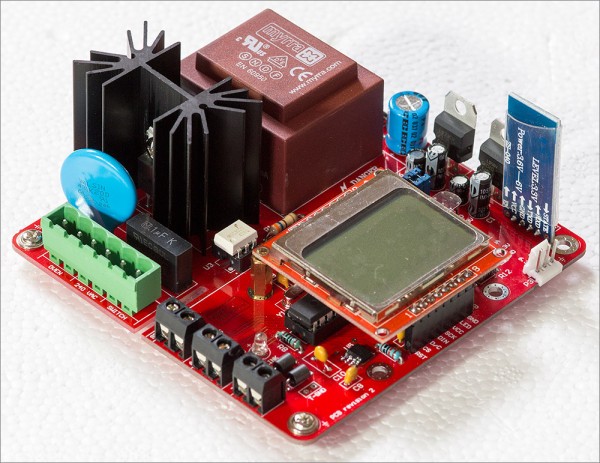
Secondly, the built-in LCD is overkill. We live in the age of the so called landfill android device where you can buy a powerful tablet computer for just £30 online. Why not harness that power and use bluetooth to transmit a control protocol back and forth to a simple on-board controller?
Finally, I used an SSR to pulse the oven power supply on and off. That always irked me. A fully integrated controller would be supplied by the mains and use zero-crossing detection to drive a triac that would dim the halogen oven instead of just switching it on and off.
A few months ago I set to work solving all these issues and I’m happy to say that they’ve all been addressed. In the remainder of this article I’ll present a reflow controller that’s almost entirely through-hole so anyone can build it. It’ll be driven direct from the mains supply and will feature bluetooth control via an Android app.
The schematic
Let’s get straight into the schematic. This is a modular design so I’ll pick on each part individually and explain what’s going on. Here’s the full document
This design is for countries with a 220-240VAC supply. I have estimated some of the values that I consider to be appropriate for countries with a 120VAC supply and they are shown in red on the schematic but I haven’t tested these and would appreciate any corrections from people in those countries.
For more detail: An Android Reflow controller that anyone can build
- Why was the new controller designed with through-hole components?
To make it easier for anyone to build since soldering surface-mount connectors like the old 0.4mm LCD is difficult by hand. - How does the new controller communicate with the user?
It uses Bluetooth to transmit a control protocol back and forth to a simple on-board controller and an Android app. - What replaced the built-in LCD from the previous project?
The built-in LCD was replaced by harnessing the power of a cheap tablet computer via Bluetooth. - Does the new design use a solid-state relay to switch power?
No, it uses a fully integrated controller supplied by the mains that drives a triac instead of switching power on and off with an SSR. - How does the controller manage the halogen oven power?
It uses zero-crossing detection to drive a triac that dims the halogen oven rather than just pulsing it on and off. - What voltage supply is this design intended for?
This design is for countries with a 220-240VAC supply, though estimated values are shown for 120VAC regions. - Can I build this controller if I live in a 120VAC country?
Estimated values are provided in red on the schematic for 120VAC countries, but these have not been tested by the author. - What type of oven does this controller work with?
The controller is designed to drive and dim a halogen oven.