Summary of AMPERE DEBUTS 80-CORE ARM SERVER PROCESSOR
Ampere Computing introduced Altra, a 64-bit ARM-based server processor with 80 cores using 7nm technology. Built on the Neoverse N1 license, it features single-threaded cores for security and efficiency, supporting up to 210W power consumption. The chip offers high scalability for cloud workloads like AI, databases, and web hosting, serving as a host node alongside specialized accelerators.
Parts used in the Altra Project:
- 80-core processor
- Neoverse N1 license architecture
- ARMv8.2 instruction set architecture
- Four-instruction wide superscalar out-of-order cores
- Single-threaded cores
- 64kbyte level-one instruction cache per core
- 64kbyte level-one data cache per core
- 1Mbyte level 2 data cache per core
- 32Mbyte system-level cache
- 8 72bit-wide DDR4 interfaces
- 128 lanes of PCIe Gen4
- TSMC 7nm manufacturing process technology
Ampere Computing LLC has announced a 64-bit ARM-based processor for servers comprising 80 cores and targeting 7nm manufacturing process technology. By Peter Clarke @ eenewseurope.com
Altra is a follow-up to the 32-core Skylark processor, otherwise known as eMAG, which has been manufactured in TSMC’s 16nm FinFET process. Even as that product came to market in 2018 the company was advising of a 7nm processor to follow (see Startup Ampere prices ARM server chips ).
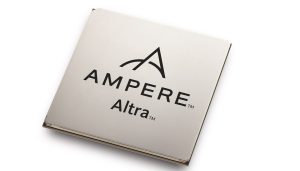
Altra is an 80-core processor based on Neoverse N1 license, designed for predictable high performance, security isolation, scalability and leading power efficiency. It comes in single socket and dual socket versions, which are sampling to customers.
The device is scalable up to 80 cores per chip with a power consumption footprint of up to 210W. The cores are specificed up to 3.0GHz clock frequency. The core is a four-instruction wide superscalar out-of-order processor based on the ARMv8.2 instruction set architecture. Each core is single-threaded to provide reduced performance variability and increased security against system-level side-channel attacks.
There are 64kbyte level-one instruction and data caches per core and 1Mbyte level 2 data caches per core. There is also a processor-wide 32Mbyte system-level cache.
There are 8 72bit-wide DDR4 interfaces per chip and 128 lanes of PCIe Gen4 for highest IO bandwidth.
Altra is Ampere’s cloud-focused product, and first in a new class of CPUs rolling out on an annual basis from Ampere’s roadmap. The increased performance and power efficiency will make Altra suitable for many workloads including data analytics, artificial intelligence, database, storage, telco stacks, edge computing, web hosting and cloud native applications.
Jeff Wittich, senior vice president of products at Ampere, said that for some intensive training loads arrays of GPUs or some more specialized tensor processors or neural network accelerators could possibly provide superior power efficiency. “Training on TPU, IPU or GPU can make sense, but inference we can do. In other circumstances we will be the host node for an accelerator,” he told eeNews Europe .
Read more: AMPERE DEBUTS 80-CORE ARM SERVER PROCESSOR
-
What is the core count of the new Ampere Altra processor?
The Altra processor comprises 80 cores. -
Which manufacturing process technology does the Altra chip use?
It targets the 7nm manufacturing process technology. -
Does the Altra processor support dual socket configurations?
Yes, it comes in single socket and dual socket versions. -
What is the maximum power consumption footprint of the device?
The power consumption footprint is up to 210W. -
How many DDR4 interfaces are included per chip?
There are 8 72bit-wide DDR4 interfaces per chip. -
Can the Altra processor handle AI inference tasks?
Yes, the company states that inference can be done by the Altra processor. -
What type of caching is provided at the system level?
There is a processor-wide 32Mbyte system-level cache. -
Why are the cores designed to be single-threaded?
They are single-threaded to provide reduced performance variability and increased security against system-level side-channel attacks.