
Summary of 8049 Spy using pic microcontroller
This article describes building an "8049 Spy" to read internal ROM contents of 8048/8049 processors without a dedicated programmer. It serves as an I/O expansion for the 6802 Nano Computer or any microcontroller with sufficient I/O lines. The device reads up to 4 KB of data via a serial link at 9600 baud, outputting Intel Hex files.
Parts used in the 8049 Spy:
- 8048 processor
- 8049 processor
- Voltage regulator (7805)
- Inverter circuit
- Crystal oscillator
- 12V regulated power supply
- PC with serial link capability
- 6802 Nano Computer (optional host)
What do you do when you have to read the internal ROM contents of a 8048 or 8049 processor and you don’t own a programmer for those devices? You simply build this 8049 spy of course!
That is exactly what I did when I wanted to know how my Philips Frequency Counter PM 6668 worked. With this knowledge I was able to add some interesting features to that beautiful counter. You can find a description of the SB-6668 project elsewhere on this site.
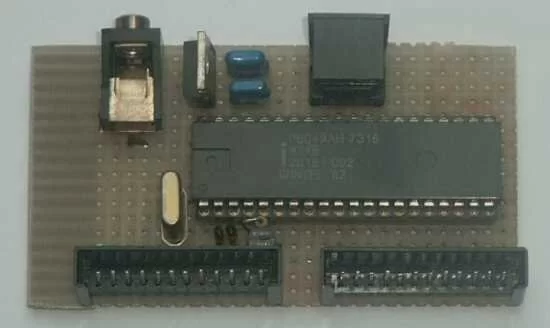 This 8049 Spy is not a stand alone project. It is designed as an I/O expansion to my 6802 Nano Computer. So if you’re interested in this 8049 Spy, you should start building the 6802 Nano Computer first. Basically you could connect this device to any micro controller with enough I/O, but then you’ll have to write the reading routine yourself, which is not particularly difficult though.
As an alternative you can connect the 8049 Spy to just about any other micro controller that has about 12 I/O lines free (or 11 and one serial output). But then you’ll have to write the program that reads the ROM contents yourself, something that is not that difficult really.
Operation of the 8049 Spy is not difficult. Simply insert the 8048 or 8049 processor you want to read, apply the 12V power supply and the contents of the ROM will be transferred through the serial link to your PC. The file is transferred in Intel Hex format, and the communication is set to 9600 baud, 8 data bits, no parity, 1 stop bit.
A total of 4 kb is transferred this way. Originally the 8048 only has 1 kb of ROM, and the 8049 contains 2 kb of ROM. But since the addressing mechanism of the 8048 family was designed to accommodate a maximum of 4 kb, I decided to read the entire 4 kb address space. You can simply ignore or delete the part of the file that you’re not interested in.
Circuit Description
As you can see in this diagram you don’t need too much hardware to read the ROM contents of an 8049. The main part in the diagram is the 8049 (or 8048) that you want to read. Apart from that you only need a voltage regulator, an inverter circuit and a crystal oscillator.
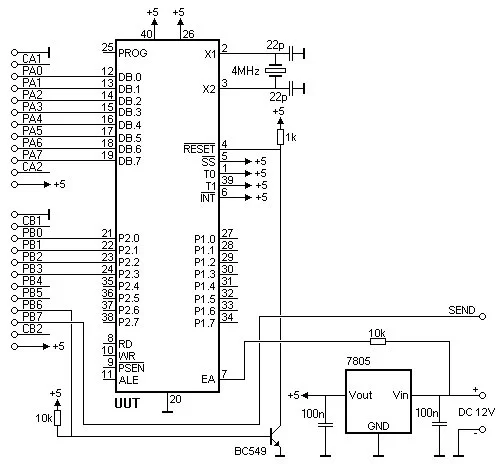 The voltage regulator is needed here, because you also need a 12V supply to connect to the EA line of the 8049, which places it in programming mode.
Warning: This 12V must be a regulated 12V, and not a roughly rectified 12V originating from a cheap mains adapter!
The 5V output of the 7805 is used to supply the 8049 under test and the 6802 Nano Computer.
For more detail: 8049 Spy
- What is the purpose of the 8049 Spy?
To read the internal ROM contents of 8048 or 8049 processors without owning a specific programmer. - How does the device transfer data to the PC?
The ROM contents are transferred through a serial link in Intel Hex format. - What are the communication settings used by the 8049 Spy?
The communication uses 9600 baud, 8 data bits, no parity, and 1 stop bit. - Can this project be used with microcontrollers other than the 6802 Nano Computer?
Yes, it can connect to any microcontroller with about 12 free I/O lines or 11 I/O lines plus one serial output. - Why is a regulated 12V supply required?
A regulated 12V supply is needed for the EA line to place the 8049 in programming mode; unregulated voltage is not suitable. - What is the maximum amount of memory that can be read?
The device reads the entire 4 kb address space, even though original chips may only contain 1 kb or 2 kb. - Is writing a reading routine difficult if using a different microcontroller?
No, writing the program to read the ROM contents yourself is described as not particularly difficult. - What happens to the extra memory data beyond the chip's capacity?
You can simply ignore or delete the part of the file that you are not interested in.