PIC12CE518 I2C EEPROM using PIC12CE518 with Proteus Simulation

Summary of PIC12CE518 I2C EEPROM using PIC12CE518 with Proteus Simulation


This article details a PIC12CE518 microcontroller project demonstrating internal I2C EEPROM read/write operations. The system writes the value 0x85 to memory, reads it back, and displays the data on 7-segment screens via a shift register using serial GPIO transmission. Simulated in Proteus, the project serves as an educational tool for understanding embedded memory management, firmware handling, and real-time data visualization in compact microcontrollers.

Parts used in the PIC12CE518 I2C EEPROM Project:

  • PIC12CE518 Microcontroller
  • 74199 Shift Register
  • 7-Segment Displays (2 units)
  • GPIO-based input trigger
  • Power supply
  • Proteus VSM simulation environment

Introduction

This microcontroller project demonstrates how to write and read data using the internal I2C EEPROM of the PIC12CE518 and visualize the result through digital outputs. Designed and tested in Proteus simulation, the project highlights practical EEPROM interfacing—an essential concept in embedded systems and DIY electronics.

The system writes a value (0x85) into EEPROM memory, reads it back, and transmits the result serially for display. This makes it a great learning example for understanding data storage, I2C communication, and firmware handling in compact PIC microcontrollers.

This PIC12CE518 EEPROM Proteus Simulation also helps reinforce how EEPROM operations work in real embedded system applications.

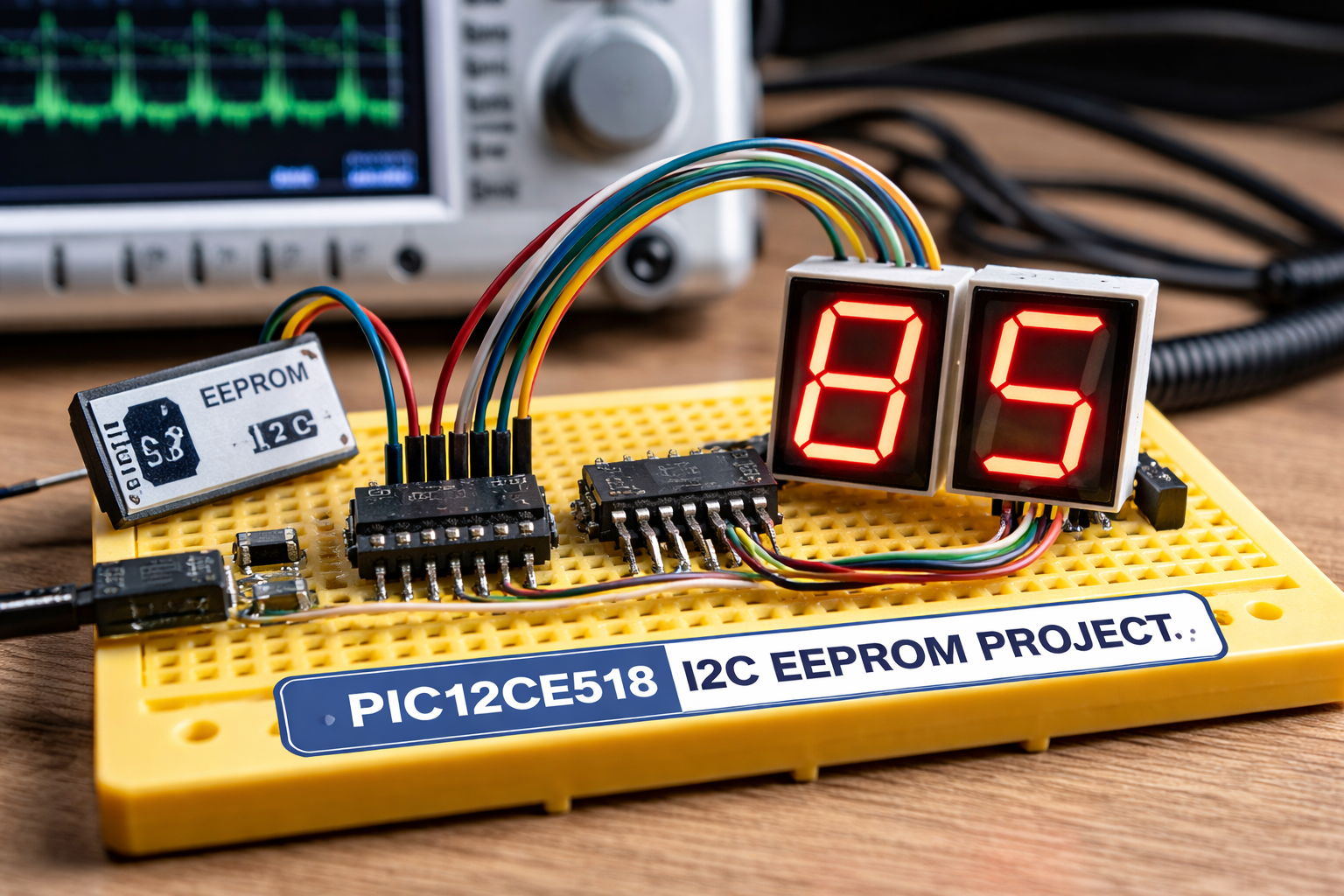
PIC12CE518 EEPROM project with seven-segment display
Illustrative View of the Concept.

How the Project Works (Overview)

The project revolves around the internal EEPROM module of the PIC12CE518. The firmware performs a continuous loop of operations:

  1. Initializes GPIO pins for communication

  2. Writes a fixed byte (0x85) into EEPROM

  3. Reads the stored value back

  4. Sends the value serially via GPIO pins

  5. Waits for input signal transitions to repeat the process

The EEPROM operations use built-in routines (WRITE_BYTE, READ_CURRENT) from Microchip’s EEPROM driver.

Workflow Explanation

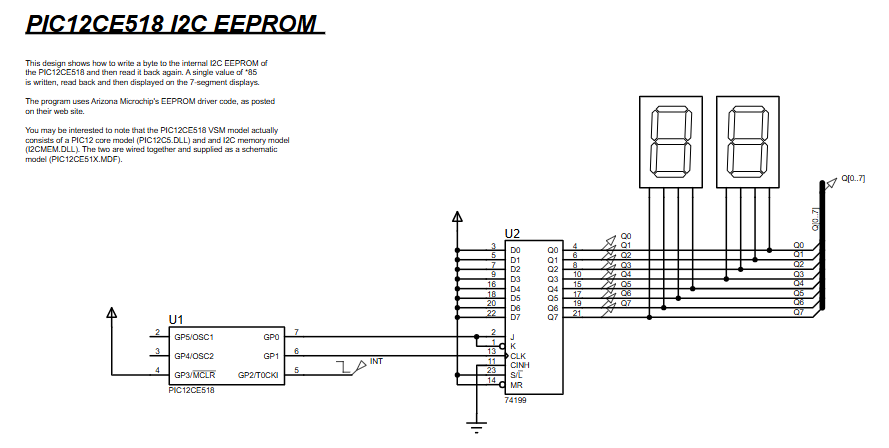
Based on the schematic and code logic, the workflow is:

  1. PIC12CE518 Controller

    • Controls EEPROM operations

    • Manages GPIO communication

  2. Internal EEPROM

    • Stores the byte value (0x85)

    • Address pointer increments each cycle

  3. Shift Register (74199)

    • Receives serial data from PIC

    • Converts it into parallel output

  4. 7-Segment Displays

    • Display the stored EEPROM value

  5. Input Trigger (GPIO Pin)

    • Controls timing for read/write cycles

Workflow Steps:

  • Write → Wait → Read → Output → Increment Address → Repeat

Key Features

  • Internal I2C EEPROM read/write implementation

  • Serial data transmission via GPIO (bit-banging)

  • Integration with shift register (74199) for display control

  • Continuous memory cycling with auto-increment address

  • Real-time visualization using 7-segment displays

  • Fully testable in Proteus simulation environment

Components Used

  • PIC12CE518 Microcontroller

  • 74199 Shift Register

  • 7-Segment Displays (2 units)

  • GPIO-based input trigger

  • Power supply

  • Proteus VSM simulation environment

Applications

This type of embedded systems project has real-world relevance in:

  • Data logging systems

  • EEPROM-based configuration storage

  • Calibration memory in devices

  • Industrial embedded controllers

  • Sensor data buffering systems

  • Educational microcontroller labs

Explanation of Code

The firmware is written in MPASM (Assembly) and focuses on EEPROM control and serial output.

Key Functional Blocks:

  • GPIO Configuration

    • Sets direction for communication and control pins

  • EEPROM Write Operation

    • Loads address into EEADDR

    • Writes data (0x85) into EEDATA

    • Calls WRITE_BYTE

  • EEPROM Read Operation

    • Uses READ_CURRENT routine

    • Retrieves stored data

  • Serial Output Routine (serout)

    • Bit-by-bit transmission via GPIO

    • Uses clock pulses for synchronization

  • Loop Control

    • Waits for input pin changes

    • Increments EEPROM address

Source Code

	TITLE "PIC with Flash EE data memory Interface"
;
;       Program:          FL51XINC.ASM  V1.10
;       Revision Date:   
;                         09-09-97      Adapted to 12C51x parts
;			  01-Apr-1999	Added emulation hooks
;

; #define EMULATED    ; comment this line out for use on real part

; PIC12C51X EEPROM communication code.  This code should be included in
; with the application.  These routines provide the following functionality:
; write a byte to a specified address.
; read a byte from a specified address.
; read a byte from the next address.

Proteus Simulation

In the Proteus simulation, the circuit demonstrates:

  • EEPROM write and read operations in real-time

  • Serial data shifting through the 74199 register

  • Output displayed on dual 7-segment displays

  • GPIO pin acting as a trigger for operation cycles

The simulation visually confirms correct EEPROM behavior, making it ideal for debugging and learning before hardware implementation.

Conclusion

This project is a compact yet powerful demonstration of EEPROM handling in embedded systems. Using Proteus simulation, it provides a safe and visual way to understand memory operations, serial communication, and display interfacing.

Whether you’re learning microcontroller programming or building real-world DIY electronics, this project builds a solid foundation in firmware-driven data storage.

This PIC12CE518 EEPROM Proteus Simulation project is a great foundation for learning EEPROM-based embedded systems.

Quick Solutions to Questions related to PIC12CE518 I2C EEPROM Project:

  • What value is written into the EEPROM memory?
    The system writes the fixed byte value 0x85 into the EEPROM memory.
  • How is the stored data displayed to the user?
    The stored value is transmitted serially via GPIO pins to a 74199 shift register, which drives dual 7-segment displays.
  • Can this project be tested without physical hardware?
    Yes, the entire circuit was designed and tested within the Proteus VSM simulation environment.
  • What programming language is used for the firmware?
    The firmware is written in MPASM Assembly code.
  • Does the project use external EEPROM chips?
    No, the project utilizes the internal I2C EEPROM module of the PIC12CE518 microcontroller.
  • How does the system manage memory address increments?
    The firmware automatically increments the address pointer after each read/write cycle to enable continuous memory cycling.
  • What triggers the read and write cycles?
    A specific GPIO pin acts as an input trigger that controls the timing for repeating the operation process.
  • Are there real-world applications for this type of project?
    Yes, this architecture applies to data logging, configuration storage, calibration memory, and sensor data buffering systems.


About The Author

Ibrar Ayyub

I am an experienced technical writer holding a Master's degree in computer science from BZU Multan, Pakistan University. With a background spanning various industries, particularly in home automation and engineering, I have honed my skills in crafting clear and concise content. Proficient in leveraging infographics and diagrams, I strive to simplify complex concepts for readers. My strength lies in thorough research and presenting information in a structured and logical format.

Follow Us:
LinkedinTwitter