
Summary of PIC and Serial LCD Displays using PIC16F877 with Proteus Simulation
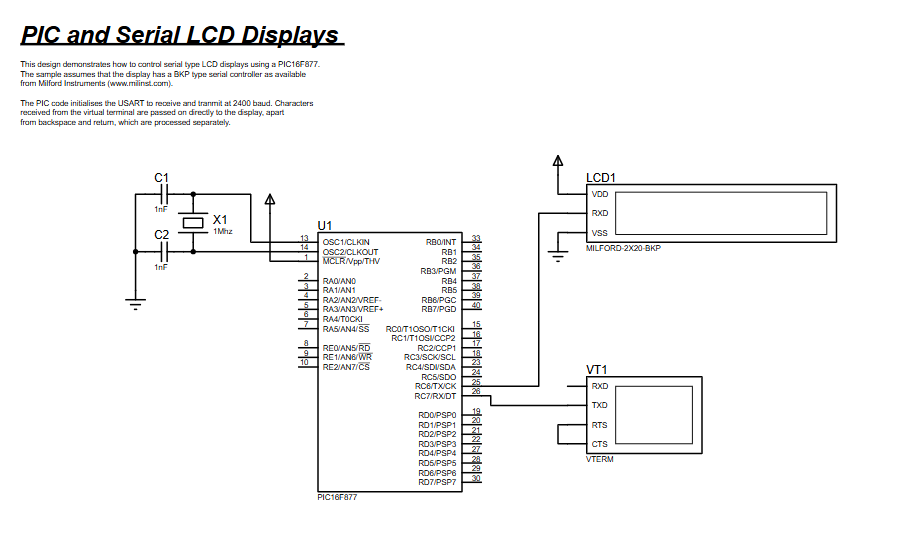
This project shows a PIC16F877 microcontroller driving a Milford serial alphanumeric LCD via its USART at 2400 baud (1 MHz clock). Characters from a serial terminal are forwarded to the LCD; control characters (carriage return, backspace) are handled as commands. Built and tested in Proteus VSM with MPASM firmware, it demonstrates low-pin-count serial LCD interfacing, real-time echoing, and basic command handling for beginners.
Parts used in the PIC16F877 Serial LCD Demo:
- PIC16F877 microcontroller
- Milford Serial Alphanumeric LCD (BPK-type controller)
- Virtual Terminal (Proteus)
- 1 MHz Crystal Oscillator
- Capacitors (timing and stability)

- How does the PIC communicate with the serial LCD?
The PIC uses its internal USART to transmit bytes over the TX pin at 2400 baud to the serial LCD. - Can special characters be handled?
Yes; special characters like carriage return and backspace are detected and processed as LCD commands. - Why is the baud rate set to 2400?
The LCD controller expects 2400 baud when the PIC runs with a 1 MHz clock for reliable communication. - Does this require many I/O pins like a parallel LCD?
No; the serial LCD controller reduces I/O usage because the PIC only needs a serial TX connection. - Is the project tested only in Proteus?
It is built and tested in Proteus VSM, but it can run on real hardware with a compatible serial LCD module. - How is the startup message sent to the LCD?
The firmware sends a predefined welcome string character-by-character after an initialization delay. - What happens if no serial data is received?
The program waits in a loop until a character arrives from the serial terminal. - Can the startup message be changed?
Yes; modify the character sequence sent after initialization in the firmware. - Is the code written in a specific assembler?
Yes; the project firmware is written in MPASM for PIC16 architecture. - Can this interface be used for sensors or menus?
Yes; the LCD interface can be reused to display sensor data or menus as stated in the article.