
Summary of MAXIM’S MAX4295 CIRCUIT PROVIDES CLASS D MOTOR CONTROL
Class D audio amplifiers can efficiently control small DC motor speed and direction in battery-powered devices by using a potentiometer as a variable DC input to the amplifier. A bias resistor matches the potentiometer to the amplifier input. Potentiometer midpoint stops the motor, one extreme gives maximum forward, the other gives maximum reverse. The amplifier’s output LC filter (L1, L2, C1, C2) can sometimes be omitted depending on motor characteristics, but should be used if the control circuitry is remote to reduce EMI.
Parts used in the Class D motor control project:
- Class D audio amplifier IC (IC1), e.g., MAX4295
- Potentiometer (R2)
- Bias resistor (R1)
- Inductor L1
- Inductor L2
- Capacitor C1
- Capacitor C2
- Small DC motor
Class D audio amplifiers provide a dual benefit for battery-powered portable devices (Figure 1). They enhance battery life, and they produce much less power dissipation than do their linear cousins. Those features make Class D amplifiers ideal candidates for controlling speed and direction in small electric motors.
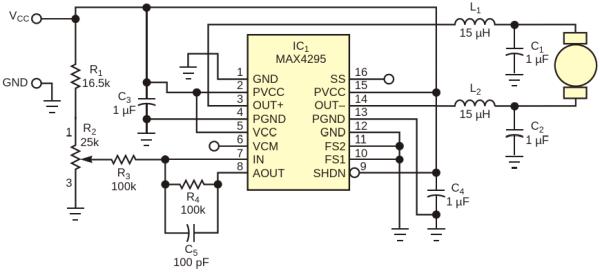
The standard application circuit for a Class D audio amplifier, IC1, requires only slight modifications. In place of the usual audio-signal input is a variable dc voltage that potentiometer R2 generates. Resistor R1 biases the potentiometer to match the input range of IC1. Full-counterclockwise rotation of the potentiometer corresponds to maximum-speed reverse rotation of the motor. Midscale on the potentiometer corresponds to motor off, and full-clockwise rotation of the potentiometer produces maximum-speed forward rotation in the motor. The characteristics of a given motor may allow you to eliminate the amplifier’s output filter, which comprises L1, L2, C1, and C2. But, unless the control circuitry is near the motor, you should include the filter to reduce EMI.
Read more: MAXIM’S MAX4295 CIRCUIT PROVIDES CLASS D MOTOR CONTROL
- How does the potentiometer control motor speed and direction?
The potentiometer provides a variable DC input to the amplifier where full-counterclockwise yields maximum reverse, midscale yields off, and full-clockwise yields maximum forward. - What is the role of the bias resistor R1?
R1 biases the potentiometer to match the input range of the Class D amplifier IC. - Can the amplifier output filter be omitted?
The filter comprising L1, L2, C1, and C2 can be omitted depending on motor characteristics. - When should the output filter be included?
The filter should be included if the control circuitry is not near the motor to reduce EMI. - Why are Class D amplifiers suitable for battery-powered motor control?
They improve battery life and produce much less power dissipation than linear amplifiers. - What replaces the usual audio input in this motor-control application?
A variable DC voltage generated by the potentiometer replaces the usual audio-signal input.