
Summary of 6 Digit LED Clock
This article describes a DIY 6-digit LED clock built using a PIC18F26K20 microcontroller, SA23-12SRWA displays, and a DS32kHz crystal. The design employs common anode multiplexing with BC327 PNP transistors for digit control and a ULN2003A array for voltage translation to drive the high forward voltage segments from a 12V supply.
Parts used in the 6 Digit LED Clock:
- SA23-12SRWA red 7 segment displays
- Microchip PIC18F26K20 microcontroller
- Dallas DS32KHZ temperature compensated 32.768kHz crystal
- BC327 PNP transistor
- ULN2003A darlington transistor array
- Prototyping pad board
- 2kΩ resistor
- 10kΩ pull up resistor
I recently found six 2.3″ red 7 segment displays in my collection which I purchased from Rapid Electronics when they were clearing out non-RoHS stock. Since I have no clock at my work bench I decided to construct one from some prototyping pad board, a Microchip PIC18F26K20 microcontroller and a Dallas DS32KHZ temperature compensated 32.768kHz crystal.
The displays I used are SA23-12SRWA, which don’t appear to be available from Rapid any more, the closest is SA23-12EWA, however, Farnell and the other usual distributors sell them.
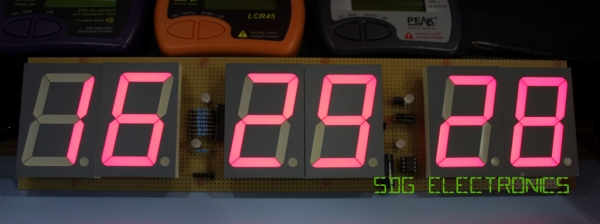 The 7 segment displays are common anode displays, with segments consisting of four red LEDs in series and the decimal places consisting of two red LEDs in series. To reduce the number of GPIO used to drive the display, various methods can be used – such as multiplexing, shift registers or dedicated display drivers. I’ve chosen to use plain display multiplexing, requiring one GPIO for each digit common anode, and one GPIO for each segment – with the colon separators, that gives 7 common anodes, and 8 cathodes with the decimal places and colons commoned together. There are many methods to reduce the number of GPIOs needed further than this, but the chosen microcontroller does not have a shortage of GPIO for this application.
The forward voltage of the segments is slightly high – the datasheet specifies between 7.4V and 10V. For this reason, the anode drivers for the displays have to perform both voltage translation in addition to sourcing enough current for the displays.
A BC327 PNP transistor is used to source the 12V supply to the digit common anode. The transistor used here must be rated for the full current of each digit with all segments lit. The BC327 is rated for a maximum collector current of 800mA, which is more than adequate for these displays, even when driving them at high peak forward currents. With a minimum current gain of greater than 100, the 2kΩ limits the maximum base current to prevent damage to the transistor whilst allowing around 500mA collector current to flow.
The voltage translation is provided by a ULN2003A darlington transistor array. This is effectively a package of 7 open collector darlington transistors which is used in this circuit to turn the BC327 on by pulling the base to 0V through the 2kΩ resistor. The 10kΩ resistor acts as a pull up resistor to hold the transistor off when the open collector transistor is off.
For more detail: 6 Digit LED Clock
-
What microcontroller is used in this project?
The project uses a Microchip PIC18F26K20 microcontroller. -
How are the 7 segment displays driven in this circuit?
The displays are driven using plain display multiplexing requiring one GPIO for each digit common anode and one GPIO for each segment. -
Why are BC327 transistors used for the anode drivers?
They are used to source the 12V supply to the digit common anode because they must perform voltage translation and source enough current for the displays. -
What provides the voltage translation for the display segments?
A ULN2003A darlington transistor array provides the voltage translation by turning the BC327 on through the base resistor. -
What is the forward voltage range of the display segments?
The datasheet specifies the forward voltage of the segments is between 7.4V and 10V. -
Can the SA23-12SRWA displays be purchased from Rapid Electronics now?
No, these displays do not appear to be available from Rapid anymore as they were clearing out non-RoHS stock. -
What type of displays are used in this clock?
The project uses common anode displays where segments consist of four red LEDs in series. -
What component keeps the BC327 transistor off when the open collector is inactive?
A 10kΩ resistor acts as a pull up resistor to hold the transistor off when the open collector transistor is off.