
Summary of Weather Station
Summary: The Small Weather Station is a battery-powered wireless system that logs temperature, humidity, atmospheric pressure, and battery voltage, with connectors for rain, wind, and wind-direction sensors (magnetic reed switches). It transmits sensor data via a 433 MHz superhet RF radio to a receiver, and server software logs locally or publishes data online. The Atmega-based station wakes every 12 minutes using a low-power library, reads sensors, transmits, then sleeps. Code for the project is available for download.
Parts used in the Small Weather Station:
- Atmega microcontroller
- BMP180 pressure sensor
- DHT22 temperature and humidity sensor
- Magnetic reed switches for rain sensor
- Magnetic reed switches for wind sensor
- Magnetic reed switches for wind direction sensor
- 433MHz Superhetrodyne RF Kit (transmitter)
- Receiver radio (compatible 433MHz)
- Battery power source
- Rocket Scream Low Power Library (software for low-power sleep)
- Server software (custom, for logging/publishing)
What is it?
The Small Weather Station is a battery-operated, wireless, weather station. I have been working on the project for almost a year now, and now I have an unshielded prototype that is partially functional. I say partially functional, because it does not have any wind/rain sensors installed, only the connections for them. So far it can log several things: temperature, humidity, atmospheric pressure, and battery voltage. However, the connectors for the rest of the sensors are functional; the only thing they require are several magnetic reed switches.
Data collected from the Small Weather Station can be logged on a computer or published to the internet. This is accomplished by connecting the computer to the receiver radio, and running the server software I have written.
You can download all the code I used for this project at the bottom of this page.
How it works:
There are three sections of this project that work together to bring weather information online. The weather station, the receiver, and the server software:
Weather Station:
The weather station is connected to the following sensors: BMP180, DHT22, rain, wind, and wind direction. The rain, wind, and wind direction sensors are made up of switch circuits. The radio used is the 433MHz Superhetrodyne RF Kit. It’s about $7, which makes it more expensive than other RF kits on eBay, but it has a very realistic range of 50m, and the signal can penetrate walls easily.
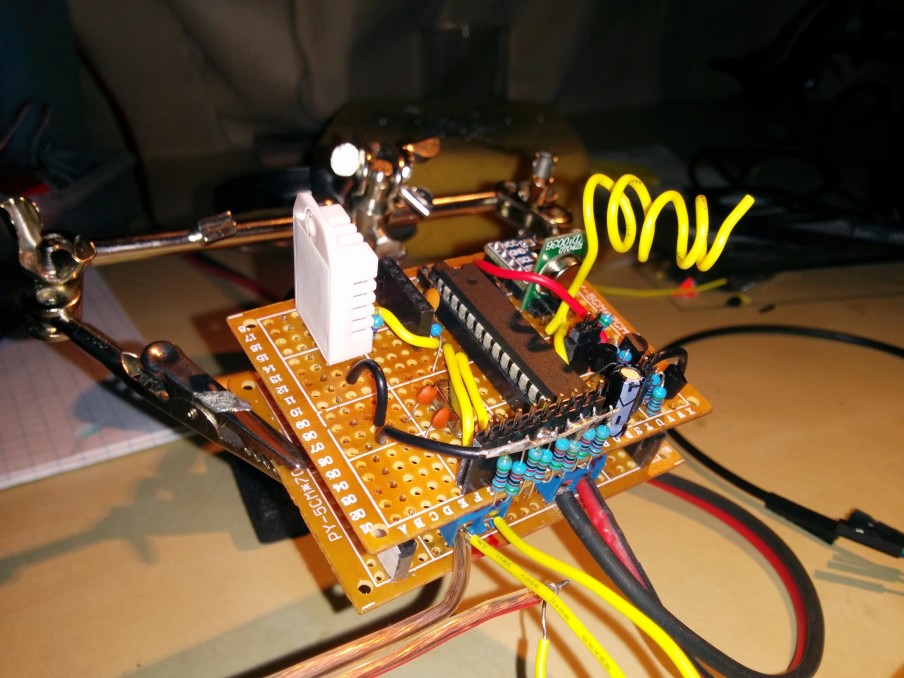
The weather station Atmega does a loop every 12 minutes, sleeping in-between using the Rocket Scream Low Power Library. The loop gathers data from the sensors, transmits them using the radio, then goes back to sleep.
For more detail: Weather Station
- What sensors does the Small Weather Station currently log?
It logs temperature, humidity, atmospheric pressure, and battery voltage. - Does the prototype include wind and rain sensors?
The prototype has connectors for wind and rain sensors but no installed sensors; they require magnetic reed switches. - What radio is used to transmit the data?
It uses a 433MHz Superhetrodyne RF Kit for transmission. - How often does the weather station transmit data?
The Atmega runs a loop every 12 minutes to gather and transmit data. - How does the station conserve battery power?
It sleeps between loops using the Rocket Scream Low Power Library. - How is collected data accessed or published?
Data is sent to a receiver radio connected to a computer running the server software, which logs or publishes the data. - Can the radio signal pass through walls and what range does it have?
The Superhetrodyne RF Kit has a realistic range of about 50 m and the signal can penetrate walls easily. - Is the project code available?
Yes, all the code used for the project is available for download from the project page.