
Summary of PIC16F877A LED blink
This project configures a PIC16F877A microcontroller to blink 33 LEDs by using each available digital I/O pin. All analog channels are set to digital; ports A–E are configured as outputs and toggled continuously. RA4 requires a pull-up resistor because it is open-drain. The code is written in MikroC PRO for PIC and inverts each port every 500 ms to blink the LEDs.
Parts used in the PIC16F877A 33 LED Blink Project:
- PIC16F877A microcontroller (40-pin)
- 33 LEDs
- Current-limiting resistors for each LED
- Pull-up resistor for RA4
- Power supply (Vdd and Vss connections)
- Decoupling capacitor(s)
- Programming connector or ICSP for PIC
- Prototyping board or PCB and wiring
The Microchip PIC16F877A has 40 pins 33 of them can be input or output. In this simple project I am going to configure this microcontroller to blink a 33 LED each LED is connected to one I/O pin.
The PIC16F877A has 8 analog channels, so we have to configure all these channels as digital output.
The pin RA4 is an open drain output we must add a pull up resistor to turn it on and off.
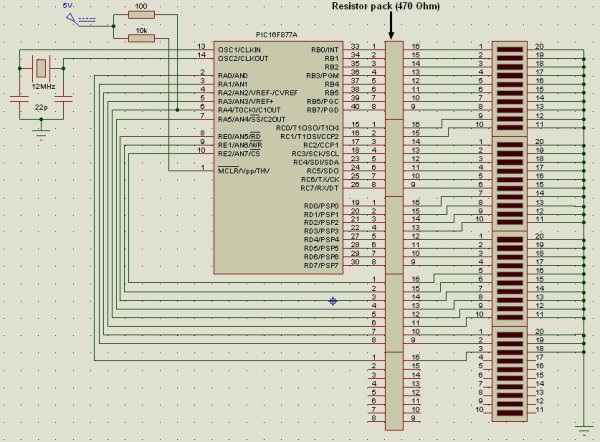
The circuit schematic is shown by the following picture:
The code is written using MikroC PRO for PIC compiler:
void main(){ ADCON1 = 0x07; // Configure all analoge pins as digital PORTA = 0; TRISA = 0; // Configure PORTA as output PORTB = 0; TRISB = 0; // Configure PORTB as output PORTC = 0; TRISC = 0; // Configure PORTC as output PORTD = 0; TRISD = 0; // Configure PORTD as output PORTE = 0; TRISE = 0; // Configure PORTE as output while (1) { PORTA = ~ PORTA; // Invert PORTA status PORTB = ~ PORTB; // Invert PORTB status PORTC = ~ PORTC; // Invert PORTC status PORTD = ~ PORTD; // Invert PORTD status PORTE = ~ PORTE; // Invert PORTE status delay_ms(500); } } For more detail: PIC16F877A LED blink
- How are the analog pins configured for digital output?
The code sets ADCON1 = 0x07 to configure all analog pins as digital. - How do you configure the microcontroller ports as outputs?
The code clears each PORT register and sets TRISx = 0 for TRISA, TRISB, TRISC, TRISD, and TRISE to configure them as outputs. - How is RA4 handled differently from other pins?
RA4 is an open-drain output and requires a pull-up resistor to turn it on and off. - How many LEDs does this project blink and how are they connected?
The project blinks 33 LEDs, each connected to one I/O pin of the PIC16F877A. - What compiler is used for the provided code?
The code is written using MikroC PRO for PIC compiler. - How often do the LEDs toggle state in the example code?
The code inverts all ports and then delays for 500 ms, causing the LEDs to toggle every 500 ms. - Which ports are toggled in the main loop?
PORTA, PORTB, PORTC, PORTD, and PORTE are inverted in the main loop. - What operation is used to invert the port outputs?
The code uses bitwise NOT (~) on each PORT register to invert the outputs.
