
Summary of Two way Simple Very Small Telephone Exchange
This project is a very small two-line telephone exchange using a PIC16F84A microcontroller providing full bidirectional intercom between two ordinary telephones; when one goes off-hook the exchange rings the other and connects them. Power is from a 230 V supply with a step-down transformer producing multiple voltages; the controller interfaces two SLIC modules.
Parts used in the Very Small Telephone Exchange:
- Step down transformer (230 V to 30 V, 15 V & 100 V)
- Two bridge 1 A rectifiers
- 7805 5V regulator
- 7812 12V regulator
- 1000 µF, 35 V electrolytic capacitor
- 1000 µF, 16 V electrolytic capacitor
- 150 mA fuse and fuse holder
- Necessary wires and AC supply wiring
- 2SC945 transistors x3
- 1N4007 diode x1
- 1N4148 diodes x2
- LED x1
- 4.7 µF (16 V) capacitors x4
- 22 pF capacitors x2
- 10 K resistors x4
- 4.7 K resistors x4
- 330 ohm resistor x1
- 12 V telephone relay x1
- Necessary wires for controller/SLIC connections
- PIC16F84A microcontroller with firmware version 1.00
- Two SLIC modules (each with TN, SD, RG connections)
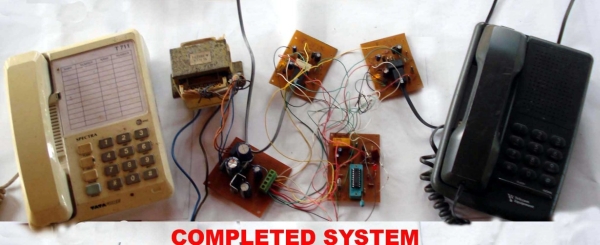
This is a very small telephone exchange attached only two ordinary Tele phones. Fully bi-directional facility with an intercom system. When a phone is in off hook condition , Exchange will detect it & send ringing pulse to other phone. When it will be picked up , the connection will be established between both phones. This will be taken place vice-versa.
Micro Controller = PIC16F84A
Firmware version = 1.00
Power Supply = 230 v
 Power Supply Unit
The Power Supply Unit.
This is used normal step down transformer (400ma) for generating three type of deference voltages & 100 AC volt for rigging.
It doesnt provided a PCB pattern for the power supply unit. So a Vero board can be used to build the unit.
Parts List :
1.Step down transformer ( 230 V to 30 V , 15 V & 100 V )
2.Two bridged 1 A rectifiers
3.7805 5V regulator
4.7812 12V regulator
5.1000 uf 35 V
6.1000 uf 16 v
7.150 ma fuse & its holders.
8.Necessary Wires & a wire code for AC supply.
The controlling unit ( Exchange )
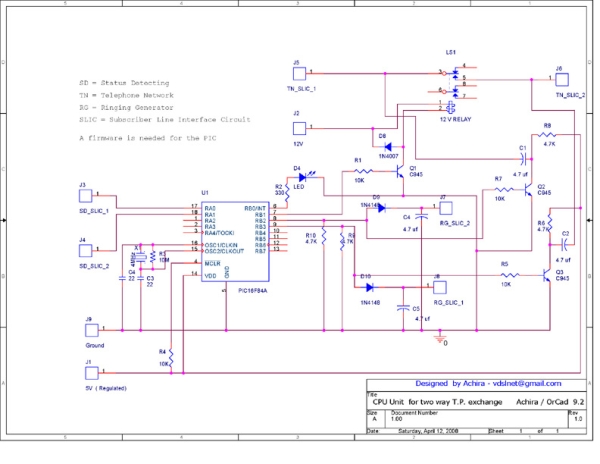
This circuit is base on PIC16F84A microcontroller. Two slimier SLIC are connected to The controlling unit. It needs to identify following connections on the controlling unit circuit diagram.
TN_SLIC_1 & TN_SLIC_2
SD_SLIC_1 & SD_SLIC_2
RG_SLIC_1 & RG_SLIC_2
One SLIC connections should be marked as,
1. TN_SLIC_1
2. SD_SLIC_1
3. RG_SLIC_1
Other SLIC connections should be marked as,
1. TN_SLIC_2
2. SD_SLIC_2
3. RG_SLIC_2
These connections should be connected as on the controlling unit circuit diagram.
 Parts List :
Transistors
1. 2SC945 x 3
Diodes
1. 1N4007 x 1
2. 1N4148 x 2
3. LED x 1
Capacitors ( 16 V )
1. 4.7 uf x 4
2. 22 pf x 2
Resistors
1. 10 K x 4
2. 4.7 K x 4
3. 330 x 1
Other Parts
12 V telephone rely x 1
Necessary wires
PIC16F84A with the firmware
For more detail: Two way Simple Very Small Telephone Exchange
- What microcontroller is used in the exchange?
The PIC16F84A microcontroller is used with firmware version 1.00. - How many telephones can this exchange support?
It is attached to two ordinary telephones only. - How does the exchange detect and connect calls?
When a phone goes off hook the exchange detects it and sends a ringing pulse to the other phone; picking up establishes the connection bidirectionally. - What voltages does the power transformer provide?
The step down transformer provides 30 V, 15 V, and 100 V AC outputs. - Are PCB patterns provided for the power supply unit?
No PCB pattern is provided; a Vero board can be used to build the power supply unit. - What SLIC connections are required for each line?
Each SLIC requires TN_SLIC_x, SD_SLIC_x, and RG_SLIC_x connections (for SLIC 1 and SLIC 2 respectively). - Which relay is used in the controlling unit?
A 12 V telephone relay is used in the controlling unit. - What diodes are listed in the parts for the controller?
The controller parts list includes one 1N4007 and two 1N4148 diodes plus one LED. - What capacitors are needed for the controller section?
The controller uses four 4.7 µF (16 V) capacitors and two 22 pF capacitors. - What resistors are required for the controller?
The controller requires four 10 K resistors, four 4.7 K resistors, and one 330 ohm resistor.
