


Summary of Triangle Wave Generator Circuit using Op-amp
This tutorial explains how to build a triangular waveform generator using a single op-amp (LM358) and basic passive components. It describes the circuit operation as a relaxation oscillator: the op-amp acts as a comparator with hysteresis, charging and discharging a capacitor to produce a triangle wave, and an AC coupling stage centers the output around zero. Component values and hysteresis determine frequency and amplitude, and the output can be amplified for practical use.Parts used in the Triangle Wave Generator:
- 1x LM358 or similar op-amp
- 3x 1K resistors
- 1x 10K resistor
- 1x 100K resistor
- 1x 1nF ceramic capacitor
- 1x 1uF electrolytic capacitor
Function generator or waveform generator is an integral part of electronics and used to produce various kinds of waveforms like a sine wave, square wave, Sawtooth wave, etc. We have already designed sine wave generator circuit, square wave generator circuit, and sawtooth wave generator circuit. Now in this tutorial, we will show you, how to design a triangular waveform generator circuit using Op-amp and few basic components.
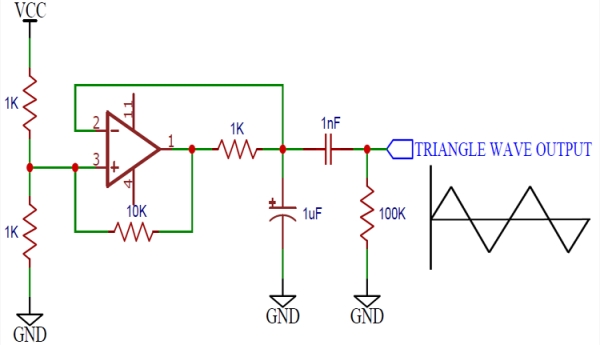
A triangle wave consists of a constant rising slope followed by a constant falling slope, and the wave resembles a poorly drawn mountain range.
Triangle wave generators are used in things as diverse as transistor curve tracers, PWM controllers, class D amplifiers, and tone generators.
Parts Required
- 1x LM358 or similar op-amp
- 3x 1K resistors
- 1x 10K resistor
- 1x 100K resistor
- 1x 1nF ceramic capacitor
- 1x 1uF electrolytic capacitor
Op-amp LM358
Op-amps are also known as Voltage Comparators. When the voltage at the non-inverting input (+) is higher than the voltage at inverting input (-), then the output of the comparator is High. And if the voltage of inverting input (-) is Higher than the non-inverting end (+), then output is LOW. Know more about the working of op-amp here.
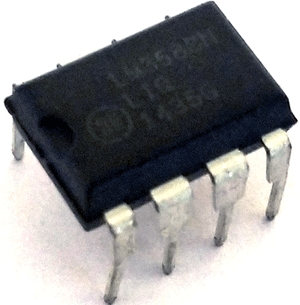
LM358 is a Dual Low Noise Operational Amplifier which has two independent voltage comparators inside. This is a general-purpose op-amp which can be configured in many modes like comparator, summer, integrator, amplifier, differentiator, inverting mode, non- inverting mode, etc. To learn more about LM358 go through LM358 various circuits as amplifier and comparator
Circuit Diagram
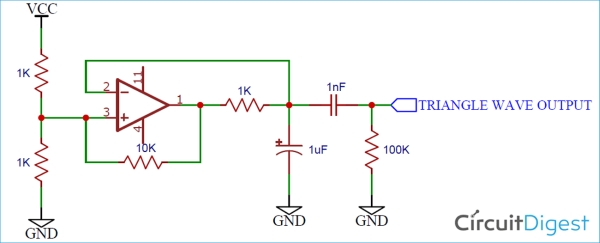
Schematics for Op Amp triangular wave generator is given below:
Working of Triangle Wave Generator
This circuit is a simple example of a relaxation oscillator using a single op-amp as a comparator.
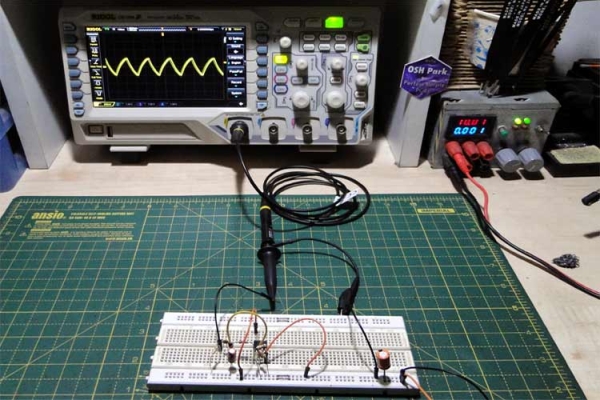
Initially, let us assume that the capacitor is discharged. This puts the inverting input at a voltage lower than the non-inverting input, which is half the supply voltage from the resistor divider.
The output goes high till the capacitor voltage goes above half the supply voltage, at which point the voltage at the inverting input is greater than the non-inverting input. The output then goes low, discharging the capacitor. At the same time, the 10K resistor acts as hysteresis – when the output goes low, the bottom leg of the voltage divider now has a 1K and a 10K in parallel, which decreases the overall resistance and reduces the reference voltage.
The values of the hysteresis resistor and the resistor divider can be changed to increase or decrease the frequency.
The output of the opamp is then AC coupled to produce a signal that has an equal positive and negative swing. This signal can easily be amplified.
So this is how a simple triangle wave generator can be built using a single Op-amp and few discrete components.
Source: Triangle Wave Generator Circuit using Op-amp
- What op-amp is used in the triangle wave generator?
The article uses an LM358 or a similar op-amp. - How is the triangle wave produced in this circuit?
The op-amp acts as a comparator with hysteresis, charging and discharging a capacitor to create a constant rising and falling slope, forming a triangle wave. - Can the frequency of the triangle wave be changed?
Yes, changing the hysteresis resistor and the resistor divider values increases or decreases the frequency. - What role does the 10K resistor play?
The 10K resistor provides hysteresis by altering the voltage divider when the output switches, affecting the reference voltage. - Why is the output AC coupled?
The output is AC coupled to produce a signal with equal positive and negative swing centered around zero. - What capacitors are used in the project?
A 1nF ceramic capacitor and a 1uF electrolytic capacitor are used. - Is the LM358 configured as a comparator in this design?
Yes, the LM358 is used as a comparator (op-amp comparator) in this relaxation oscillator circuit. - Can the triangle wave output be amplified?
Yes, the article states the AC coupled signal can easily be amplified.
Related projects
Implementing Smart Cooling Control for Induction Heaters with PIC Microcontrollers
Today, induction heating powers countless industrial processes like melting, heat treatment, and welding, plus everyday appliances like cooktops. Its key advantages? High...
Power & BatteryIntegrating Solar Power: Microcontroller-Based Approaches for Domestic Electricity
Abstract: Microcontrollers have found extensive application in endeavors aimed at reducing power consumption. The availability of microcontroller development tools has made them...
Power & BatteryEfficient Power Generation with Microcontroller-Controlled Thermoelectric Generators
INTRODUCTION The global demand for electrical energy continues to rise steadily, necessitating a shift towards renewable energy sources as traditional fossil fuels...
Power & BatteryOptimizing Performance: A Guide to Stacking Precision Power Supplies
1. Introduction Statement of Purpose Our project selection stems from the recognition that power supplies represent a crucial and costly aspect of...
Power & Battery10 Mistakes with Hiring a Home Solar Installer and How to Avoid Them
Are you thinking about installing a home solar system? If so, then you're on the right track. Hitting the pavement for the...
Power & Battery · PIC18F252BATTERY CHARACTERIZER using PIC18F252
Introduction This circuit is a battery characterizer that applies a fixed load to a charged NiCad or NiMH cell and measures milliamp-hour...

Muhammad Bilal
I am a highly skilled and motivated individual with a Master's degree in Computer Science. I have extensive experience in technical writing and a deep understanding of SEO practices.