
Summary of TRIAC BLOC – a solid-state relay with I2C interface
The author designed a multifunction solid-state relay (TRIAC BLOC) for high-power switching up to 6 kW, usable for kiln refurbishment, stage dimming, and single-phase motor speed control. It features zero-cross detection, I2C control, linear power output, phase-shift dimming, zero-cross switching, output filtering, snubber network, separate ZC and trigger headers for MCU-free use, spare MCU pins, and open-source hardware and firmware with parts and boards available.
Parts used in the TRIAC BLOC:
- Triac(s) for high-power switching
- Snubber network components (resistor and capacitor)
- Output filter choke (for dimmer mode)
- Zero-cross detection circuit components
- Microcontroller unit (MCU) with I2C interface
- I2C bus connectors
- Headers for low-level zero-crossing signal output and triac trigger input
- Power connectors suitable for up to 6 kW
- PCB with spare MCU pins broken out
- Passive components (resistors, capacitors, diodes as required)
From time to time I get requests to make some high power switching, so I decided to design a solid-state relay that could handle a lot of different situations. The most common use for it I have is refurbishing old ceramic kilns. Since our technical life is close to the stage (both theatre and music), I also wanted it to be usable as a dimmer module. And, just for kicks, as a single phase AC motor speed controller, in case we would want that.
So here it goes. The design and code are on github: https://github.com/Miceuz/triac-bloc. I still have some spare boards and parts if anyone is interested – drop me a note (mic at wemakethings.net).
Features:
- maximum power – 6kW
- zero crossing detection
- controllable via I2C protocol
- linear output power control
- phase shift dimmer mode
- switch at zero-crossing mode
- output filtering for dimmer mode
- snubber network
- “low level” zero-crossing signal output
- triac trigger signal input
- 4 spare MCU pins available for additional features
- open source hardware and firmware
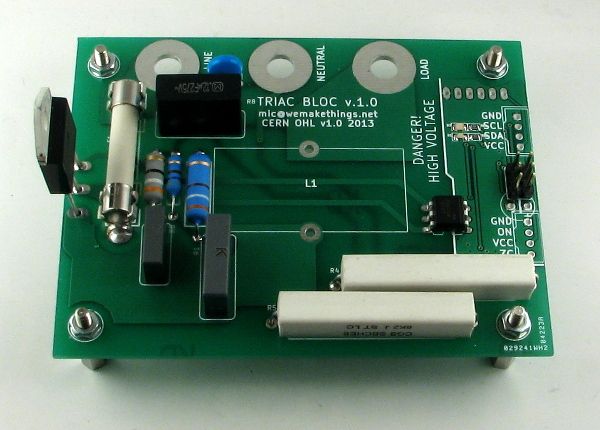
Since deep in my heart I’m still a programmer, I wanted digital control that would solve some issues, like being able to set the output power in a linear manner. But nevertheless, the module is still usable without a microcontroller – zero-crossing and turn on signals are available on a separate header on the board. You can add or remove components based on particular needs. No need for dimming or motor control? Skip the filter choke and snubber. Want to integrate it into existing digital solution? Skip the micro and use zc and trigger signals directly.
For more detail: TRIAC BLOC – a solid-state relay with I2C interface
- What maximum power can TRIAC BLOC handle?
The module is designed for a maximum power of 6 kW. - Does TRIAC BLOC support zero-crossing detection?
Yes, it includes zero-cross detection and provides a low-level zero-crossing signal output. - Can TRIAC BLOC be controlled digitally?
Yes, it is controllable via the I2C protocol and has open-source firmware. - Is TRIAC BLOC usable without a microcontroller?
Yes, zero-crossing and turn-on signals are available on a separate header so the module can be used without a microcontroller. - Does TRIAC BLOC support dimming?
Yes, it supports phase shift dimmer mode and includes output filtering for dimmer mode. - Can TRIAC BLOC be used as a single-phase AC motor speed controller?
Yes, it was designed to be usable as a single-phase AC motor speed controller. - Are there hardware options to omit features?
Yes, you can add or remove components based on needs—for example skip the filter choke and snubber if dimming or motor control are not required. - Are spare MCU pins available for additional features?
Yes, the board breaks out four spare MCU pins for additional features. - Is the project open source?
Yes, both hardware and firmware are open source and available on GitHub.

