
Summary of THIN-FILM BATTERY CAN ATTACH TO WEARABLES AND MEDICAL BIOSENSORS
Molex’s thin-film zinc–manganese dioxide battery conforms to the body for comfortable wearables and medical biosensors, avoids lithium disposal issues, and uses a vertically stacked construction to lower internal resistance, boost peak current for wireless data transmission, increase usable capacity, and reduce footprint. It is thin, flexible, bendable, available in 1.5 V and 3 V options, and marketed as an economical, environmentally safer alternative for low-power disposable applications.
Parts used in the Molex Thin-Film Battery Project:
- Zinc anode
- Manganese dioxide cathode
- Vertically stacked thin-film layers
- Encapsulation/flexible substrate
- Electrical contacts for 1.5 V and 3 V configurations
- Adhesive or attachment interface for wearables
Molex’s battery can attach to wearables and medical biosensors and conform to a patient’s body for maximum comfort
Molex’s thin-film battery is made of zinc and manganese dioxide, making disposal much easier for the end-user. Most developed countries have disposal regulations; this makes it costly and inconvenient for end-users to dispose of products with lithium batteries.
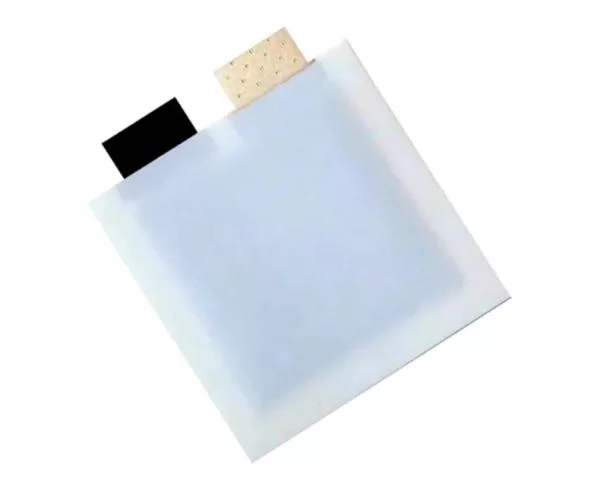
Consumer and medical manufacturers need solutions that are comfortable and lightweight for the wearer. Molex’s thin-film battery can attach to wearables and medical biosensors and conform to a patient’s body for maximum comfort.
Many printed batteries cannot reach the peak current levels required for wirelessly transmitting data. The stacked construction of this battery offers lower internal resistance, boosting peak current and enabling wireless communication.
Features
- Reduced distance between the anode and cathode
- Vertically-stacked construction provides the following compared to single-layered construction:
- Reduced internal resistance
- Increased peak current
- Increased usable capacity
- Reduced footprint
- Vertically-stacked construction provides the following compared to single-layered construction:
- No heavy metals
- Offers an economical, environmentally safe alternative to lithium
- Available in 1.5 V and 3 V configurations
- Delivers power suitable for low-power disposable applications
- Thin, flexible form-factor
- Supports design flexibility appropriate for a wide variety of products
- Flexible and bendable
Read more: THIN-FILM BATTERY CAN ATTACH TO WEARABLES AND MEDICAL BIOSENSORS
- What materials are used in Molex’s thin-film battery?
The battery is made of zinc and manganese dioxide. - Can the battery conform to a patient’s body?
Yes, the battery is thin, flexible, and bendable so it can conform to a patient’s body for comfort. - Does the battery contain heavy metals like lithium?
No, it offers an alternative to lithium and is described as having no heavy metals for easier disposal. - Are there different voltage configurations available?
Yes, the battery is available in 1.5 V and 3 V configurations. - Can the battery support wireless data transmission?
Yes, its stacked construction reduces internal resistance and boosts peak current to enable wireless communication. - What advantages does the vertically stacked construction provide?
Vertically stacked construction reduces internal resistance, increases peak current and usable capacity, and reduces footprint compared to single-layered construction. - Is this battery suitable for disposable low-power applications?
Yes, it delivers power suitable for low-power disposable applications. - Does the design support a variety of product applications?
Yes, the thin, flexible form factor supports design flexibility for a wide variety of products.