
Summary of The SnapPiCam | A Raspberry Pi Digital Camera
The SnapPiCam is a DIY Raspberry Pi–powered touchscreen digital camera with interchangeable magnetic and screw-on lenses. Built around the Raspberry Pi and a 5 MP camera board, four models (Compact, Adventurer, MegaZoom, MegaZoom Plus) offer varying displays, LiPo power and charging, fuel-gauges, and zoom lens options. Open hardware/software plans and parts lists are available; models support WiFi, USB/HDMI access, and colorful customizable bodies and straps.
Parts used in the SnapPiCam:
- Raspberry Pi (Model A)
- Raspberry Pi 5 Mega-Pixel camera board
- 2.8 inch LCD with touchscreen (Adventurer, MegaZoom, MegaZoom Plus)
- Button board (Compact)
- LiPo battery (e.g., 1200mAh for Compact)
- DC-DC converter
- On-board LiPo charger (basic 500mAh or advanced 120mAh-1000mAh)
- i2c LiPo fuel gauge (Adventurer, MegaZoom, MegaZoom Plus)
- Logic level shifter (Adventurer, MegaZoom, MegaZoom Plus)
- Magnetic lens ring and magnetic lenses (0.67X Wide & Macro or 180° Fish-Eye)
- 2x Zoom Magnetic Telephoto Lens (MegaZoom Plus)
- 4x-12x aluminium MegaZoom lens (MegaZoom)
- 6x-18x MegaZoom Plus lens (MegaZoom Plus)
- Anodised aluminium lens attachment ring (MegaZoom, MegaZoom Plus)
- WiFi USB dongle (optional for wireless upload)
- USB Mini B cable (for charging)
- Screws (black or silver)
- Camera body panels (various fluorescent colours or clear/neutral grey)
- Wrist strap (Adventurer) or shoulder strap (MegaZoom, MegaZoom Plus)
- Tripod mount
- Protective bag and lens caps (MegaZoom, MegaZoom Plus)
- Lens cleaning cloth (MegaZoom, MegaZoom Plus)
Build your own Raspberry Pi powered Touchscreen Digital Camera complete with interchangeable lenses!
e SnapPiCam is a D.I.Y. Digital Camera you can build at home. It is a great weekend project and it is easily assembled with the most basic of tools by just about anyone.
All four SnapPiCam cameras feature the amazing Raspberry Pi Model A and the crisp Raspberry Pi 5 Mega-Pixel camera board.
The SnapPiCam is an Open Hardware & Open Software Project. The Plans & Parts List will be made publicly available for free.
I had the idea for the SnapPiCam after reading Adafruit’s PiTFT Tutorial which described how to build a Touch-screen camera. In the final paragraph they go on to mention how it would be quite easy for an advanced maker to squeeze in a LiPo and a DC-DC Converter into the space between the Raspberry Pi and the PiTFT. Instructables had a Raspberry Pi Competition running at the same time and I thought a camera would make a great entry into the competition.
It took a little over two weeks to complete the original design for the camera. The SnapPiCam was submitted into the competition and after a few tense weeks the winners were announced, the camera had won First Prize!
You can read more about the idea behind the SnapPiCam and see the development of the first version of the camera over at Instructables by clicking the link below.
http://www.instructables.com/id/The-SnapPiCam-A-Raspberry-Pi-Camera/
The SnapPiCam was so popular that Adafruit asked me to write a build tutorial which was to be featured on the Adafruit Learning System. Follow the link below to read through the tutorial.
http://learn.adafruit.com/snappicam-raspberry-pi-camera
The Proto-Pile. A heap of all the old development versions of the SnapPiCam. Inset is an image of the original prize-winning SnapPiCam.
The four SnapPiCam models are powered by LiPo batteries and each camera has its own on-board LiPo Charger. Just plug any connected USB Mini B cable into the camera’s charger port and wait for the green light. The Adventurer and MegaZoom models have an I²C LiPo Fuel Gauge so you can keep an eye on the battery level.
The SnapPiCam is designed to work with a multitude of magnetic lenses and each kit comes with a choice of either a combined 0.67X Wide & Macro Magnetic Lens or a 180° Fish-Eye Magnetic Lens. Simply pop the lens onto the magnetic ring at the front of the camera and you’re ready to go.
Connect a WiFi dongle to the SnapPiCam’s USB port for wireless photography. You can upload directly to DropBox using your phone’s Wi-Fi & Internet connection. All the Raspberry Pi’s ports are accessible with the exception of the Micro USB Port. You can connect USB devices, HDMI cables, Video cables and Headphones.
The SnapPiCam MegaZoom has an aluminium bodied 4x – 12x variable MegaZoom lens which can be screwed onto the front of the camera. You can still use all the magnetic lenses when the MegaZoom lens is detached. The MegaZoom Plus offers an unprecedented 6x-18x variable MegaZoom lens!
The Compact is a go anywhere fun camera that fits easily into your pocket. The camera is controlled with a button board which is plugged directly onto the Raspberry Pi’s GPIO header.
The Compacts features.
- 5 Mega-Pixel Camera.
- Raspberry Pi.
- 1200mAh LiPo Battery.
- DC DC Converter.
- Basic 500mAh LiPo Charger.
- Two body versions are available, Clear & Neutral Grey.
- Choose either Black or Silver screws.
- Pick from a selection of fluorescent colours for the front & back. Colours include Fluorescent Acid Green, Fluorescent Hellios Yellow, Fluorescent Lava Orange, Fluorescent Mars Red and Fluorescent Neptune Blue.
- 100mm x 68mm x 50mm.
The Adventurer is for the person that wants that little bit extra. Navigate around the camera’s menus using a 2.8″ LCD with Touch-screen & four Tactile Buttons. There is also a battery Fuel Gauge so you’ll never be caught short on power.
The Adventurer’s features.
- 5 Mega-Pixel Camera.
- Raspberry Pi.
- 2.8″ LCD With Touch-screen & Tactile Buttons.
- i2c LiPo Fuel Gauge.
- Logic Level Shifter,
- Advanced 120mAh – 1000mAh LiPo Charger.
- Available in a variety of fluorescent colours including Fluorescent Acid Green, Fluorescent Hellios Yellow, Fluorescent Lava Orange, Fluorescent Mars Red and Fluorescent Neptune Blue.
- Choose either Black or Silver screws.
- A wrist-strap to keep your camera safe.
- Mount the camera on a Tripod.
- 100mm x 68mm x 60mm.

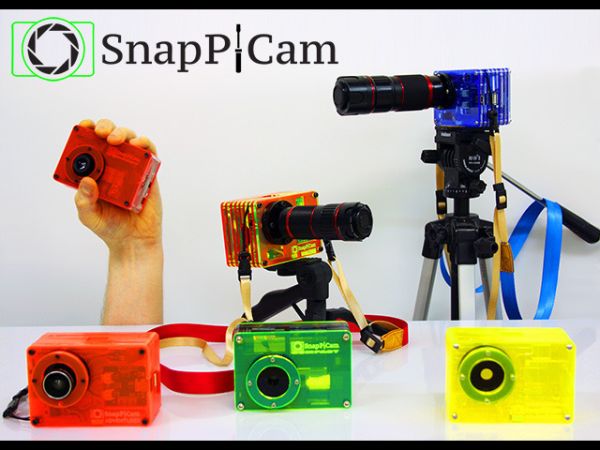
The MegaZoom, everything is better in Mega! The MegaZoom 4x-12x Aluminium Bodied Lens screws to the front of the SnapPiCam MegaZoom. Remove the MegaZoom lens and you can still attach the magnetic lenses.
The MegaZoom’s features.
- 5 Mega-Pixel Camera.
- Raspberry Pi.
- 2.8″ LCD With Touch-screen & Tactile Buttons.
- i2c LiPo Fuel Gauge.
- Logic Level Shifter,
- Advanced 120mAh – 1000mAh LiPo Charger.
- Available in a variety of fluorescent colours & striped patterns. Colours include Fluorescent Acid Green, Fluorescent Hellios Yellow, Fluorescent Lava Orange, Fluorescent Mars Red and Fluorescent Neptune Blue.
- Choose either Black or Silver screws.
- A shoulder-strap to keep your camera safe.
- Mount the camera on a Tripod.
- Anodised aluminium lens attachment ring.
- A 4x-12x Variable MegaZoom Lens with manual focus.
- A protective bag and lens caps for the MegaZoom Lens.
- Lens cleaning cloth.
- 100mm x 68mm x 60mm (160mm with MegaZoom lens).
The MegaZoom Plus gives you massive 6x-18x MegaZoom Plus capabilities! The Plus also comes with a 2x Zoom Magnetic Telephoto Lens.
The MegaZoom Plus’s features.
- 5 Mega-Pixel Camera.
- Raspberry Pi.
- 2.8″ LCD With Touch-screen & Tactile Buttons.
- i2c LiPo Fuel Gauge.
- Logic Level Shifter,
- Advanced 120mAh – 1000mAh LiPo Charger.
- Available in a variety of fluorescent colours & striped patterns. Colours include Fluorescent Acid Green, Fluorescent Hellios Yellow, Fluorescent Lava Orange, Fluorescent Mars Red and Fluorescent Neptune Blue.
- Choose either Black or Silver screws.
- A shoulder-strap to keep your camera safe.
- Mount the camera on a Tripod.
- Anodised aluminium lens attachment ring.
- 2x Zoom Magnetic Telephoto Lens.
- A monstrous 6x-18x Variable MegaZoom Lens with manual focus.
- A protective bag and lens caps for the MegaZoom Plus Lens.
- Lens cleaning cloth.
- 100mm x 68mm x 60mm (195mm with MegaZoom Plus lens).
- Bragging rights.
For more detail: The SnapPiCam | A Raspberry Pi Digital Camera
- What core electronics power the SnapPiCam?
The SnapPiCam uses a Raspberry Pi Model A and the Raspberry Pi 5 Mega-Pixel camera board. - Can the SnapPiCam be powered by a battery?
Yes, all models are powered by LiPo batteries and include an on-board LiPo charger. - Does the SnapPiCam support interchangeable lenses?
Yes, it supports magnetic lenses and screw-on MegaZoom lenses depending on the model. - How do you recharge the SnapPiCam battery?
Plug a USB Mini B cable into the camera's charger port and wait for the green light. - Can the SnapPiCam upload photos wirelessly?
Yes, by connecting a WiFi dongle to the USB port you can upload photos, including to DropBox via a phone's Wi-Fi connection. - Which models include a touchscreen display?
The Adventurer, MegaZoom, and MegaZoom Plus include a 2.8 inch LCD with touchscreen. - Does the Compact model include a touchscreen?
No, the Compact is controlled with a button board plugged onto the Raspberry Pi's GPIO header instead of a touchscreen. - Which models provide a LiPo fuel gauge?
The Adventurer, MegaZoom, and MegaZoom Plus include an i2c LiPo fuel gauge. - Are the SnapPiCam plans and parts lists available?
Yes, the SnapPiCam is an Open Hardware and Open Software project and the plans and parts list are made publicly available for free. - Can the MegaZoom lenses be removed to use magnetic lenses?
Yes, when the MegaZoom lens is detached you can still attach the magnetic lenses.