
Summary of Smartphone Nose
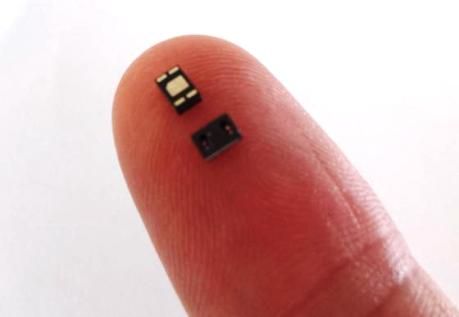
Our patented CMOS MEMS micro-hotplates enable miniaturized metal oxide (MOX) gas sensors with low power and rapid response. Suspended micro-hotplates heat MOX sensing material to 200–400°C, where resistance changes detect gases; fast temperature cycling and modulation improve sensitivity, selectivity, and measurement speed. Advanced algorithms provide selectivity, drift compensation, and self-calibration. CCS800 family offers ultra-low-power sensors in a compact 3 × 2 mm SMD package, with other package options on request.
Parts used in the CCS800 Product Family:
- CMOS MEMS micro-hotplate
- High-reliability membrane (suspension)
- Metal oxide (MOX) sensing material
- Heater elements integrated on micro-hotplate
- Advanced signal-processing algorithms (selectivity, drift compensation, self-calibration)
- CCS800 sensor IC
- 3 mm x 2 mm SMD package (standard)
- TO package option (available on request)
Our patented CMOS MEMS Micro-hotplates technology provides a unique silicon platform for our Metal Oxide (MOX) gas sensors and enables sensor miniaturisation, significantly lower power consumption and ultra-fast response times.
Our Micro-hotplates are suspended in a high reliability membrane and act as heater elements for a metal oxide based sensing material. The material resistance will change due to reactions to selected gases and concentrations at temperatures between 200°C to 400°C. Through enabling very fast cycle times, advanced temperature modulation techniques can be used to ensure maximum sensitivity, stability and gas selectivity and minimise measurement times.
Advanced algorithms support the MOX gas sensors family, for maximum selectivity, drift compensation and for self-calibration, enabling easy and timely integration into a wide range of applications.
The CCS800 product family of ultra-low power gas sensor are supported in a compact 3mm x 2mm surface mount device (SMD) package as standard. Other package options including TO are available on request.
The table below indicates the key product parameters for our CCS800 product family of ultra-low power gas sensors
For more detail: Smartphone Nose
- What is the operating temperature range for the MOX sensing material?
The MOX sensing material operates at temperatures between 200°C and 400°C. - How do the micro-hotplates improve sensor performance?
Micro-hotplates enable very fast cycle times and temperature modulation, improving sensitivity, stability, gas selectivity, and minimizing measurement times. - What packaging is standard for the CCS800 sensors?
The standard package is a compact 3 mm x 2 mm surface mount device (SMD). - Are other package options available?
Yes, other package options including TO are available on request. - What role do advanced algorithms play with these sensors?
Advanced algorithms provide maximum selectivity, drift compensation, and self-calibration to support sensor integration. - What advantages does CMOS MEMS micro-hotplate technology provide?
It enables sensor miniaturisation, significantly lower power consumption, and ultra-fast response times. - How is gas detection achieved with the MOX sensors?
Gas reactions change the resistance of the MOX material at elevated temperatures, which is measured to detect gases and concentrations.

