
Summary of SMART MARBLES AND AI TO DETECT FLAWS IN PIPELINES
This project involves researchers developing "smart marbles" containing sensors and AI to detect pipeline flaws. Using evolutionary algorithms, the system simulates 500 cycles to optimize marble configurations for specific environments before deployment. The marbles adapt autonomously, potentially assigning tasks like location tracking or leak detection based on real-time data.
Parts used in the Smart Marbles Project:
- Small circuit boards
- Sensors
- Golf-sized balls
- AI software
- Computer simulation model
- Programmed algorithm
A small team of researchers led by Peter Baltus, professor of microelectronics at the department of Electrical Engineering at Eindhoven Institute of Technology, the Netherlands, has developed small circuit boards equipped with sensors that can easily fit into a small golf-sized ball. While moving inside a pipeline, these swarm of smart marbles or balls can detect any obstacles, damages or leaks that are present in the pipeline network.
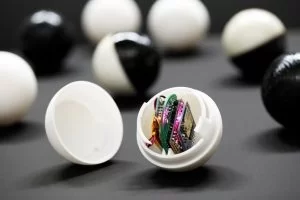
When operating in an unusually difficult environment inside a pipeline, the researchers decided to use the power of AI (Artificial Intelligence). It enabled the marbles to evolve its own ability to adapt to the current situation inside the pipeline. This process was simulated accurately with software. After retrieving the realtime pipeline data, an initial model of the pipeline was developed on a computer. A programmed algorithm then simulated the environment which the marbles had to deal with. It took about 500 simulation cycles to develop an optimal configuration that almost matched the inside of the pipeline system. This simulation software was then put into the circuits within the marbles. Then the marbles were finally released in the same real pipeline system yielding significantly good results.
When you are unfamiliar with an environment, you also can’t know which features a sensor is going to need in order to explore that environment,” said Peter Baltus. “I draw a parallel with evolution because the process is so unpredictable. We don’t have a solution, so we let an algorithm do it. This algorithm mixes the most successful balls and works towards an optimum. We don’t know the results of that simulation process beforehand. Perhaps the algorithm decides to give each marble its own task, which could lead to location marbles and marbles that detect leakages. The fact that our first evolution experiment shows that the principle works are actually unbelievable, and they even evolve in the right direction as well.
Read more: SMART MARBLES AND AI TO DETECT FLAWS IN PIPELINES
- What is the primary function of the smart marbles?
The marbles can detect obstacles, damages, or leaks inside a pipeline network while moving through it. - How does the AI help the marbles operate in difficult environments?
AI enables the marbles to evolve their own ability to adapt to the current situation inside the pipeline. - How many simulation cycles were required to develop an optimal configuration?
It took about 500 simulation cycles to develop an optimal configuration that almost matched the inside of the pipeline system. - Can the marbles perform different specific tasks?
Yes, the algorithm may decide to give each marble its own task, such as location tracking or detecting leakages. - How was the initial model of the pipeline created?
An initial model was developed on a computer after retrieving realtime pipeline data. - Where was the simulation software placed?
The simulation software was put into the circuits within the marbles before they were released. - Why did the researchers choose an evolutionary approach?
They chose this because the process is unpredictable when unfamiliar with an environment, so they let an algorithm find the solution. - Did the first evolution experiment succeed?
Yes, the results were unbelievable and showed the principle works while evolving in the right direction.