
Summary of Simpler superconducting promised by nanowire device
MIT researchers Adam McCaughan and Karl Berggren developed the nanocryotron, a nanowire-based superconducting circuit that could enable much cheaper zero-resistance devices and be 50–100 times more energy efficient than current chips. While not faster than today's chips, the device can solve readout challenges for Josephson-junction computations, detect single photons, and has been combined into a half-adder for digital arithmetic. The work, published in Nano Letters, aims to advance superconducting computing and quantum communications by offering a simpler, practical superconducting element.
Parts used in the Nanocryotron:
- Nanowire-based superconducting circuit (nanocryotron)
- Josephson junctions (contextual application)
- Superconducting light detectors (single-photon detectors)
- Wiring to interconnect nanocryotrons (for half-adder)
- Nanofabrication materials and substrates (implied for device creation)
MIT researchers have developed a circuit design that could make simple superconducting devices with zero electrical resistance much cheaper to manufacture, and which would be 50 to 100 times as energy efficient as today’s chips. Even though the circuits’ speed probably would not top that of today’s chips, they could solve the problem of reading out the results of calculations performed with Josephson junctions.
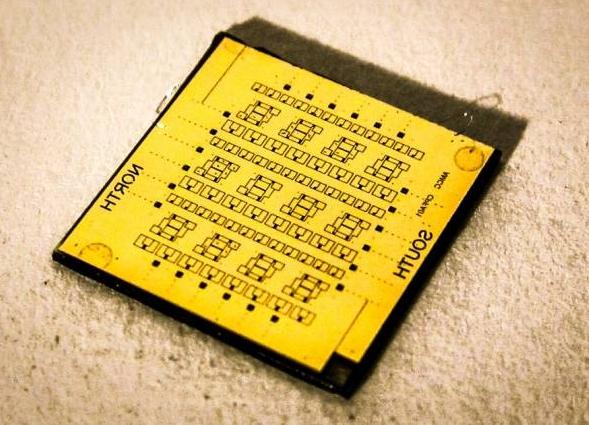
The MIT researchers – Adam McCaughan, a graduate student in electrical engineering, and his adviser, professor of electrical engineering and computer science Karl Berggren – call their device the nanocryotron, after the cryotron, an experimental computing circuit developed in the 1950s by MIT professor Dudley Buck (see “Dudley Buck’s Forgotten Cryotron Computer“). The cryotron was briefly the object of a great deal of interest – and federal funding – as the possible basis for a new generation of computers, but it was eclipsed by the integrated circuit.
“The superconducting-electronics community has seen a lot of new devices come and go, without any development beyond basic characterization,” said McCaughan. “But in our paper published in Nano Letters, we have already applied our device to applications that will be highly relevant to future work in superconducting computing and quantum communications.”
Superconducting circuits are used in light detectors that can register the arrival of a single light particle, or photon; that’s one of the applications in which the researchers tested the nanocryotron. McCaughan also wired together several of the circuits to produce a fundamental digital-arithmetic component called a half-adder.
Superconductors have no electrical resistance, meaning that electrons can travel through them completely unimpeded. Even the best standard conductors – like the copper wires in phone lines or conventional computer chips – have some resistance; overcoming it requires operational voltages much higher than those that can induce current in a superconductor. Once electrons start moving through an ordinary conductor, they still collide occasionally with its atoms, releasing energy as heat.
For more detail: Simpler superconducting promised by nanowire device
- What is the nanocryotron?
The nanocryotron is a nanowire-based superconducting circuit device developed by MIT researchers for simpler superconducting electronics. - Can the nanocryotron make superconducting devices cheaper?
Yes; the researchers say it could make simple superconducting devices much cheaper to manufacture. - Does the nanocryotron improve energy efficiency?
Yes; it would be 50 to 100 times as energy efficient as today's chips according to the researchers. - Is the nanocryotron faster than current chips?
No; the circuits' speed probably would not top that of today's chips. - What applications were tested with the nanocryotron?
Researchers tested it in superconducting light detectors that can register single photons and used multiple devices to build a half-adder. - Can nanocryotrons help with Josephson-junction computing?
Yes; they could solve the problem of reading out results from calculations performed with Josephson junctions. - Who developed the nanocryotron?
Adam McCaughan, a graduate student in electrical engineering, and professor Karl Berggren at MIT developed the device. - Where was the nanocryotron work published?
The researchers published their paper in Nano Letters.