


Summary of Power Pic RGB with voltage control using PIC12F675
This project, "Power Pic RGB with voltage control," utilizes a PIC12F675 microcontroller to generate and adjust RGB LED colors based on two independent external voltages. One voltage controls the hue (color), while the other regulates intensity (value). Originally inspired by an interface for a Theremin Music Controller, this development version operates without a PCB. The circuit employs three MOSFETs as drivers to manage current flow to the red, green, and blue LEDs, ensuring each component receives power safely within its 300mA limit.Parts used in the Power Pic RGB with voltage control:
- PIC 12F675 microcontroller
- RGB LED (Red, Green, Blue)
- Three MOSFETs
- 5V power supply
- External device supplying two independent voltages
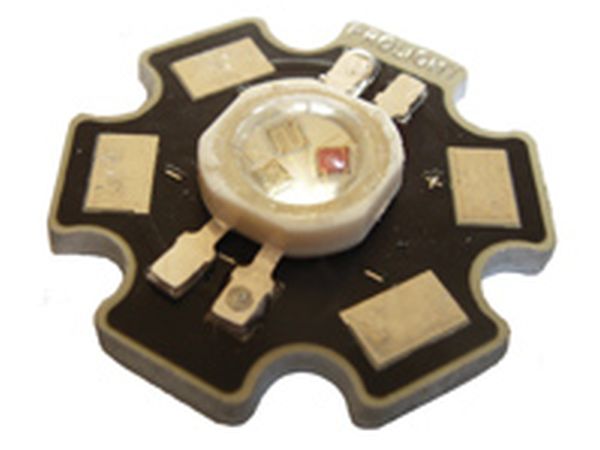
The idea originally came from Artur Grycuk who wanted to interface his Theremin Music Controller with RGB Leds. The controller has two output voltages, one for volume and another for pitch, ranging from 0 to 4 and 0 to 5 volts respectively.
Design
Unlike the previous Power Pic RGB with infrared remote control and Power Pic RGB project, this one is designed to be a development version, without any PCB.
Here's the concept diagram:
The microcontroller in this circuit is similar to the one used in the other Pic RGB projects. The software is compiled only for a PIC 12F675 because this model includes an ADC but may be easily changed to another pic12F*, as long as it has an ADC and a free timer to generate the PWM.
Schematic
The schematic is also very similar to the others, except that it now contains two pins configured as analog inputs.
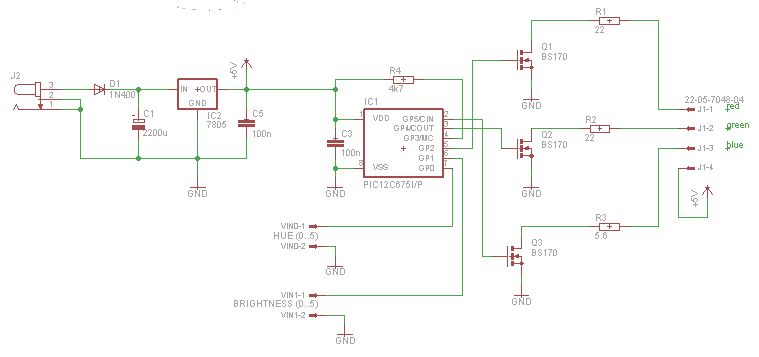
At the left side is the 5V power supply. The pic 12F675 microcontroller is in the middle and the LED driver at the right. This driver consists of three mosfets that will drive the LED. Click on the image to enlarge it.
As stated on all other Pic Rgb circuits, each mosfet can drive a maximum 600mA through its drain but according to Prolight each LED (red, green and blue) can only sustain 300mA, which makes this mosfet perfect for the job.
For more detail: Power Pic RGB with voltage control using PIC12F675
Quick Solutions to Questions related to Power Pic RGB with voltage control:
- How does this circuit change the color of the LED?
The circuit changes the color using two independent voltages supplied by an external device to select the hue and intensity. - What is the maximum current each MOSFET can drive?
Each MOSFET can drive a maximum of 600mA through its drain. - Can the microcontroller be changed to another model?
Yes, it can be changed to another pic12F* model as long as it has an ADC and a free timer to generate PWM. - Does this project use a printed circuit board?
No, this development version is designed without any PCB. - What are the voltage ranges provided by the source device?
The controller outputs range from 0 to 4 volts for volume and 0 to 5 volts for pitch. - Why are the MOSFETs considered perfect for this job?
They are perfect because they can handle up to 600mA while the LEDs only sustain 300mA. - What was the original inspiration for this design?
The idea came from Artur Grycuk who wanted to interface his Theremin Music Controller with RGB LEDs. - What function do the two analog input pins serve?
The two pins configured as analog inputs receive the external voltages to control color and intensity.
Related projects
PIC 12F675 Programmable 12V Battery Monitor
Being an active outdoor guy, I have a few different types of 12V lights and a variety of battery types. - For...
Audio, Sound & Radio · PIC12F675Audio CRO using PIC12F675 Microcontroller
This project is a miniature Audio CRO. For those not familiar with the abbreviation "CRO," it means "Cathode Ray Oscilloscope" and this...
Development Boards & Kits · PIC12F675DIY $1 PIC 12f675 JDM Programmer (Cheap and Easy)
Hi EveryBody i am Again Doing something. and it is with PIC's! Almost Everybody do not want a Big Arduino in their...
LED ProjectsAn Application-Driven Microcontroller Curriculum
Understanding how to apply microcontrollers lies at the core of modern embedded systems education. This student project takes an experiential approach to...
LED ProjectsBuild this microcontroller controlled rainbow flying disc – and then throw it!
Hello all and welcome to this super simple and inexpensive instructable. If you like throwing frisbees AND you like flashing lights AND...
LED ProjectsLED Scrolling Display Project Working With Circuit Diagram
We normally use a simple static LED display screen to convey a message. Earlier, when we want to display large data, we...

Ibrar Ayyub
I am an experienced technical writer holding a Master's degree in computer science from BZU Multan, Pakistan University. With a background spanning various industries, particularly in home automation and engineering, I have honed my skills in crafting clear and concise content. Proficient in leveraging infographics and diagrams, I strive to simplify complex concepts for readers. My strength lies in thorough...