


Summary of PIC12F microcontroller project board
This article introduces a development board for PIC12F series microcontrollers, ideal for compact embedded projects like appliances. The board includes a regulated 5V power supply, ICSP header, reset circuit, and prototyping area. It supports various PIC12F models (e.g., PIC12F683) and demonstrates interfacing with a 4-digit seven-segment display using mikroC Pro for PIC.Parts used in the PIC12F Development Board:
- Two-pin terminal block for DC input (6-12V DC)
- AMS1117-5.0V regulator
- PIC12F microcontroller on a DIP IC socket
- Tact switch connected to RA3 I/O pin
- Header connector for ICSP programming using chipKIT2/3
- Headers to access I/O pins and power supply pins
- Small prototyping area for additional circuit
- 4-digit serial seven segment LED display module
The 12F series of PIC microcontrollers are handy little 8-pin devices designed for small embedded applications that do not require too many I/O resources, and where small size is advantageous. These applications include a wide range of everyday products such as hair dryers, electric toothbrushes, rice cookers, vacuum cleaners, coffee makers, and blenders. Despite their small size, the PIC12F series microcontrollers offer interesting features including wide operating voltage, internal programmable oscillator, 4 channels of 10-bit ADC, on-board EEPROM memory, on-chip voltage reference, multiple communication peripherals (UART, SPI, and I2C), PWM, and more. The following project board is designed for fast and easy development of standalone applications using PIC12F microcontrollers. It features on-board regulated +5V power supply, header connectors to access I/O pins, ICSP header for programming, a reset circuit, and small prototyping area for placing additional components.
The picture below shows a closer view of the features on board.
- Two-pin terminal block for DC input (6-12V DC)
- AMS1117-5.0V regulator
- PIC12F microcontroller on a DIP IC socket
- Tact switch connected to RA3 I/O pin, which is input only. It can be used to reset the microcontroller if MCLR is enabled. Otherwise, it can be used as an user input switch.
- Header connector for ICSP programming using chipKIT2/3.
- Headers to access I/O pins and power supply pins (Vcc = +5V). Note that RA5 has been mislabeled as RP5 on silkscreen.
- Small prototyping area for connecting additional circuit. The regulated +5V power supply for the additional circuit can be derived from the Vcc header pins.
Important: The RA0-RA5 names are used for I/O pins of the PIC12F micrcontrollers in the enhanced mid-range family (PIC12F1822, PIC12F1840, etc). The corresponding I/O pins for the old ones (PIC12F629, PIC12F675, PIC12F683, etc) are named as GP0-GP5, and have the same pin configurations. Therefore, this board can be used for both.
Test program
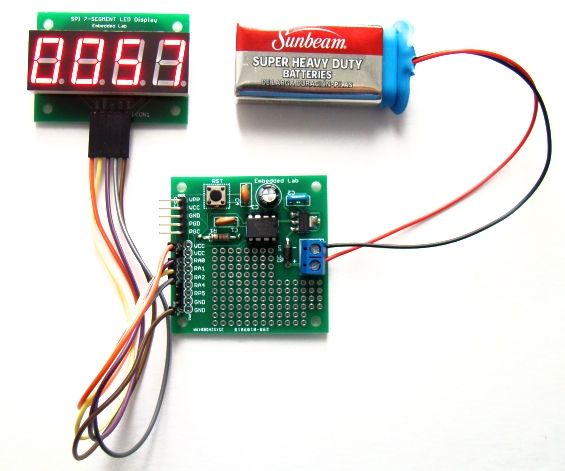
The following program is written in mikroC Pro for PIC compiler to illustrate the interfacing of the 4-digit serial seven segment LED display module with the PIC12F development board. The microcontroller used on the board is PIC12F683. The GP0, GP1, and GP2 pins of the PIC12F683 drives the CS, MOSI, and CLK pins, respectively, of the 7-segment display module to create a 4-digit up-counter. The counter counts from 0000 to 9999 and then reset to zero and start again.
For more detail: PIC12F microcontroller project board
Quick Solutions to Questions related to PIC12F Development Board:
- What applications are suitable for the PIC12F series?
The PIC12F series is designed for small embedded applications such as hair dryers, electric toothbrushes, rice cookers, vacuum cleaners, coffee makers, and blenders. - Can this board be used with older PIC12F models?
Yes, the board works with both enhanced mid-range family chips (like PIC12F1822) and older ones (like PIC12F629), as they share the same pin configurations despite different naming conventions. - How is the microcontroller powered on the board?
The board features an AMS1117-5.0V regulator that provides a regulated +5V power supply derived from a 6-12V DC input via a two-pin terminal block. - What compiler was used for the test program?
The test program illustrating the 4-digit up-counter was written using the mikroC Pro for PIC compiler. - Which pins drive the seven-segment display in the example project?
The GP0, GP1, and GP2 pins of the PIC12F683 drive the CS, MOSI, and CLK pins of the 7-segment display module respectively. - What is the function of the tact switch on the board?
The tact switch connects to the RA3 pin; it can reset the microcontroller if MCLR is enabled or serve as a user input switch otherwise. - Does the board support external component prototyping?
Yes, there is a small prototyping area where additional circuits can be connected, using the Vcc header pins for regulated +5V power. - Is there a labeling error on the board silkscreen?
Yes, the RA5 pin is mislabeled as RP5 on the silkscreen.
Related projects
Voltage Measurement with A PIC Microcontroller
Voltage Measurement with PIC Microcontroller articulates a methodical framework for facilitating analog voltage measurement using the PIC18F4520, an advanced member of Microchip’s...
Development Boards & KitsUltra-Low Power: Microcontroller Standby Current to 130uA with OPEnS Power Control Board
At the OPEnS Lab, a key focus for our projects is achieving exceptionally long battery life. This was particularly true for the...
Development Boards & KitsAn Integrated Approach to Developing Applications with Microchip PIC Microcontrollers
1. Introduction In our daily lives, a variety of devices such as telephones, household appliances, and cars incorporate "smart" electronics, typically manifested...
Development Boards & KitsMicrocontroller-Driven AC Voltage Control with Soft Start Feature
1. INTRODUCTION PWM-based AC voltage controllers find extensive application in uninterruptible power supplies (UPS) and high-power flexible AC transmission systems. This variable...
Development Boards & KitsPIC Microcontroller-Based IC Tester for Efficient Integrated Circuit Verification
1. INTRODUCTION Within the electronics industry[1], as circuit complexity undergoes a drastic increase and the demand for higher reliability rises, a significant...
Development Boards & Kits · PIC16F887Hands-On Microcontroller Projects: BK300 Development Board Featuring PIC16F887 Chip Lab
1. INTRODUCTION The study of microcontroller systems is experiencing a global surge across various fields within science, engineering, and technology departments of...

Ibrar Ayyub
I am an experienced technical writer holding a Master's degree in computer science from BZU Multan, Pakistan University. With a background spanning various industries, particularly in home automation and engineering, I have honed my skills in crafting clear and concise content. Proficient in leveraging infographics and diagrams, I strive to simplify complex concepts for readers. My strength lies in thorough...