
Summary of One Chip Video Poker using PIC16F628 microcontroller
This article describes a simple video poker game built using a PIC 16F628 microcontroller and a 20x4 character LCD. Originally intended as a birthday gift, the project was delayed due to memory limitations of an older chip but is now functional using MPASM assembly language. It requires minimal components, avoids printed circuit boards, and focuses on basic dealing and scoring logic suitable for small computers.
Parts used in the One Chip Video Poker:
- PIC 16F628 microcontroller
- 20x4 character LCD
- PIC programmer capable of handling the 16F628
- .hex file (ready to burn)
This is a simple video poker game for the PIC 16F628 and a 20×4 character LCD. It’s written in PIC assembly for MPASM.
I started the project in 2002. I originally intended it as a birthday present for my brother, who is an enthusiastic if occasional player of casino video poker. This Mark I version foundered, though, as the PIC 16F84 didn’t have quite enough program ROM to handle it; I shelved the project until just recently when I got a programmer that could handle the 16F628.
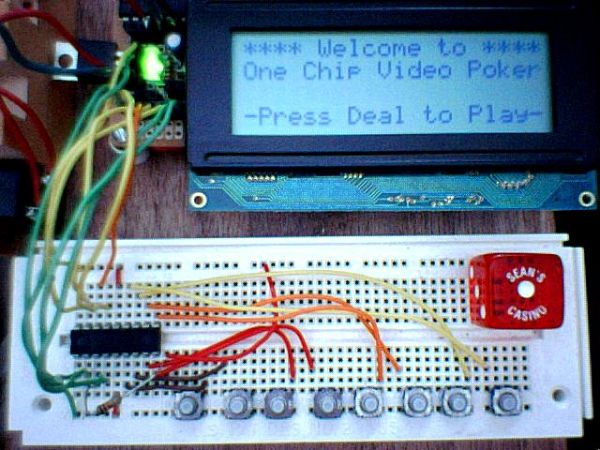
As of this writing (Aug. 10, 2004) I still haven’t gotten around to making a “production model” suitable as a gift, but the brother may yet receive one.
If you build this project, please email me and let me know what you think of it!
For Those Who Just Want To Build It
The Hardware Section is for you – it shows the schematic and parts list and has the .hex file ready to burn!
Overview
Why Video Poker, you ask?
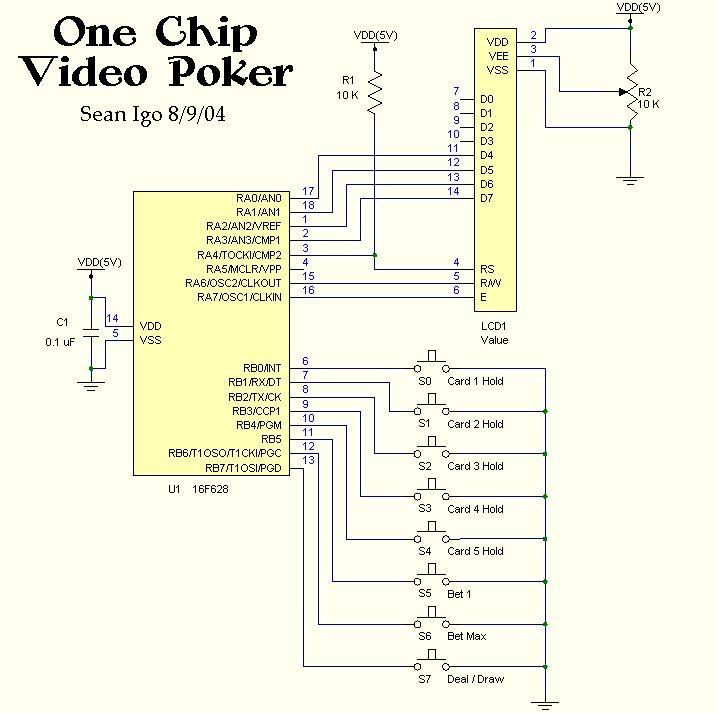
- It’s fun!
- It’s a simple game requiring no real strategy on the computer’s part – all it has to do is deal and score. An ideal candidate for a tiny computer.
- And yet, implementing it touches on a wide range of game programming, general assembly language, and PIC-specific techniques.
- It can be built with a minimum of parts and no need for a printed circuit board. The LCD is by far the biggest expense in this project, assuming you already have the computer and programmer board needed for PIC development. With a bit of luck, though, 4×20 displays can be found for under $20 U.S. at surplus shops – and sometimes they’re not too much more than that brand new. Some possible suppliers are listed on the links page.
For more detail: One Chip Video Poker using PIC16F628 microcontroller
- What microcontroller is used in this project?
The project uses a PIC 16F628 microcontroller. - Can this game be built without a printed circuit board?
Yes, it can be built with a minimum of parts and no need for a printed circuit board. - Why was the original Mark I version shelved?
The original PIC 16F84 did not have enough program ROM to handle the game. - What programming language is used for this project?
The game is written in PIC assembly for MPASM. - Is real strategy required from the computer for this game?
No, it is a simple game requiring no real strategy on the computer's part other than dealing and scoring. - What is considered the biggest expense in this project?
The LCD is by far the biggest expense in this project. - How much might a 4x20 display cost at surplus shops?
They can sometimes be found for under $20 U.S. at surplus shops. - Does the author offer a production model ready as a gift?
As of August 10, 2004, the author has not yet made a production model suitable as a gift.
