Summary of NEW CARRIER BOARDS AND MINI-PCS FOR JETSON
Diamond Systems launched the Stevie carrier board for Nvidia's Jetson AGX Xavier, alongside other Jetson solutions like Elton, Jethro, Ziggy, ZiggyBox, and Jetbox-Nano. All units ship with Linux BSPs. The Stevie board supports high-performance computing with extensive I/O options including MIPI-CSI cameras, HDMI, Ethernet, USB, CAN, serial ports, and storage slots.
Parts used in the Stevie Carrier Board Project:
- Nvidia Jetson AGX Xavier module
- Stevie carrier board
- HDMI port
- Gigabit Ethernet ports
- USB 3.1 ports
- MIPI-CSI camera connectors
- Micro-SD slot
- Mini-PCIe slot
- M.2 slot
- CAN interface
- Serial interface
- Audio interface
- MCU-driven data acquisition circuit
- Linux BSP
Diamond Systems has unveiled a Stevie carrier board for Nvidia’s high-end Jetson AGX Xavier module. Diamond also promoted some other Jetson carriers and embedded systems, which all ship with Linux BSPs. They include Diamond Systems’ Elton, also for the Xavier, the Jethro and Ziggy carriers, both of which support the earlier Jetson TX2 and industrial-temperature Jetson TX2i. Diamond also included the Ziggy-based ZiggyBox mini-PC and its Jetbox-Nano enclosure for Nvidia’s Jetson Nano Development Kit for the Jetson Nano module.
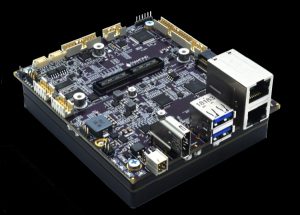
At 105 x 92mm, the Stevie board is slightly larger than the 100 x 87mm Jetson AGX Xavier module. The high-end Nvidia Xavier has 10x the energy efficiency and more than 20x the performance of the Jetson TX2. It features 8x ARMv8.2 cores and a 512-core Nvidia Volta GPU with 64 tensor cores and 2x Nvidia Deep Learning Accelerator (DLA) engines. Available also is a 7-way VLIW vision chip, and also a 16GB 256-bit LPDDR4 RAM and 32GB eMMC 5.1. Stevie enables a host of real-world ports for easier connectivity. coastline ports features includes an HDMI port, 2x Gigabit Ethernet, and 2x USB 3.1 ports. The block diagram available suggests there’s another HDMI port, which probably serves as an input interface.
The Stevie board enables connectors for up to 8x MIPI-CSI HD cameras or 4x 4K cameras. It is also equipped with a micro-SD slot plus mini-PCIe and M.2 slots supporting I/O add-ons and SSD storage. Additional features include 2x CAN, 4x serial, an audio interface, and a 9-20VDC input. Stevie’s MCU-driven data acquisition circuit has a 12-bit A/D up to 1MSPS, 12-bit D/A, and 3.3V GPIO. Diamond offers support for these interfaces with a free C-language programming library, a GUI control panel for “convenient control and monitoring of real-world processes and also a ready-to-run data logging capability.”
The CTI Rogue carrier for the Xavier has a similar set of I/O. It enables more USB ports and M.2 slots but is limited to 6x CSI cameras. Let’s take a look at the other Jetson carriers and embedded systems promoted.
Read more: NEW CARRIER BOARDS AND MINI-PCS FOR JETSON
- What is the size of the Stevie board?
The Stevie board measures 105 x 92mm. - How does the performance of the Jetson AGX Xavier compare to the Jetson TX2?
The Jetson AGX Xavier offers more than 20x the performance and 10x the energy efficiency of the Jetson TX2. - Can the Stevie board support multiple cameras?
Yes, it enables connectors for up to 8 MIPI-CSI HD cameras or 4 4K cameras. - Does the Stevie board include an audio interface?
Yes, the Stevie board is equipped with an audio interface among its additional features. - What programming support does Diamond offer for the Stevie interfaces?
Diamond provides a free C-language programming library and a GUI control panel for monitoring real-world processes. - What voltage input range does the Stevie board accept?
The Stevie board accepts a 9-20VDC input. - Are there other Jetson carriers mentioned besides Stevie?
Yes, the article mentions Elton, Jethro, Ziggy, ZiggyBox, Jetbox-Nano, and CTI Rogue carriers. - What type of GPU does the Jetson AGX Xavier feature?
It features a 512-core Nvidia Volta GPU with 64 tensor cores.