
Summary of MICROSCANNER MIRRORS REPLACE HUMAN VISION
Fraunhofer IPMS developed a microscanner mirror for LiDAR systems that enables 3D scanning of vehicle surroundings beyond 200 meters. Integrated into LiDAR sensors, the MEMS mirror steers and splits the laser beam in two dimensions while time-of-flight measurements provide distance as the third dimension, producing 3D point clouds to detect pedestrians, cyclists, and other hazards—contributing to safer autonomous driving and adoption of emergency assist systems.
Parts used in the Microscanner Mirror LiDAR Project:
- Microscanner mirror (MEMS mirror)
- Laser diode or other laser source
- LiDAR transmitter containing the microscanner mirror
- LiDAR sensor / receiver
- Evaluation algorithm / processing unit
- 3D point cloud generation software
In autonomous vehicles, it is advanced technology that takes the wheel, allowing passengers to sit back and enjoy the ride. Yet such systems have to meet stringent safety standards. For example, an autonomous vehicle must be able to recognize obstacles and other hazards – and apply the brakes in an emergency. Such a vehicle could be equipped with a new microscanner mirror from the Fraunhofer Institute for Photonic Microsystems IPMS. This performs a 3D scan of the vehicle surroundings to a range of over 200 meters. When integrated within a LiDAR system, it can obviate the need for human vision and thereby make a key contribution to the safety of autonomous driving.
Today’s vehicles already feature a variety of advanced driver-assistance systems. In coming years, it will become compulsory to install emergency systems such as evasive steering support in new vehicles, thus paving the way for the advent of autonomous driving. Yet even in coming vehicle generations, humans will still be expected to keep an eye on their surroundings and react in dangerous situations. This could well change, however, with the introduction of LiDAR (light detection and ranging) systems, which measure the distance between the vehicle and other objects. Such systems are able to scan the surrounding area for potential hazards and thereby replace the human eye. As such, they mark a decisive step on the way towards safe autonomous driving.
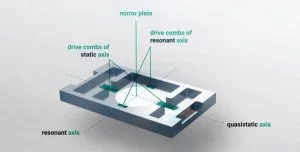
A team of researchers at Fraunhofer IPMS in Dresden has now developed a new type of microscanner mirror, which forms a key element of LiDAR systems that are capable of 3D digital vision. This component is used to steer the laser that generates a 3D scan of the surrounding area. AEye, a specialist for LiDAR systems in autonomous vehicles, is already using the microscanner mirror in its 4Sight LiDAR sensor. “With our technology platform, we’re able to meet design specifications for new microscanners suitable for use with LiDAR,” explains Dr. Jan Grahmann, research associate at Fraunhofer IPMS. “LiDAR systems are able to scan the surrounding area in three dimensions and therefore detect pedestrians, cyclists or other vehicles. Our MEMS mirror splits the laser beam in two dimensions and focuses the light on the object that is being measured. By measuring the time of flight of the reflected light, it is also possible to determine the distance to the object as a third dimension.”
In detail, the process is as follows: light from a laser diode or other laser source is directed at a microscanner mirror installed in the transmitter of the LiDAR system. The mirror scans the surrounding area in two dimensions. To determine the third dimension, the light reflected from the object is captured by a LiDAR sensor. Here, the following applies: the more light captured by the sensor, the more accurately the distance to the object can be determined. This is a task performed by an evaluation algorithm. The distance to each scanned position in the vehicle surroundings generates a 3D point cloud that represents the LiDAR field of vision.
Read more: MICROSCANNER MIRRORS REPLACE HUMAN VISION
- What is the role of the microscanner mirror in LiDAR systems?
The microscanner mirror steers and splits the laser beam in two dimensions to scan the surrounding area for LiDAR 3D scanning. - How is distance determined in the described LiDAR system?
Distance is determined by measuring the time of flight of the reflected light captured by the LiDAR sensor. - Can the microscanner mirror help detect pedestrians and cyclists?
Yes, by generating a 3D point cloud from scanned distances, the system can detect pedestrians, cyclists, and other vehicles. - What component provides the light for the microscanner mirror?
Light is provided by a laser diode or another laser source directed at the microscanner mirror. - Does more captured light affect distance accuracy?
Yes, the more light captured by the sensor, the more accurately the distance to the object can be determined. - What output does the LiDAR system generate to represent the surroundings?
The system generates a 3D point cloud representing the LiDAR field of vision. - Is the microscanner mirror already used in commercial LiDAR sensors?
Yes, AEye is using the microscanner mirror in its 4Sight LiDAR sensor.