Summary of MAX6369 Series Watchdog Timers
The MAX6369-74 watchdog-only supervisors come in SOT23-8 packages with selectable watchdog timeouts (1.7 ms to 104 s), start-up delays (1.7 ms to 104 s), and output pulse widths (1.7 ms or 170 ms) set by part selection and three pins (SEL0, SEL1, SEL2). They consume up to 20 µA versus ~120 µA for classic 555-based solutions and save board area by eliminating large timing resistors and capacitors.
Parts used in the MAX6369-74 Watchdog Supervisor Project:
- MAX6369-74 series watchdog-only supervisor (SOT23-8 package)
- SEL0 pin
- SEL1 pin
- SEL2 pin
- 5V supply (or appropriate VCC as per part)
- PCB board footprint for SOT23-8
The MAX6369-74 series watchdog-only supervisors are available in tiny SOT23-8 packages and have selectable watchdog timeout periods (1.7ms to 104s), start-up delays (1.7ms to 104s) and output pulse widths (1.7ms and 170ms) depending on the part selected and the state of 3 pins (SEL0, SEL1, SEL2).
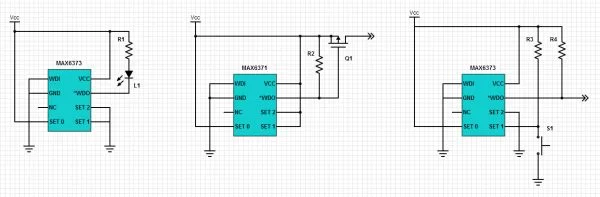
These parts have several advantages over the historical “555” solutions. As well as the lower supply current (20µA max instead of 120µA max at 5V supply) the overall solution takes much less board area with the smaller package and the absence of large timing resistors and capacitors.
For more detail: MAX6369 Series Watchdog Timers
- What watchdog timeout ranges are available?
Selectable watchdog timeouts from 1.7 ms to 104 s depending on part selection and SEL0/SEL1/SEL2 pin states. - What start-up delays can be selected?
Start-up delays from 1.7 ms to 104 s depending on part selection and the states of SEL0, SEL1, and SEL2. - What output pulse widths are provided?
Output pulse widths of 1.7 ms and 170 ms depending on the selected part and pin states. - What package is the MAX6369-74 available in?
They are available in tiny SOT23-8 packages. - How does supply current compare to 555 solutions?
MAX6369-74 parts have lower supply current, 20 µA max versus 120 µA max for 555-based solutions at 5V. - Do these parts reduce board area compared to 555-based designs?
Yes, they reduce board area by eliminating large timing resistors and capacitors and using a smaller package. - How are timeout and delay settings selected?
By part selection and by configuring the SEL0, SEL1, and SEL2 pins.