
Summary of JeVois, The Open-Source Smart Vision Camera
JeVois is an open-source, quad-core smart vision camera compatible with Arduino, Raspberry Pi, and PCs. It integrates a video sensor, CPU, USB, and serial port into a compact 1.7 cubic inch unit. Users initialize the device by inserting a microSD card containing pre-loaded algorithms, enabling immediate operation via standard camera software. The system leverages a custom Linux kernel, C/C++ frameworks, and buildroot for scalability, supporting libraries like OpenCV and tiny-dnn.
Parts used in the JeVois Project:
- Video sensor
- Quad-core CPU
- USB interface
- Serial port
- MicroSD card
- Open-source machine vision algorithms
- Custom Linux kernel drivers
- C++-17 high-level vision processing framework
- Buildroot framework infrastructure
- CMake build system
JeVois, which can be translated from French as: I see, is an open-source quad-core camera that can be connected easily with your project whether you are using Arduino, Raspberry Pi or just running it on your PC. JeVois contains a video sensor, quad-core CPU, USB video and a serial port in only 1.7 cubic inches. To start working with your JeVois you only need to insert a microSD card loaded with the provided open-source machine vision algorithms and then connecting it to your computer. It will work immediately just by opening a camera software.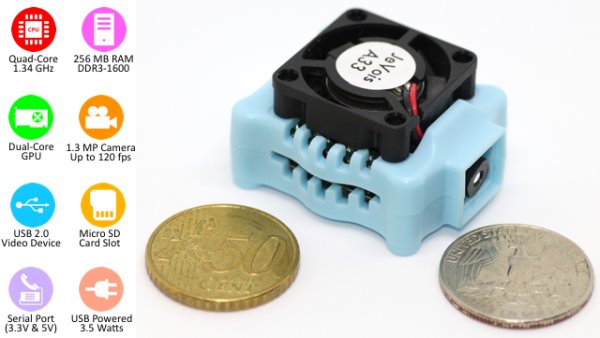
“For ease of programming and configuration, all of the operating system, core JeVois software, and any necessary data files are stored on a single high-speed Micro-SD card that can easily be removed and plugged into a desktop or laptop computer. The JeVois software framework combines custom Linux kernel drivers for camera sensor and for USB output, written in C, and a custom high-level vision processing framework, written in C++-17. “
Easy to integrate with other open-source libraries, including tiny-dnn, OpenCV, boost, zBar, Eigen, turbojpeg, etc. This framework is scalable since the operating system infrastructure is built using the buildroot framework where adding and using different libraries is easy. New vision modules can be added to the core of JeVois thanks to the fact the core software is managed by cmake. Thus, you can customize the vision algorithm you would like to run your JeVois.
For more detail: JeVois, The Open-Source Smart Vision Camera
- How do I start working with JeVois?
You only need to insert a microSD card loaded with the provided open-source machine vision algorithms and connect it to your computer. - What operating systems or devices can JeVois connect to?
JeVois can be connected easily with projects using Arduino, Raspberry Pi, or just running on a PC. - Where are the operating system and core software stored?
All of the operating system, core JeVois software, and necessary data files are stored on a single high-speed Micro-SD card. - Can I customize the vision algorithm on JeVois?
Yes, new vision modules can be added to the core thanks to the fact that the core software is managed by cmake. - Which open-source libraries does JeVois integrate with?
It is easy to integrate with libraries including tiny-dnn, OpenCV, boost, zBar, Eigen, and turbojpeg. - What programming languages are used for the JeVois software framework?
The framework combines custom Linux kernel drivers written in C and a custom high-level vision processing framework written in C++-17. - Is the JeVois software framework scalable?
Yes, the framework is scalable since the operating system infrastructure is built using the buildroot framework where adding different libraries is easy. - Does JeVois require special software to work immediately?
No, it will work immediately just by opening a camera software after connecting the device.
